EN 15038:2026 Raises EU Translation Sourcing Bar
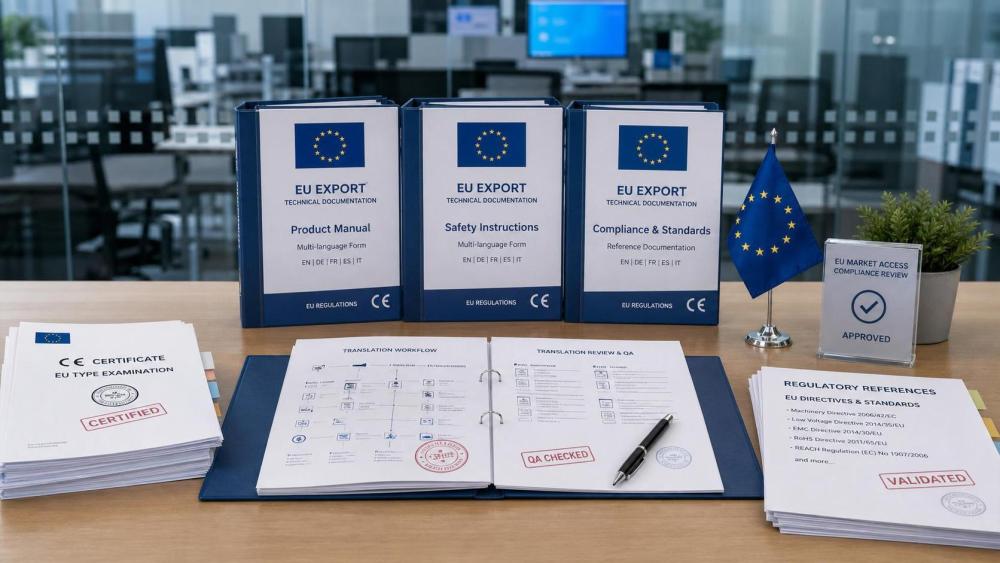
On July 12, 2026, CEN published the revised EN 15038:2026 for technical translation services, introducing updated quality requirements that directly affect multilingual product documentation destined for the EU market. The change is especially relevant to suppliers handling product manuals, safety labels, and regulatory dossiers, because it links documentation sourcing more closely to certification status, AI-assisted post-editing controls, and market-access expectations under industry standards.
What the revised standard now requires
According to the provided event information, CEN released EN 15038:2026 on July 12, 2026. The revision updates quality requirements for technical translation services.
The confirmed changes include mandatory AI-assisted post-editing validation logs and a dual-certification requirement referencing ISO 17100:2015 and ISO 18587:2016.
The provided summary also states that the change affects global suppliers providing EU-bound product manuals, safety labels, and regulatory dossiers, and that immediate alignment is required for market access under industry standards.
Where the pressure is likely to appear first in the supply chain
Documentation buyers may need to tighten vendor screening
From an industry perspective, buyers that outsource technical translation for EU-bound documentation are likely to feel the impact first at the procurement stage. Because the updated standard points to mandatory validation logs and dual certification, sourcing decisions may increasingly depend on whether translation vendors can demonstrate the required credentials and documented post-editing controls.
What deserves closer attention is the likely effect on tender documents, supplier qualification reviews, and purchase specifications for multilingual documentation. Even where the commercial relationship remains unchanged, the compliance basis for selecting language-service providers may become more demanding.
Manufacturers exporting to the EU may face documentation delivery risks
For manufacturers shipping products with manuals, labels, or regulatory files to the EU, the main exposure is not only translation quality in a general sense, but whether supporting documentation is prepared through service providers aligned with the revised standard. Analysis shows that this can affect document release timing, internal compliance checks, and readiness for submission or shipment.
The practical issue is that multilingual product documentation often sits close to final delivery milestones. If translation sourcing does not match the revised requirements, the risk may emerge in approval workflows, document handover, or market-entry preparation rather than in product manufacturing itself.
Compliance and certification-related service providers may see stricter documentation expectations
Service providers involved in compliance support, dossier preparation, or technical document coordination may also need to pay closer attention to the translation chain behind submitted materials. Observably, the revised standard puts more weight on traceable post-editing validation and recognized certification status, which may influence how documentation packages are reviewed before submission or acceptance.
For these participants, the key point is less about rewriting technical content and more about checking whether the translation process behind regulated materials can be evidenced in a way consistent with the new requirements.
Practical points companies should review now
Check whether current translation suppliers meet the stated certification basis
Analysis shows that companies using external providers for EU-bound manuals, safety labels, or regulatory dossiers should review whether those providers can demonstrate alignment with the dual-certification requirement cited in the event summary. Where supplier onboarding documents or approved-vendor lists do not reflect this, procurement and compliance teams may need to reassess qualification criteria.
Review how AI-assisted post-editing is documented
The mandatory validation-log requirement deserves immediate attention because it relates to process evidence, not only output quality. Companies should closely watch whether existing service arrangements, document-control procedures, and audit trails are sufficient to capture AI-assisted post-editing validation in a verifiable form. The provided information does not define the exact format or review method, so this remains an area to monitor rather than assume resolved.
Watch for changes in submission, tender, and handover documentation
Where multilingual documentation supports product delivery, regulatory filing, or customer acceptance, businesses should monitor whether tender files, technical appendices, or document handover requirements begin to reflect the revised standard more explicitly. It is more appropriate to understand this as a near-term compliance checkpoint for documentation packages, especially where translation quality assurance forms part of market-access preparation.
Plan for possible effects on timing and supplier replacement
Observably, any requirement that combines process logging with dual certification can affect delivery planning if current vendors are not yet aligned. Companies should therefore pay attention to transition risk in procurement scheduling, supplier backup arrangements, and document release sequencing. The available information does not confirm how quickly market participants will operationalize these requirements in practice, so execution pace still needs to be watched.
Why this looks like an execution signal, not just a wording update
Analysis shows that this development is more than a routine standards revision because the provided summary ties the update directly to immediate alignment for market access under industry standards. That makes the signal commercially relevant for companies that treat multilingual documentation as part of export delivery rather than as a purely administrative task.
At the same time, it would be premature to treat every downstream requirement as fully defined. Observably, the confirmed facts establish the new requirements and their relevance to EU-bound documentation, but they do not yet describe detailed enforcement pathways, review criteria, or sector-specific implementation practices. For that reason, the market should read this as a live compliance development with practical implications already visible, while still tracking how execution expectations are expressed in actual procurement and documentation workflows.
How the market is likely to read this update for now
On the basis of the provided information, EN 15038:2026 should currently be understood as a concrete standards change with immediate relevance for sourcing multilingual product documentation for the EU. The most important implication is not broad market speculation, but the narrower operational question of whether translation vendors, documentation processes, and compliance records are aligned with the revised requirements.
A balanced reading is that this is already a meaningful execution signal for companies supplying EU-bound manuals, safety labels, and regulatory dossiers, while some practical details of implementation still warrant continued observation.
Basis of this article and what still needs verification
This article is based on the user-provided news title, event date, and event summary. For developments of this kind, relevant source categories typically include official announcements, regulator publications, trade or customs authority information, industry association updates, standards organization documents, and reporting by authoritative media.
No specific official source link was provided in the input, so the exact official publication path still needs to be verified on an ongoing basis. Further observation should focus on detailed implementation language, certification interpretation, tender-document changes, market feedback, and how companies are executing the revised requirements in actual documentation and delivery processes.
Weekly Insights
Stay ahead with our curated technology reports delivered every Monday.
Recommended News
 Supply ChainOct 15, 2026How to choose a supply chain strategy for unpredictable demand
 Supply ChainOct 14, 2026How to assess an industrial equipment supplier's spare parts support
 Supply ChainOct 14, 2026EU Updates CSDDD Guidance on Global Supply Chain Due Diligence
 Global SourcingOct 13, 2026How to assess industrial automation suppliers for legacy integration