MOQ Pricing Benchmark: When Low Volume Stops Making Sense
MOQ Pricing Benchmark: Where Low Volume Stops Working
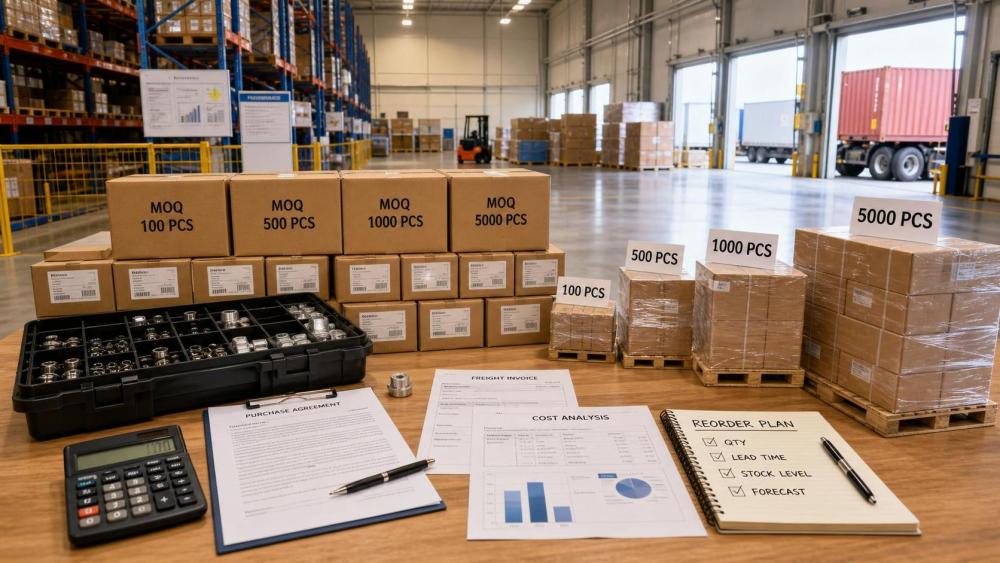
An MOQ pricing benchmark matters because a cheap-looking small order often becomes expensive in practice.
The visible unit price is only one layer. Setup costs, freight terms, lead time, and replenishment risk usually carry equal weight.
In cross-border sourcing, the real question is not whether low volume is possible. It is when low volume stops making economic sense.
That is why the MOQ pricing benchmark is widely used as a decision lens rather than a simple quote check.
Across industrial components, packaging materials, fabricated parts, chemicals, and capital spares, the break point shifts by category.
GTIIN’s market analysis often shows the same pattern across sectors: low-volume orders reduce commitment, but they also weaken cost efficiency and bargaining power.
So the useful benchmark is not the supplier’s stated MOQ alone. It is the volume at which landed cost, service reliability, and future leverage start to improve together.
What does an MOQ pricing benchmark actually measure?
At a basic level, it compares price behavior across order bands.
But in real procurement work, the MOQ pricing benchmark measures something broader: the point where fixed costs are diluted enough to support sustainable buying.
Those fixed costs may include tooling allocation, machine changeover, batch testing, export packaging, documentation, and inland transport.
A supplier may accept a trial order below MOQ. That does not mean the order is commercially efficient.
More common is a stepped structure. At very low quantity, the buyer pays for flexibility. At moderate quantity, pricing normalizes. At higher quantity, strategic concessions appear.
This is why an MOQ pricing benchmark should be built around several cost layers:
- Quoted unit price by quantity tier
- Landed cost after freight, duty, and handling
- Lead time stability at each volume level
- Quality risk from small-batch or rush production
- Supplier willingness to reserve capacity later
Without these layers, the benchmark becomes misleading. A low entry quote can hide a weak supply position.
When does a small order stop making financial sense?
The answer is rarely tied to one exact quantity. It usually appears when three warning signals start showing up together.
First, the unit price gap remains large even after negotiation. If the next order tier lowers total cost meaningfully, the low-volume position is probably temporary.
Second, freight and handling consume too much of the total value. This happens often with dense industrial parts and low-value consumables.
Third, the supplier starts treating the order as a non-priority batch. Lead times stretch, batch scheduling becomes unstable, and engineering changes receive less attention.
A practical judgment table helps clarify the breakpoint:
In actual sourcing, the MOQ pricing benchmark becomes more useful when it is linked to annualized demand, not one-off purchase events.
Is the lowest MOQ always the safest choice?
Not necessarily. A low MOQ reduces inventory exposure, but it can increase operational fragility.
This is especially true in categories affected by volatile raw material indexes, container rates, energy costs, or compliance changes.
For example, steel fabrications, polymer packaging, and electronic subassemblies often show unstable pricing at the lowest order bands.
A supplier may accept a small batch today, then reprice aggressively next month because the order does not fit normal production planning.
This is where the MOQ pricing benchmark should be paired with resilience indicators.
GTIIN’s supply chain research regularly highlights that the cheapest flexible quantity is rarely the most stable quantity.
More reliable signals include repeatable lead time, consistent quality release, and transparent cost drivers across several purchase cycles.
A safer approach is to ask two linked questions:
- What volume creates acceptable landed cost?
- What volume earns predictable supplier behavior?
If the answers differ widely, the order is probably sitting below the practical benchmark.
How should buyers compare MOQ pricing benchmark results across suppliers?
Direct quote comparison is a weak method because suppliers define MOQ differently.
One factory may calculate MOQ by SKU. Another may calculate by material batch, machine hour block, or container utilization.
So a valid MOQ pricing benchmark needs normalized assumptions.
In practice, four comparison points create a more honest picture:
- Base quantity and next two price-break tiers
- Incoterm and port pair used in the quote
- Whether testing, certification, or special packing is included
- Reorder lead time after first approval
It also helps to compare the supplier’s attitude toward future scale.
Some suppliers quote low only to enter the account, then resist price improvement later. Others offer modest first-batch terms but strong scale economics.
That difference matters more than a narrow opening price gap.
GTIIN often frames this as a mapping issue: cost, compliance, transport, and production logic must be read together, not line by line.
What mistakes usually distort MOQ decisions?
The first mistake is treating MOQ as a supplier problem instead of a demand-planning problem.
If internal forecasts are fragmented, even a reasonable MOQ will feel too high.
The second mistake is ignoring the cost of repeated low-volume transactions.
Multiple urgent small orders can cost more than one planned larger release, even when storage costs are considered.
Another common issue is over-focusing on unit price while missing customs delays, pallet inefficiency, or inspection duplication.
Need-to-know compliance changes can also reshape the MOQ pricing benchmark.
Environmental reporting rules, origin shifts, and sector-specific testing requirements can raise the cost floor for small batches.
A short checklist helps reduce these blind spots:
- Confirm annual usage before negotiating batch size
- Separate sample logic from repeat-order logic
- Calculate landed cost by order frequency, not just by unit
- Test whether mixed-SKU ordering can meet the same benchmark
- Review how tariff and compliance changes affect small lots
So what is a practical next step when the benchmark looks unfavorable?
Start by identifying whether the constraint is technical, commercial, or logistical.
If the issue is technical, redesigning packaging, tolerances, or batch testing may lower the practical MOQ.
If the issue is commercial, a forecast-backed blanket order can unlock a better tier without taking full inventory immediately.
If logistics are the problem, consolidation across SKUs, plants, or regions may improve the MOQ pricing benchmark faster than a price negotiation.
The strongest decisions usually come from combining supplier quotes with wider trade intelligence.
That includes export trend signals, freight shifts, regulatory exposure, and category-specific production economics.
This broader view is where GTIIN adds practical value. Its cross-sector sourcing analysis helps turn isolated price discussions into supply chain decisions with context.
In simple terms, the right MOQ pricing benchmark is the one that balances cost, supply continuity, and room to scale.
Before the next sourcing round, compare quantity tiers, landed cost, reorder stability, and compliance exposure on the same sheet. That usually reveals where low volume truly stops making sense.
Weekly Insights
Stay ahead with our curated technology reports delivered every Monday.
Recommended News
 Supply ChainOct 15, 2026How to choose a supply chain strategy for unpredictable demand
 Supply ChainOct 14, 2026How to assess an industrial equipment supplier's spare parts support
 Supply ChainOct 14, 2026EU Updates CSDDD Guidance on Global Supply Chain Due Diligence
 Global SourcingOct 13, 2026How to assess industrial automation suppliers for legacy integration