Woodworking Production Line Quotes: Defining the Delivered Scope
A woodworking production line quote is useful only when it identifies what the buyer will receive, what the supplier will do, and what the factory must provide. Two proposals may list similar machines yet leave very different amounts of work outside the quoted price. A panel saw with an outfeed table, for example, is not equivalent to a system that also includes transfer conveyors, controls integration, installation and production testing.
For procurement teams planning an expansion, the delivered scope should be defined before prices are ranked. The comparison needs to cover the physical equipment, interfaces, site work, performance assumptions and acceptance conditions. Otherwise, a low initial price can become difficult to evaluate once unquoted electrical work, software changes or commissioning visits are added.
Start with the production requirement, not the machine list
A supplier cannot size or price a line reliably from a floor plan and a target output alone. The request for quotation should describe the products to be made, the process sequence and the variation in the production mix. A line cutting large batches of identical cabinet panels has different handling and scheduling needs from one processing frequent changes in panel size, thickness and finish.
Give bidders a representative range of materials and workpieces, including panel dimensions, thicknesses, surface finishes and any restrictions on edge or face damage. Identify the operations required, such as cutting, labeling, edge banding, drilling, sorting or packing. If some operations will remain on existing equipment, show where material and production data will enter and leave the proposed line.
Output targets also need a common basis. State whether the requirement concerns finished parts, cut panels or another unit, and specify the product mix, shift pattern and operating assumptions behind it. A headline capacity quoted for repeated cuts in one material may not reflect a schedule with frequent recipe changes, labeling and manual inspection. Ask each bidder to explain its calculation and identify the bottleneck it expects under the stated conditions.
Before issuing the request, procurement can use the woodworking production line quote checklist to structure questions around equipment, services and factory-expansion requirements. The same questions should go to every bidder so that differences in scope appear in the response rather than after the purchase order.
Define the physical boundary of the line
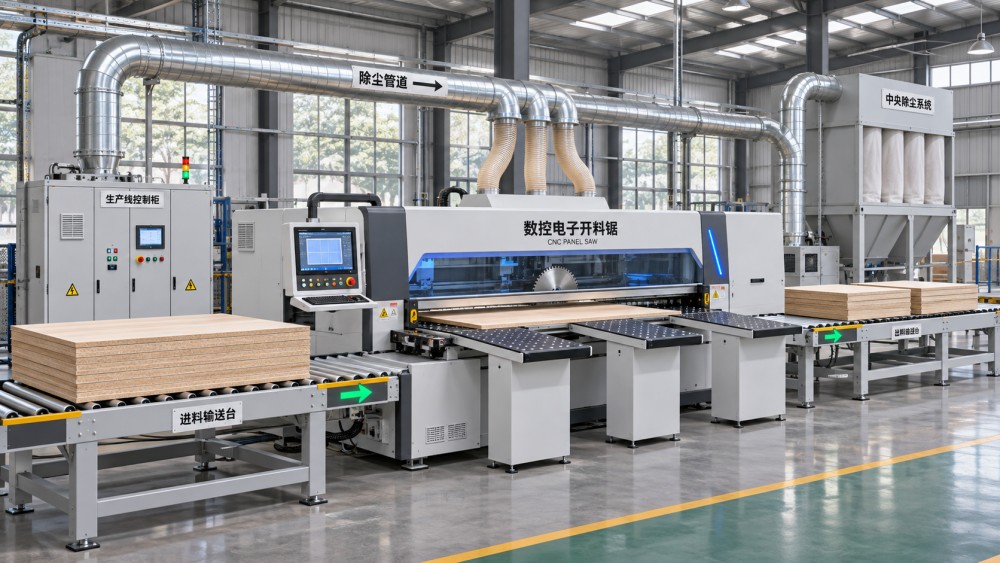
A machine schedule should name each item, its function and its quantity, but the interfaces between items deserve equal attention. For a panel-processing line, the scope might begin at a stack-lifting device and end at a finished-part conveyor. Another proposal might begin at the saw infeed and require operators to move and sort every part. Both can be described as a cutting line, but they impose different space, labor and handling requirements.
For each interface, record where one supplier’s responsibility stops and another party’s begins. Include the connection between new machines, any existing conveyor or storage system, and the route by which offcuts and waste leave the process. Drawings should show equipment footprints, operator access, maintenance clearances and material flow. A layout is not automatically a commitment to supply everything shown; the equipment schedule and exclusions must agree with it.
Ask for inclusions and exclusions in writing rather than treating silence as inclusion. If a supplier offers optional equipment, require the option price and its effect on layout, capacity and installation to be shown separately. This makes it easier to compare a manual handling arrangement with an automated one without confusing an equipment difference with a pricing difference.
Separate equipment price from the cost of a working line
The equipment price is only one component of the expenditure needed to put a line into service. A comparison should account for freight, insurance, unloading, taxes or duties where applicable, rigging, installation, utilities, software, training and start-up support. The parties should state which costs are included, which are estimated and which remain unknown pending a site survey.
Delivery terms deserve particular scrutiny. A quote for equipment delivered to a named location does not, by itself, establish who unloads it, moves it inside the building or pays for storage if the site is not ready. Identify the agreed trade term and named place where relevant, then define practical responsibilities that the term or contract leaves open. The buyer should also confirm packaging, shipment splits and the treatment of damage or missing items on arrival.
For factory expansion, site readiness can be a significant source of uncertainty. The line may require floor preparation, power distribution, compressed air, network connections or modifications to an existing dust collection arrangement. Rather than assume the supplier will discover these needs during installation, request a utility schedule and preliminary site requirements with the offer. The factory team can then price its own work against the same documented assumptions.
A useful comparison is an evaluated project cost: the quoted scope plus separately priced work the buyer expects to need. Keep uncertain allowances visible rather than presenting them as confirmed prices. If a bidder has not supplied enough information to estimate an exclusion, record that gap alongside the price; it is a commercial risk, not a zero-cost item.
Test capacity claims against the intended operating conditions
Throughput, accuracy and finish quality are meaningful only when the test conditions are defined. Request a description of the material, dimensions, cutting pattern, feed arrangement, staffing and operating sequence behind each proposed performance figure. Distinguish machine cycle time from line output: a fast cutting cycle does not eliminate delays caused by loading, sorting, label application or downstream congestion.
If the factory processes coated panels, for instance, the acceptance discussion should address the surfaces and edges that will be inspected, the method of inspection and the agreed quality criteria. The suitable criteria depend on the product and subsequent processing. A tolerance or surface requirement copied from another project may be unnecessarily restrictive or may fail to protect the buyer’s actual needs.
It is also sensible to define what happens when the line processes a mix outside the supplier’s demonstrated conditions. Ask for limitations on minimum and maximum workpiece sizes, unsupported material types and any required tooling or adjustments. A line selected for large panels may need different handling provisions for small parts; a capacity figure for one format should not be assumed to apply to the other.
Agree on acceptance before placing the order
The contract should distinguish any factory acceptance test at the supplier’s facility from site acceptance after installation. A factory test can verify specified functions before shipment, but it may not reproduce the buyer’s utilities, upstream equipment or actual production mix. Site acceptance should define the material to be used, who supplies it, the test sequence, measurement method and the responsibilities of both parties.
Include a procedure for documenting defects, agreeing corrective work and repeating a test where necessary. Payment milestones can be linked to clearly described events, but the commercial terms should also address delays caused by an unready site, unavailable material or incomplete supplier work. Without those distinctions, a dispute over acceptance can become a dispute over who controlled the conditions.
Make controls, data and support part of the scope
Software is easy to understate in a hardware-led quote. Determine whether the line needs cutting lists, labels, machine programs or production status information from existing systems. Identify the source and destination of each data exchange, the expected file format or interface, and the party responsible for mapping and testing it. A statement that equipment is “integration ready” should be accompanied by a description of what is included and what remains to be developed.
Commercial details matter as well: distinguish perpetual rights from subscriptions where applicable, identify recurring charges, and ask whether updates, remote support and additional user access are included. The buyer should know what happens if a software component or network connection is unavailable and whether the line can continue in a defined manual mode.
For maintenance, request an agreed document package: equipment drawings, operating and maintenance instructions, parts identification and any software backup or recovery information the supplier will provide. Specify the language and delivery date. Training should identify its audience, duration, location and subject matter; a brief operator demonstration is not necessarily equivalent to maintenance training or instruction on recovering from common stoppages.
Warranty wording should establish its start and end conditions, coverage, exclusions and the process for reporting faults. Ask who pays for travel, replacement parts and freight under the proposed terms, and how support is provided if a specialist must attend the site. Spare-parts recommendations are easier to evaluate when the supplier distinguishes routine consumables from components intended to reduce downtime after a failure.
Turn the preferred quote into a controlled contract baseline
Once the technical and commercial comparisons are complete, reconcile the selected proposal with the purchase order and contract. Attach the final equipment schedule, layout, utility requirements, interface matrix, exclusions and acceptance plan. Where documents conflict, establish their order of precedence. A later revision to a drawing should not silently alter a capacity commitment or transfer a connection cost to the factory.
Use a change procedure that records the reason for a proposed modification, its effect on price and delivery, and any consequences for testing or warranties. This applies to buyer-requested changes as well as supplier substitutions. A replacement component may be acceptable, but procurement and engineering need enough information to judge its fit with the agreed scope.
The best comparison is not simply between the lowest and highest numbers. It is between clearly defined outcomes: what arrives, who connects it, what performance will be checked, and what work remains with the factory. If those boundaries cannot yet be priced, they should remain visible as open decisions until the responsible party and commercial treatment are agreed.
Have questions about this sector analysis, or seeking best practices specific to your niche? Drop us a line below and let the senior consultants at GTIIN assist you.
“We respect your privacy. Your information is strictly confidential.”
Tags
Weekly Insights
Stay ahead with our curated technology reports delivered every Monday.
Recommended News
 Market TrendsNov 11, 2026What does the bulk commodity logistics forecast mean for freight rates?
 Supply ChainNov 10, 2026China Extends Pause on 24% Additional Tariff on US Goods by Two Months
 Industry StandardsNov 10, 2026Which imports are subject to EU carbon border compliance?
 Global SourcingNov 09, 2026USTR Extends 178 China Section 301 Tariff Exclusions to January 2027