Which imports are subject to EU carbon border compliance?
EU carbon border compliance applies to specified imported goods, not to every product made in a carbon-intensive industry. The EU Carbon Border Adjustment Mechanism (CBAM) covers selected cement, iron and steel, aluminium, fertilisers, electricity and hydrogen products. Whether a particular import falls within its scope depends primarily on its Combined Nomenclature (CN) classification, origin and any applicable exemption.
Product names alone are not enough to determine coverage. A steel fastener can be listed while a machine containing much more steel can fall outside the current goods list. The legal test is the classification of the imported article against Annex I of Regulation (EU) 2023/956, read together with subsequent amendments and the applicable customs rules.
Which goods are covered by CBAM?
Annex I identifies covered goods using EU customs classifications. The six sector names are useful starting points, but they do not mean that every product associated with those sectors is included.
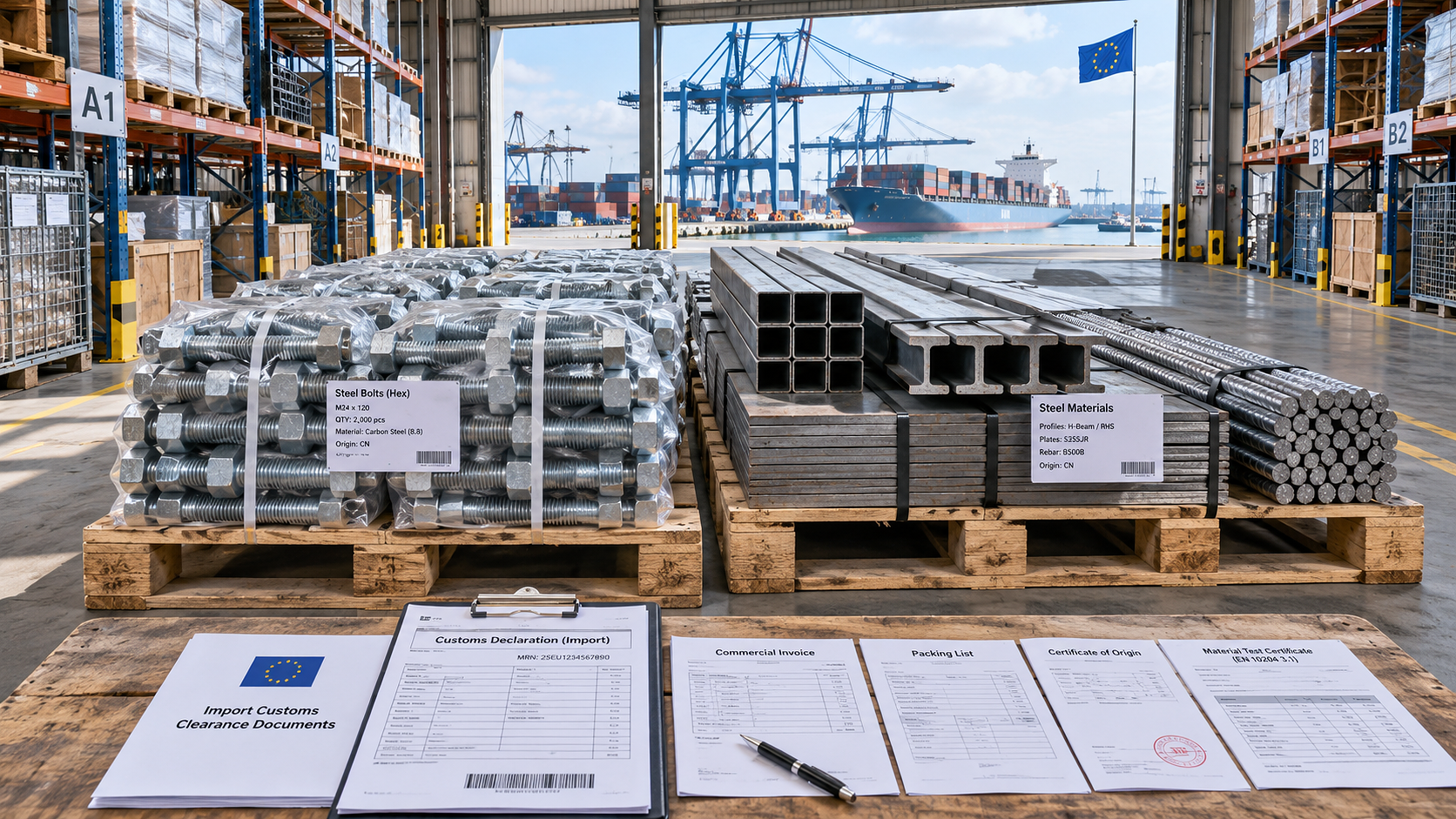
Some downstream articles are expressly included. For example, Annex I lists certain screws, bolts, nuts and similar iron or steel articles. By contrast, a complete piece of equipment is not automatically covered because its frame or fasteners are steel. The classification of the complete imported item is decisive, subject to the customs rules applicable to the transaction.
Conversely, a product described commercially as a “component” is not necessarily outside scope. If its correct CN code is listed, the fact that it will later be incorporated into machinery or a building does not remove it from CBAM. The product’s intended use and its marketing description cannot replace the legal classification exercise.
How the customs classification test works
The EU Combined Nomenclature is used to classify goods for customs purposes. It is based on the international Harmonized System, but the CN adds EU-specific detail. CBAM may refer to a broad heading or to a more specific code. An entry marked “ex” covers only the goods described alongside that code, not necessarily every product classified under it.
A reliable scope assessment starts with the product as presented for import: its composition, form, dimensions, degree of processing and other characteristics relevant to classification. The resulting CN code should then be checked against the current Annex I text. A supplier’s product name or an old customs entry can help identify the issue, but neither is conclusive if the specification or applicable nomenclature has changed.
Consider two simplified examples:
- Imported steel bolts: If the correctly classified bolts fall under an Annex I entry, they can be CBAM goods even though their individual value is small and they are intended for a larger machine.
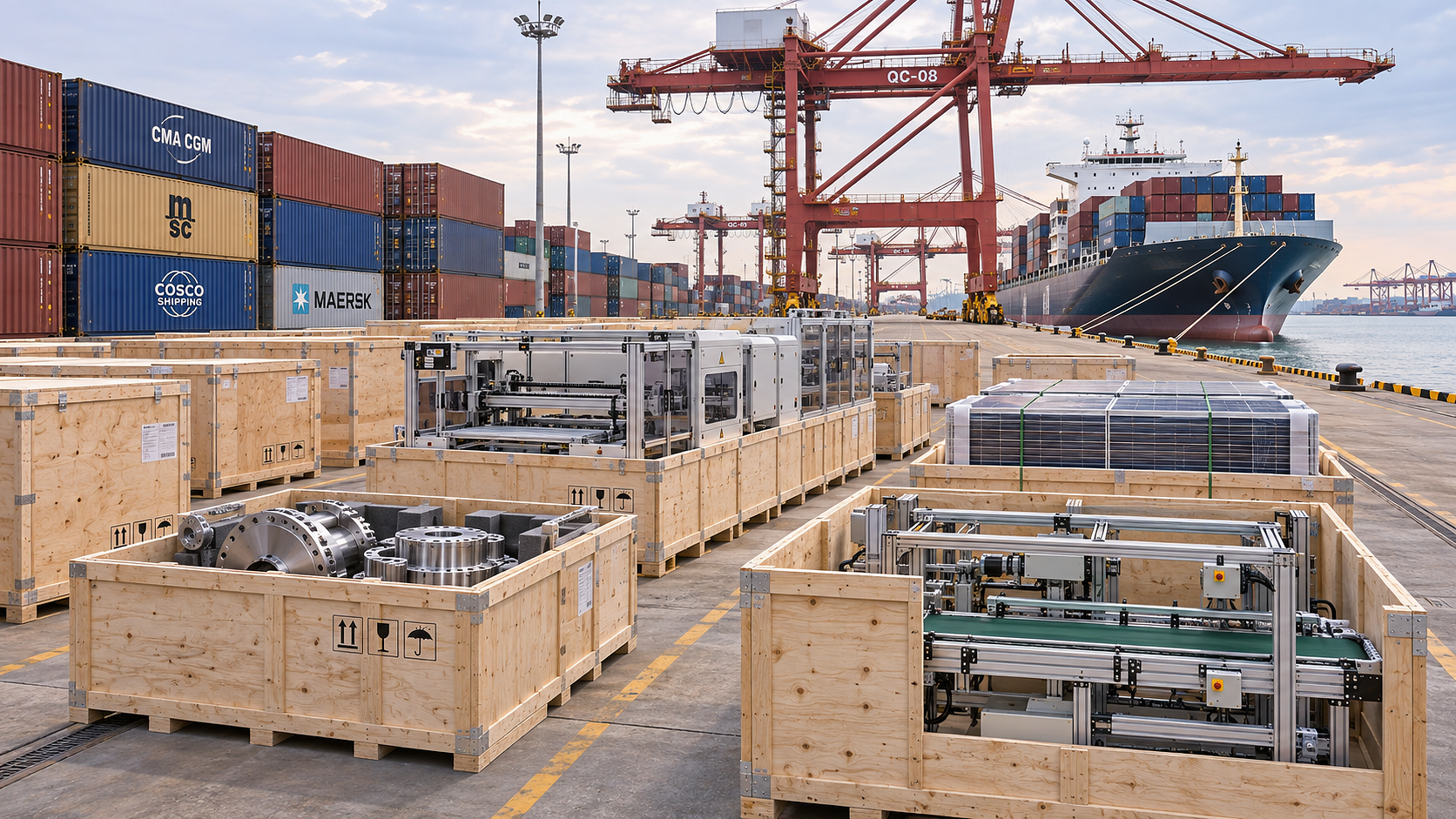
- Imported industrial machinery: A machine classified under its own machinery code is not brought into scope merely because it contains covered steel or aluminium. The relevant question is whether the machine’s own classification is listed.
Mixed shipments require particular care. A customs declaration can contain both listed and unlisted goods. Their presence in the same container does not make the whole shipment a single CBAM product, nor does an out-of-scope item exempt a listed item. Classification should follow the customs treatment of the goods as declared, rather than an informal division based only on material content.
Where classification is uncertain, the EU’s Binding Tariff Information system can provide a formal customs classification decision. A BTI decision addresses classification; it does not, by itself, resolve every CBAM question about origin, exemptions or embedded emissions.
Origin matters, but the dispatch country is not the whole answer
CBAM generally applies to covered goods originating outside the EU when they are imported into the EU customs territory. Origin is a customs concept and is not necessarily the country from which the shipment was last dispatched. A product shipped through a distribution centre in a third country does not automatically acquire that country’s origin.
There are specific exclusions for goods originating in countries and territories listed in Annex III of the CBAM regulation. These reflect participation in, or linkage with, the EU Emissions Trading System. The listed origins include Iceland, Liechtenstein, Norway and Switzerland, as well as specified territories. The legal list and its conditions should be checked rather than assuming that every European or neighbouring country is excluded.
EU-origin goods are not treated as third-country-origin goods merely because they leave the EU and later return. Nevertheless, the customs treatment of returned goods and the evidence needed to establish their status matter. A commercial statement that a product was “made in Europe” is not a substitute for the applicable origin documentation.
The reverse is also important: importing from a country with a carbon price does not automatically exempt listed goods. An eligible carbon price effectively paid in the country of origin can be relevant when calculating the CBAM obligation, subject to the regulation’s conditions and evidence requirements. It is a possible adjustment to the obligation, not a general country-of-origin exemption.
Exemptions and thresholds can change the outcome
A listed CN code and non-exempt origin do not end the assessment. CBAM contains exemptions and special rules, including rules for small quantities and particular customs situations. These provisions have changed, so an assessment based on the transitional-period rules should not be carried forward without checking the amended legislation.
Under the simplification adopted in 2025, a cumulative annual threshold of 50 tonnes of CBAM goods per importer applies, with electricity and hydrogen excluded from that mass-based exemption. The threshold is not a separate allowance for each shipment or each supplier. Once the applicable threshold is exceeded, the importer must consider the consequences under the amended rules, including the treatment of imports during the year.
The earlier small-consignment exemption, expressed by reference to intrinsic value, belongs to a different version of the rules and should not be used as a substitute for the current mass-based test. Nor should the 50-tonne threshold be treated as a general exemption for electricity or hydrogen imports.
Special circumstances, including military use and certain movements associated with customs procedures or returned goods, are addressed by specific provisions. Their application depends on the legal conditions and documentation, not simply on the commercial purpose of a shipment. A temporary movement or processing arrangement should therefore be assessed under the relevant customs and CBAM provisions before assuming that no obligation arises.
What compliance means once goods are in scope
CBAM’s transitional period ran from 1 October 2023 to 31 December 2025. During that period, the principal CBAM obligation was quarterly reporting of covered imports and their embedded emissions; CBAM certificates were not surrendered. The definitive regime began on 1 January 2026 and introduces authorisation, annual declaration and certificate-related obligations under the applicable rules.
In the definitive regime, an importer above the relevant exemption threshold generally needs the status of an authorised CBAM declarant, or must use an indirect customs representative in the circumstances provided by the regulation. Responsibility depends on how the import is arranged and which person acts as declarant. A non-EU manufacturer does not automatically become the EU CBAM declarant simply by producing or exporting the goods.
The declaration concerns more than shipment weight. It requires information on the quantity of covered goods and their embedded emissions, calculated under CBAM rules. The obligation is expressed through CBAM certificates, taking account of applicable adjustments, including the phase-in related to free allocation under the EU Emissions Trading System and eligible carbon prices paid in the country of origin.
Certificate prices are linked to EU ETS allowance prices under the CBAM calculation rules; they are not a fixed tariff per tonne of imported product. Nor does a tonne of goods necessarily correspond to one tonne of embedded CO₂. The emissions intensity of the covered product, the calculation method and applicable adjustments all affect the result.
Administrative dates and implementing requirements are subject to the amended regulation and subsequent implementing acts. In particular, the start of the definitive regime should not be confused with the first date on which certificates must be purchased or an annual declaration submitted. The European Commission’s current CBAM guidance and registry information should be consulted for the relevant compliance year.
Embedded emissions: the product boundary is not always the factory gate
CBAM distinguishes between direct emissions from production and, for relevant goods, indirect emissions associated with electricity consumed during production. The treatment of indirect emissions differs by product category and phase of the mechanism. It is therefore unsafe to assume that the same emissions boundary applies to a tonne of cement, aluminium and steel.
For some goods, the calculation also includes emissions embedded in specified precursor materials used to make the final product. This matters when production takes place across several installations or countries. A producer’s own combustion and process emissions may be only part of the information needed for a compliant figure.
Actual emissions data require information from the installation producing the goods and, where relevant, its precursor suppliers. The applicable rules also provide for default values in specified circumstances. A default value is a regulatory calculation tool, not proof of the actual emissions from a particular factory. Availability, conditions and consequences for using defaults should be assessed against the rules for the relevant period and product.
Verification requirements apply in the definitive regime under the relevant legislation. A generic corporate carbon footprint, a sustainability report or an environmental product declaration can provide context, but it is not automatically a CBAM-compliant emissions calculation or verification. The product boundary, calculation method, reporting period and verification requirements must match the CBAM rules.
Common scope errors in cross-border trade
Confusing the product list with a material list. CBAM does not currently require an importer to calculate the steel and aluminium content of every finished product entering the EU. Some downstream articles are listed, but the imported article’s CN classification remains the starting point.
Using the exporter’s tariff code without checking the EU code. Export documentation may use a national tariff classification that shares the first six Harmonized System digits with the EU system but differs at a more detailed level. The EU CN classification used for import must be assessed separately.
Assuming low shipment value settles the question. The current mass-based threshold is assessed cumulatively at importer level, not simply by looking at the invoice value of one parcel. Electricity and hydrogen require separate attention because they are excluded from that threshold.
Equating carbon data with customs coverage. A low-emissions product can still be in scope if its code and origin meet the legal tests. Conversely, a high-emissions product is not automatically a CBAM good if it is not listed in Annex I. Scope and emissions calculation are different questions.
Treating a supplier’s carbon price as an automatic deduction. Any adjustment for a carbon price paid abroad is subject to the regulation’s conditions, including evidence and the treatment of rebates or other compensation. A carbon tax existing in the producer’s country is not, on its own, enough to establish the amount deductible.
Documents that support a defensible assessment
A practical assessment links each imported product to its technical description, EU CN code, origin and relevant exemption analysis. Supporting records may include specifications, customs declarations, origin evidence, supplier identification and any classification decision. Where goods are in scope, installation-level emissions information and records supporting an eligible foreign carbon price become relevant to the declaration.
Records should also show which version of Annex I and which exemption rules were used. That distinction matters because an assessment made for a transitional-period report may not answer the same question under the definitive regime. Changes in product design, sourcing or customs classification can also alter the result without changing the commercial product name.
The principal legal source is Regulation (EU) 2023/956, especially Annexes I and III, read in its current consolidated form with subsequent amendments and implementing acts. The European Commission’s CBAM page provides legislation, guidance and registry information. Where a transaction sits near a classification or exemption boundary, the applicable legal text and customs facts take precedence over broad sector descriptions.
Have questions about this sector analysis, or seeking best practices specific to your niche? Drop us a line below and let the senior consultants at GTIIN assist you.
“We respect your privacy. Your information is strictly confidential.”
Weekly Insights
Stay ahead with our curated technology reports delivered every Monday.
Recommended News
 Supply ChainNov 10, 2026China Extends Pause on 24% Additional Tariff on US Goods by Two Months
 Industry StandardsNov 10, 2026Which imports are subject to EU carbon border compliance?
 Global SourcingNov 09, 2026USTR Extends 178 China Section 301 Tariff Exclusions to January 2027
 Supply ChainNov 09, 2026How can a tariff risk management dashboard track cost exposure?