How to qualify factory automation components from new suppliers
How to Qualify Factory Automation Components from New Suppliers

Qualifying factory automation components from a new supplier is a risk-management process, not a purchasing formality. The decision can affect uptime, safety, quality, maintenance, and customer delivery performance.
For procurement teams, the central question is whether a supplier can repeatedly deliver technically compatible, traceable, compliant components under real operating and supply-chain conditions.
Price matters, but a lower unit price rarely offsets the cost of line stoppages, commissioning delays, rejected assemblies, expedited freight, or unplanned engineering rework.
A practical qualification program should combine engineering validation, supplier-process assessment, commercial due diligence, and logistics analysis. Each layer addresses a different source of operational exposure.
This guide provides a risk-based framework for buyers evaluating new sources of sensors, PLC accessories, drives, actuators, control cabinets, safety devices, connectors, and related automation parts.
The objective is not to eliminate every supplier risk before purchase. It is to identify unacceptable risks early and establish controls for manageable ones.
Qualification depth should match component criticality. A cable gland needs a lighter process than a safety relay, servo drive, industrial controller, or machine-critical pneumatic valve.
Buyers should also distinguish between a manufacturer, an authorized distributor, an independent trader, and a private-label assembler. Their technical accountability and traceability capabilities differ substantially.
Before approving any source, define what “qualified” means internally. Clear acceptance criteria prevent commercial urgency from overriding engineering, quality, or regulatory requirements later.
Start with Component Criticality and Failure Consequences
Begin by classifying each factory automation component according to its effect on safety, output quality, line availability, regulatory compliance, and equipment lifecycle costs.
Critical components require stronger evidence because their failure can stop production, create hazardous conditions, damage equipment, or invalidate a customer’s process qualification.
Use a simple risk matrix combining failure severity, likelihood, detectability, and replacement lead time. This gives procurement and engineering a common approval language.
For example, a standard proximity sensor may be easily replaceable, while a proprietary encoder can require software configuration, mechanical alignment, and lengthy production recovery.
Include single-source exposure in the assessment. A technically acceptable supplier may still be unsuitable if its manufacturing location or freight route creates concentrated disruption risk.
Consider whether the component is installed in a regulated environment, including food processing, pharmaceuticals, cleanrooms, hazardous areas, or safety-rated machinery applications.
Criticality should determine audit intensity, sample size, documentation requirements, incoming-inspection rules, and whether a trial order is sufficient before full supplier approval.
This approach avoids wasting resources on low-impact consumables while ensuring that decisions involving high-consequence automation parts receive appropriate technical scrutiny.
A documented component-risk classification also helps explain sourcing decisions to plant managers, quality teams, insurers, and customers when supply continuity is questioned.
Verify Technical Compatibility Before Comparing Commercial Terms
Technical compatibility must be confirmed against the actual machine environment, not merely against catalogue descriptions or a supplier’s statement that a part is equivalent.
Create a specification package containing drawings, electrical ratings, interfaces, protocols, mounting dimensions, environmental limits, materials, tolerances, and required software or firmware versions.
For electrical components, verify voltage range, current rating, inrush behavior, insulation class, IP rating, EMC performance, grounding requirements, and short-circuit protection assumptions.
For motion-control items, confirm torque curves, speed limits, backlash, encoder resolution, braking behavior, thermal characteristics, shaft geometry, and drive-controller communication compatibility.
Industrial networks require particular attention. Confirm support for protocols such as PROFINET, EtherNet/IP, Modbus TCP, EtherCAT, CANopen, or IO-Link where applicable.
Ask whether the supplier has tested the proposed component with the buyer’s control architecture. Compatibility claims without test conditions provide weak evidence for approval.
Review mechanical interchangeability carefully. Small differences in thread standards, connector keying, cable bend radius, mounting hole positions, or actuator stroke can delay installation.
Where substitution is involved, require engineering approval of the bill-of-material change. Procurement should not authorize functional replacements based solely on nominal specifications.
Retain the approved datasheet revision, sample-test results, and configuration details in the supplier file. These records are essential when future lots differ unexpectedly.
Assess Manufacturing Controls, Not Just Finished Samples
A successful sample proves that a supplier can make one acceptable part. It does not prove that the supplier can control repeatability across production lots.
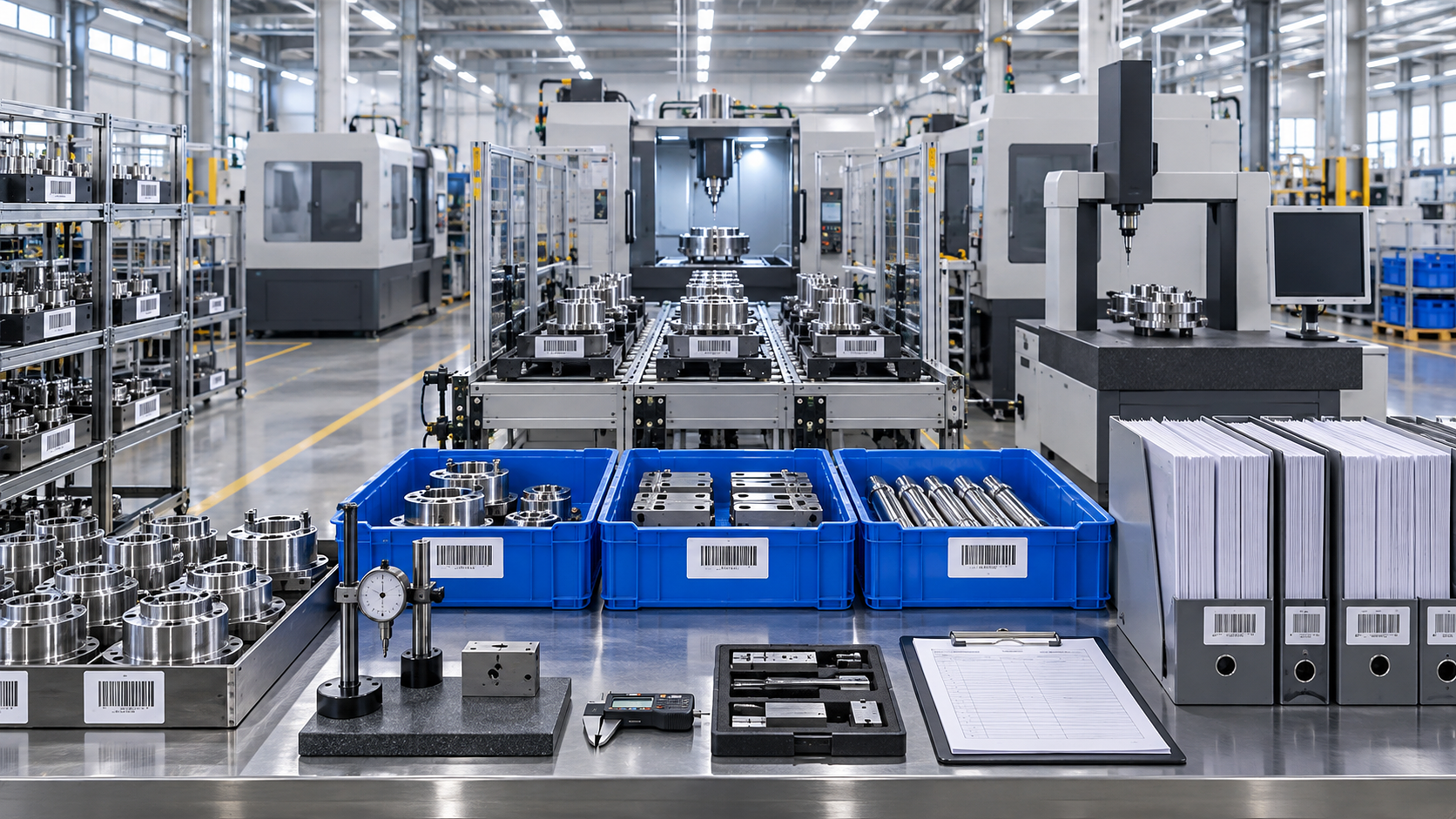
Ask new suppliers to describe their incoming-material controls, process inspections, calibration system, final testing, nonconformance handling, and corrective-action procedures.
For high-risk factory automation components, request process flowcharts, control plans, inspection instructions, and evidence that critical production equipment receives preventive maintenance.
Evaluate whether testing is functional, dimensional, visual, or documentation-based. A simple final inspection may not detect hidden defects in electronic or safety-related assemblies.
Calibration records deserve close review. Test equipment without valid calibration can produce reassuring reports that do not demonstrate actual product conformity.
Determine how the supplier manages component changes. Changes to chips, seals, cable compounds, coatings, subcontractors, or firmware can alter field performance significantly.
A capable supplier informs customers before material or process changes. The notification process should specify approval timing, validation expectations, and traceability of affected batches.
When an on-site audit is impractical, conduct a structured remote audit using live video, document sampling, factory walkthroughs, and interviews with quality personnel.
Look for consistency between documented procedures and observed practice. Mature quality systems show clear ownership, accessible records, controlled work instructions, and disciplined response to deviations.
Demand Traceability, Compliance Evidence, and Authenticity Controls
Traceability is especially important for factory automation components because counterfeit, obsolete, repaired, or unauthorized goods can enter international supply channels.
Require the supplier to state product origin, manufacturer identity, date-code practices, lot-number format, storage conditions, and whether goods are new, surplus, or refurbished.
For branded components, request authorization evidence or a verifiable chain of custody. A low price from an unapproved channel can conceal substantial authenticity risk.
Compliance documentation should match the product category and destination market. Depending on use, this may include CE, UKCA, UL, CSA, RoHS, REACH, IECEx, or ATEX evidence.
Do not assume a certificate applies to every variant. Verify exact model numbers, production sites, report dates, standards referenced, and scope limitations.
Safety-related products need elevated review. Confirm safety integrity claims, relevant standards, application restrictions, proof-test requirements, and whether installation instructions support intended use.
Buyers should also assess cybersecurity requirements for connected equipment. Networked controllers, gateways, drives, and remote-access devices may introduce vulnerabilities beyond conventional product defects.
Establish receiving checks for label quality, packaging, serial numbers, visual condition, and documentation. For critical parts, include authenticity inspection or laboratory testing when justified.
Compliance records should be stored with the approved part number and supplier profile. This reduces delays when customers, auditors, or customs authorities request evidence later.
Test Samples Under Real Operating Conditions
Supplier samples should be tested in conditions that resemble actual use, including load, temperature, vibration, contamination, electrical noise, duty cycle, and installation constraints.
A bench test is useful, but it cannot fully predict performance on an operating production line with multiple devices, variable operators, and real network traffic.
Define a written validation protocol before samples arrive. It should identify acceptance criteria, measurement methods, responsible teams, test duration, and actions after failure.
For sensors, test detection repeatability, response time, sensing range, false-trigger behavior, cable durability, and performance near metal, moisture, or electromagnetic interference.
For pneumatic and hydraulic components, examine leakage, cycle life, pressure stability, response consistency, seal materials, air quality sensitivity, and maintenance requirements.
For electronic modules, test startup behavior, fault recovery, communication stability, power-loss response, diagnostic accuracy, and interoperability with existing supervisory controls.
Include installation technicians and maintenance personnel in the trial. Their experience can reveal connector access, documentation gaps, parameterization complexity, and spare-parts concerns.
Document failures with photographs, logs, test data, and operating conditions. A supplier’s response quality is itself a meaningful indicator of future support capability.
Where the application is high consequence, approve the supplier in stages: sample validation, limited production use, monitored performance, and finally broader sourcing authorization.
Evaluate Capacity, Delivery Reliability, and Supply Chain Resilience
Factory automation components are often purchased because a project schedule or maintenance requirement cannot wait. Capacity and delivery performance therefore require direct qualification.
Ask suppliers about installed capacity, current utilization, bottleneck processes, overtime dependence, subcontracted operations, and the typical lead time for your specific configuration.
Do not rely on a generic lead-time promise. Request historical on-time delivery data, backlog information, and confirmation of how lead times change during demand peaks.
Review the supplier’s bill of materials for vulnerable inputs, including semiconductors, rare metals, specialty polymers, bearings, magnets, connectors, and externally sourced firmware.
Understand geographic concentration. A supplier with one production site, one key subcontractor, or one export port may be exposed to regional disruptions.
Ask whether alternative plants, approved second sources, buffer inventory, or dual-logistics routes exist. Resilience depends on practical recovery options, not policy statements.
For cross-border purchasing, assess Incoterms, customs documentation quality, export-control exposure, transit times, packaging standards, and the supplier’s experience shipping to your market.
Packaging is a technical issue as well as a logistics issue. Moisture-sensitive electronics, precision components, and calibrated devices require adequate protection during storage and transit.
Set performance expectations in the commercial agreement, including lead-time commitments, communication rules, expedite procedures, allocation terms, and remedies for repeated delivery failure.
Use Commercial Due Diligence to Identify Hidden Supplier Risk
Technical approval should not obscure commercial and organizational risk. A supplier’s financial health, legal identity, and customer-support capacity influence long-term sourcing reliability.
Verify corporate registration, beneficial ownership where appropriate, operating address, years in business, export history, banking details, and consistency across official documents.
Review whether the supplier holds adequate product liability insurance, especially when components will be integrated into machinery sold to regulated industries or overseas customers.
Assess credit exposure before issuing large deposits or long-term commitments. Financial distress can create sudden quality deterioration, shipment delays, or ownership changes.
Clarify warranty scope, return procedures, technical-support response times, repair options, and availability of replacement stock. Vague warranties offer little protection during a production incident.
For customized components, define ownership of drawings, tooling, firmware, test fixtures, software parameters, and any intellectual property created during development.
Contract terms should include change-notification obligations, quality responsibilities, inspection rights, confidentiality provisions, and escalation routes for major nonconformances.
Evaluate communication quality during qualification. Slow, inconsistent, or evasive responses often become more damaging after orders are placed and problems require immediate resolution.
Commercial due diligence is not separate from operational reliability. It helps buyers determine whether a supplier can remain accountable after the first successful shipment.
Build a Controlled Supplier-Approval and Monitoring Process
A supplier should not move directly from quotation to preferred-source status. A staged approval process protects production while allowing promising suppliers to demonstrate capability.
Use defined statuses such as prospect, technically approved, conditionally approved, production approved, and preferred supplier. Each status should permit clearly specified purchasing activity.
Conditional approval is useful when a supplier meets baseline requirements but still needs field-performance evidence, audit closure, documentation completion, or capacity verification.
Create a cross-functional approval panel including procurement, engineering, quality, operations, maintenance, finance, and compliance representatives when component risk warrants broad review.
Maintain a supplier scorecard covering quality defects, on-time delivery, responsiveness, corrective-action closure, documentation accuracy, pricing stability, and change-management performance.
Review the scorecard at practical intervals, especially after major projects, quality incidents, supplier relocations, material changes, or significant geopolitical and logistics disruptions.
Set triggers for reassessment. Examples include repeated lot failures, a change in manufacturing site, unexplained price reductions, certification expiry, late deliveries, or ownership changes.
Share performance feedback with suppliers using facts and agreed corrective actions. Effective supplier development can improve capability, but it should not replace necessary sourcing alternatives.
Maintain qualified backup sources for critical factory automation components whenever possible. Dual sourcing reduces recovery time and strengthens negotiating leverage during constrained supply periods.
Conclusion: Qualify for Repeatability, Not a Single Purchase
The strongest supplier qualification decisions combine component criticality, technical fit, process control, traceability, testing, resilience, and commercial accountability into one evidence-based decision.
For procurement teams, the most valuable outcome is not simply an approved supplier list. It is greater confidence that automation projects and production lines can operate reliably.
New suppliers should be evaluated according to the consequences of failure, rather than treated equally. High-risk components deserve deeper validation and stronger contractual safeguards.
By documenting requirements before sourcing, testing parts in realistic conditions, and monitoring performance after approval, buyers can reduce disruption without slowing necessary supplier diversification.
This disciplined approach turns factory automation components sourcing into a strategic capability: one that supports cost control, operational continuity, compliance confidence, and more resilient global supply chains.
Weekly Insights
Stay ahead with our curated technology reports delivered every Monday.
Recommended News
 Supply ChainSep 22, 2026How heavy equipment lifecycle data can reduce unexpected downtime
 Supply ChainSep 21, 2026How export regulations affect logistics lead times and delivery risk
 Industry StandardsSep 20, 2026What evidence is needed to pass a carbon reporting audit?
 Industry StandardsSep 19, 2026When does manufacturing compliance consulting reduce audit risk?