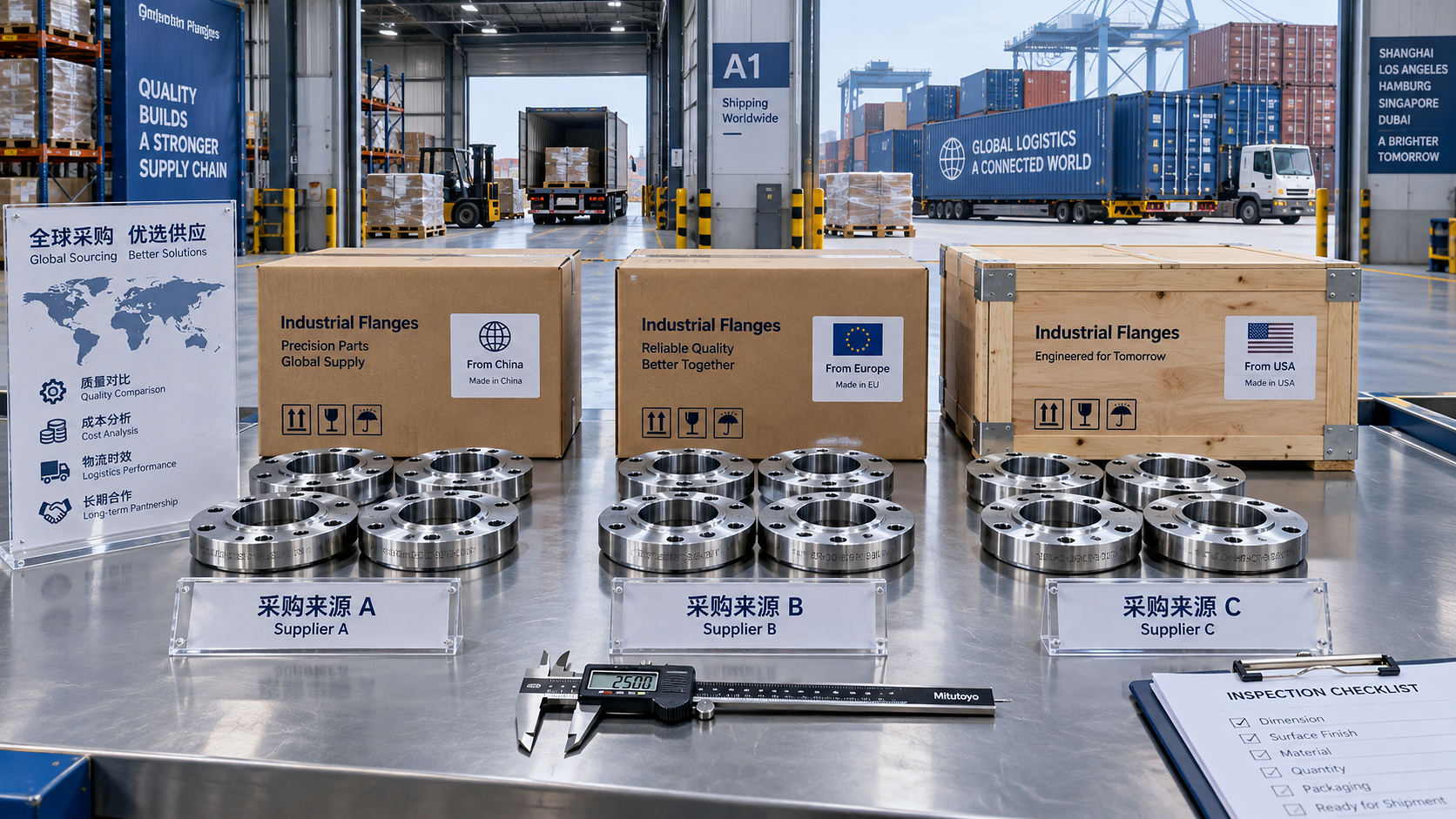
How importers use industrial trade analysis to compare sourcing countries
How importers use industrial trade analysis to compare sourcing countries
Choosing a sourcing country on unit price alone can leave procurement teams exposed to unexpected tariffs, delivery delays, and compliance costs. Effective industrial trade analysis for importers connects trade flows, supplier capacity, landed costs, and regulatory requirements to show how sourcing markets compare beyond the quotation. The aim is not to identify the cheapest country in general. It is to find the market that can deliver a particular specification, at an acceptable total cost, with risks the business can manage.
That distinction matters. A country may be competitive for standard castings but less suitable for machined assemblies requiring tight process control and frequent engineering changes. Another may offer shorter transport routes while depending on imported feedstock from the same upstream source as your existing supplier. Country selection needs to expose these differences before purchasing commits to qualification costs.
Define the purchase before comparing the countries
A useful country comparison starts with a tightly defined buying requirement. “Industrial pumps” or “steel components” is too broad. Material grade, manufacturing process, operating conditions, inspection requirements, order size, and destination market can change which locations deserve consideration.
For example, a standard replacement component and a safety-critical component may share a broad customs category but require very different supplier capabilities. Export volume alone will not reveal that difference. Before collecting trade statistics, establish the specification and separate non-negotiable requirements from preferences.
- Technical boundaries: materials, tolerances, process controls, testing, and traceability.
- Commercial conditions: annual demand, release quantities, tooling ownership, payment terms, and acceptable minimum orders.
- Delivery requirements: receiving location, replenishment frequency, packaging, and maximum tolerable interruption.
- Market-access conditions: applicable product rules, documentation, import restrictions, and customer approval requirements.
This prevents a common procurement mistake: comparing quotations that describe nominally similar products but allocate different obligations to the buyer.
Read trade flows as evidence, not a supplier ranking
Trade statistics help establish whether a country has a meaningful export base for the relevant product. Sources such as UN Comtrade and ITC Trade Map can support comparisons of export values, quantities where reported, destinations, and changes over time. Start with the appropriate Harmonized System classification, then check whether it is precise enough for the purchasing question.
The internationally harmonized six-digit HS level supports broad comparisons, but destination-country tariff schedules often extend beyond it. Classification revisions also matter when reviewing a multiyear trend. An apparent change in exports may partly reflect a code change rather than a manufacturing shift.
Look across several periods rather than selecting the latest strong year. Consistent exports to multiple markets can justify further investigation. A sudden increase needs explanation: additional production, higher commodity prices, re-exports, or one unusually large shipment could each produce a similar headline.
Be particularly careful with trade unit values, calculated by dividing reported value by quantity. They are not supplier quotations. Product mix, reporting units, quality grades, and valuation conventions can distort comparisons. Likewise, differences between one country's reported exports and its partner's reported imports may reflect timing, freight treatment, or reporting practices—not necessarily irregular trade.
Use these signals to shortlist countries and formulate questions. They do not establish that an individual factory owns the equipment, has available capacity, or can meet your drawing.
Build a cost comparison around the same delivery obligation
Country comparisons become misleading when one quote includes origin handling and another does not. Normalize quotations to a common destination, shipment size, currency assumption, and clearly named Incoterms rule and place. Incoterms allocate certain costs, obligations, and risks; they do not settle every contractual issue or replace a detailed logistics quotation.
A practical evaluation includes the purchase price, freight and insurance, duties and applicable trade remedies, brokerage, terminal handling, inland delivery, inspection, and nonrecoverable taxes. Keep recoverable import taxes separate from permanent costs, while recognizing their potential cash-flow effect. Duty calculations should follow the destination's valuation rules rather than a generic percentage added to the supplier price.
Then add the costs that rarely appear on the first spreadsheet: tooling amortization, qualification, inventory financing, expected rework supported by actual evidence, and the administrative effort required to manage the source. Avoid assigning a precise “risk premium” without a defensible basis. Scenario ranges are often more useful than a confident-looking number.
For bulky, low-value goods, packing density and inland transport may outweigh a modest factory-price difference. For precision parts, process yield and inspection requirements may dominate instead. The correct cost model follows the product, not a standard country scorecard.
Run at least a normal-delivery scenario and a plausible disruption scenario. Ask what happens if freight rises, production slips, or an urgent partial shipment becomes necessary. A lower quoted price may still win—but the saving should survive a realistic operating test.
Check origin and compliance before awarding a price advantage
The shipment's departure country is not necessarily its customs origin. This becomes important when a supplier claims preferential duty treatment or when a product is potentially subject to trade remedies. Imported inputs do not automatically prevent preferential treatment, but eligibility depends on the applicable agreement, product-specific origin rules, and supporting evidence.
Confirm the tariff classification, origin basis, and current measures with the importing jurisdiction's customs resources or a qualified adviser. WTO tariff data is useful for research, but a purchasing decision needs the applicable destination-country rules and their effective dates. Where scope is uncertain, ask about a formal ruling or other available clarification process.
Product compliance deserves a separate review. A certificate bearing a familiar logo is not sufficient evidence that the exact product meets destination requirements. Check the manufacturer, model or product scope, relevant test documentation, issuing organization, and any validity conditions. Requirements differ by product and market; a system certification does not by itself establish product conformity.
Environmental obligations can also change the comparison. For goods potentially covered by the EU Carbon Border Adjustment Mechanism, for instance, verify current scope, timing, reporting requirements, and applicable financial obligations using European Commission guidance. Do not spread a blanket carbon surcharge across every industrial import. Supplier-level emissions information may be necessary, and its availability should be tested during qualification.
Compare the production network, not just the map
Geographic proximity is useful only when it translates into dependable replenishment. Compare the full route: material procurement, production queue, inland movement, export clearance, sailing frequency, transshipment, destination clearance, and final delivery. A short sea journey can still sit inside a long order-to-receipt cycle.
Ask suppliers to distinguish processing time from waiting time. A machining operation may be quick while cast blanks, specialist coatings, or outsourced heat treatment determine the actual schedule. This is where industrial cluster depth matters: nearby subcontractors and alternative material sources can make recovery easier, provided they are technically qualified.
Historical shipment records, forwarder schedules, and pilot-order milestones provide more useful evidence than an unsupported promise of “fast delivery.” For inventory planning, examine lead-time variability as well as the average. Buffer requirements depend on demand variability and service targets too, so a shorter route does not automatically justify a large stock reduction.
Also trace shared dependencies. Two suppliers in different countries may use the same mill, specialty resin producer, port corridor, or critical subcontractor. Splitting purchase orders between them can diversify contracts without meaningfully diversifying supply.
Use decision gates before weighted scores
A weighted sourcing matrix is useful, but it can conceal an unacceptable weakness. A low price should not compensate mathematically for a mandatory compliance failure or an unachievable technical requirement. Screen those issues first.
For countries that pass, compare total cost, delivery performance, supplier depth, qualification effort, and disruption exposure. Set weights around the purchase. A continuously consumed production input needs different priorities from an occasional maintenance item. Record the evidence date and confidence level alongside each score; otherwise, an unverified sales claim can quietly receive the same standing as an audit finding.
Country-level intelligence and factory verification should remain separate layers. GTIIN's focus on global sourcing, supply chains, market trends, and industry standards fits the first layer: connecting industrial developments with procurement questions. That context can narrow the search and identify risks worth investigating. It cannot replace technical audits, sample approval, contractual review, or production validation.
Before awarding volume, request evidence that resolves the most consequential unknowns:
- A production and subcontracting map showing where critical operations occur.
- Capacity evidence tied to the required process, current workload, and realistic allocation.
- A specification-specific inspection plan and traceability records where required.
- A quotation with explicit exclusions, tooling terms, delivery basis, and validity.
- A qualification order with agreed acceptance criteria and documented delivery milestones.
The outcome need not be a single winning country. One market may suit stable base demand, while another provides a qualified alternative for urgent replenishment. Keep that alternative commercially and technically viable rather than leaving it as an unused name on a spreadsheet. Before shifting production, identify exactly which assumptions remain unproven—and make the next trial order test those assumptions.
Weekly Insights
Stay ahead with our curated technology reports delivered every Monday.
Recommended News
 Global SourcingOct 16, 2026How importers use industrial trade analysis to compare sourcing countries
 Supply ChainOct 15, 2026How to choose a supply chain strategy for unpredictable demand
 Supply ChainOct 14, 2026How to assess an industrial equipment supplier's spare parts support
 Supply ChainOct 14, 2026EU Updates CSDDD Guidance on Global Supply Chain Due Diligence