
CBP Finalizes HTS Shift for Smart Sensors
On July 2, 2026, U.S. Customs and Border Protection finalized revisions to HTS subheading 9032.89 for smart industrial sensors, with the change taking effect on August 1. The update extends the scope of this tariff category to cover AI-optimized industrial sensors with edge inference capability and real-time protocol translation, and it directly touches customs classification, duty treatment, origin marking, and Section 321 de minimis eligibility. For manufacturers, exporters, buyers, and supply-chain teams handling these products, this is worth close attention because the rule change reaches beyond tariff coding and into documentation and shipment readiness.
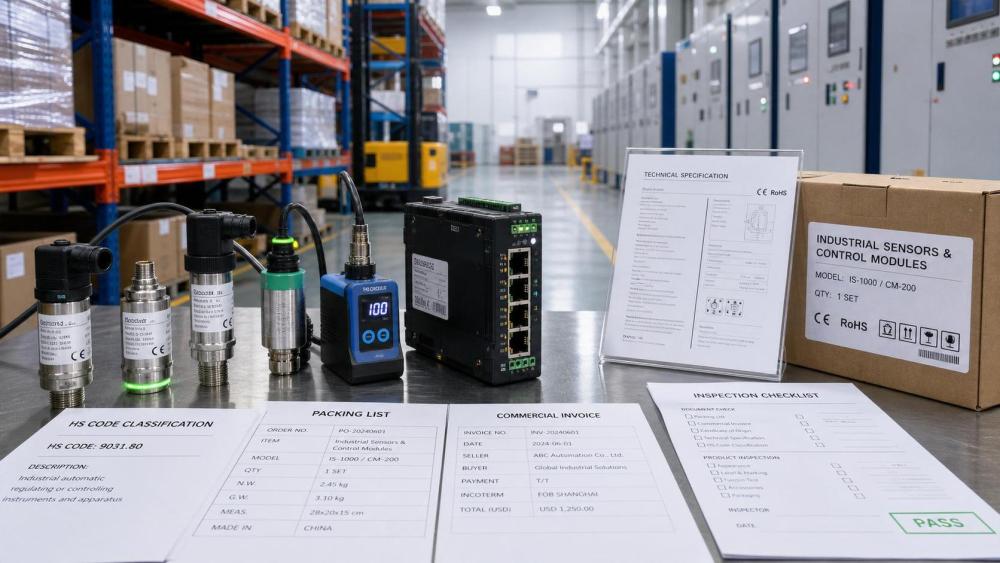
What the finalized HTS revision confirms
According to the information provided, CBP issued final modifications to Harmonized Tariff Schedule subheading 9032.89. The revised scope now includes smart industrial sensors that feature edge inference capability and real-time protocol translation, including examples such as Modbus-to-Matter and CAN-FD-to-Thread.
The effective date is August 1, 2026. The stated impacts of the revision include changes affecting duty rates, country-of-origin marking rules, and eligibility for Section 321 de minimis treatment.
The provided summary also states that non-U.S. manufacturers, including those in Shenzhen and Bangalore, must update HS coding, technical specification sheets, and commercial invoices by August 1, 2026, in order to reduce the risk of customs delays or reclassification penalties.
Where the operational pressure is likely to appear first
Export documentation and customs filing
From an industry perspective, exporters and direct trading companies are likely to feel the change first because tariff classification is reflected immediately in customs declarations and supporting shipping documents. Where product descriptions have historically focused on sensor function alone, companies may now need to check whether references to AI optimization, edge inference, or protocol translation bring a product within the revised 9032.89 scope. What deserves closer attention is whether HS coding, invoice language, and technical spec sheets remain aligned across the same shipment file.
Product specification and procurement alignment
Procurement teams and buyers may also be affected because sourcing decisions often rely on technical specifications that later become the basis for customs classification and compliance review. Analysis shows that products with embedded translation functions such as Modbus-to-Matter or CAN-FD-to-Thread may require more disciplined specification handling, especially when buyers, suppliers, and logistics providers are using different naming conventions for the same device capabilities. The practical issue is not only what the product does, but how that capability is described in transaction documents.
Manufacturing and non-U.S. supplier readiness
For non-U.S. manufacturers, the revision creates a near-term document control task. The provided information already points to updates needed in HS coding, technical spec sheets, and commercial invoices. Observably, this means manufacturing and export operations cannot treat the change as a pure customs issue; internal product records, shipping paperwork, and customer-facing technical documents may all need review before the effective date.
Logistics, delivery timing, and entry treatment
Supply-chain service providers and delivery planners may need to pay attention because the revision also affects Section 321 de minimis eligibility and origin marking treatment. Analysis shows that when classification and entry treatment rules shift at the same time, the risk is not limited to duty exposure; it can also affect clearance timing, routing choices, and the predictability of shipment release if documentation is not updated in step with the new tariff treatment.
What companies should review before August 1
Check whether product descriptions still fit the revised scope
Companies handling smart industrial sensors should review whether current product descriptions clearly identify features such as edge inference capability or real-time protocol translation. Where those features are present, it is more appropriate to understand classification review as an immediate compliance task rather than a later housekeeping step.
Reconcile technical files with commercial paperwork
What deserves closer attention is consistency between technical spec sheets and commercial invoices. If the technical file describes AI-optimized or protocol-translation functions but the invoice uses older or narrower wording, that mismatch may create questions during customs review. The provided information does not specify enforcement mechanics, so this should be treated as a documentation risk to monitor rather than as a confirmed enforcement outcome.
Revisit origin marking and shipment planning
Because the revision affects country-of-origin marking rules, companies should review how products and related paperwork present origin information. Analysis shows that this matters not only for manufacturers but also for distributors and fulfillment teams that manage relabeling, packaging, or multi-party shipment preparation before export to the United States.
Monitor de minimis treatment assumptions
The change also reaches Section 321 de minimis eligibility, which means businesses relying on existing assumptions for low-value entries should recheck those assumptions against the revised classification framework. The input does not provide detailed implementation guidance, so companies should treat this as an area requiring ongoing confirmation rather than a settled operational interpretation.
Why this looks like an execution signal, not just a headline change
Analysis shows that this development is better understood as a rule now moving into execution rather than as an early-stage policy discussion. The revision is described as final, it has a defined effective date, and it names concrete document updates expected from non-U.S. manufacturers. At the same time, it would be premature to treat every downstream practice as fully settled, because the provided information does not include detailed enforcement language, case examples, or further interpretive guidance. That makes this both an implemented change and a point for continued observation.
How the market should read the update now
At this stage, it is more appropriate to understand the CBP revision as a targeted customs and trade compliance change with practical consequences for product classification, documentation control, and shipment preparation. The immediate significance lies in the fact that smart industrial sensors with certain embedded digital capabilities are being drawn more clearly into a defined tariff treatment. The broader market impact will depend on how consistently companies update their records and how the rule is applied in day-to-day customs processing after August 1.
Basis of this article and points still to verify
This article is based on the user-provided news title, event date, and event summary. For developments of this kind, relevant source categories typically include official notices, releases from customs or trade authorities, regulatory publications, industry association updates, standard-setting documents, and reporting by authoritative trade media.
No specific official source link was provided in the input, so the underlying official publication path still needs to be verified on an ongoing basis. Observably, the points that warrant further monitoring include later CBP wording or implementation guidance, customs review practice after the August 1 effective date, changes in procurement or tender documentation, and market feedback from manufacturers, exporters, and import-side operators handling affected sensor categories.
Weekly Insights
Stay ahead with our curated technology reports delivered every Monday.
Recommended News
 Supply ChainOct 15, 2026How to choose a supply chain strategy for unpredictable demand
 Supply ChainOct 14, 2026How to assess an industrial equipment supplier's spare parts support
 Supply ChainOct 14, 2026EU Updates CSDDD Guidance on Global Supply Chain Due Diligence
 Global SourcingOct 13, 2026How to assess industrial automation suppliers for legacy integration