Industrial Sourcing for Bulk Materials: How to Compare Suppliers
Industrial Sourcing for Bulk Materials: How to Compare Suppliers
Industrial sourcing for bulk materials is no longer just about finding the lowest price.
It now depends on quality stability, supplier reliability, freight readiness, compliance control, and risk visibility.
That shift matters because a cheap quote can hide expensive downstream problems.
In real purchasing work, delays, off-spec loads, and weak documentation can erase any initial savings.
A better approach is to compare suppliers through a structured sourcing framework.
This guide explains how to evaluate industrial sourcing for bulk materials with practical, decision-ready criteria.
Why Industrial Sourcing for Bulk Materials Requires a Different Comparison Method
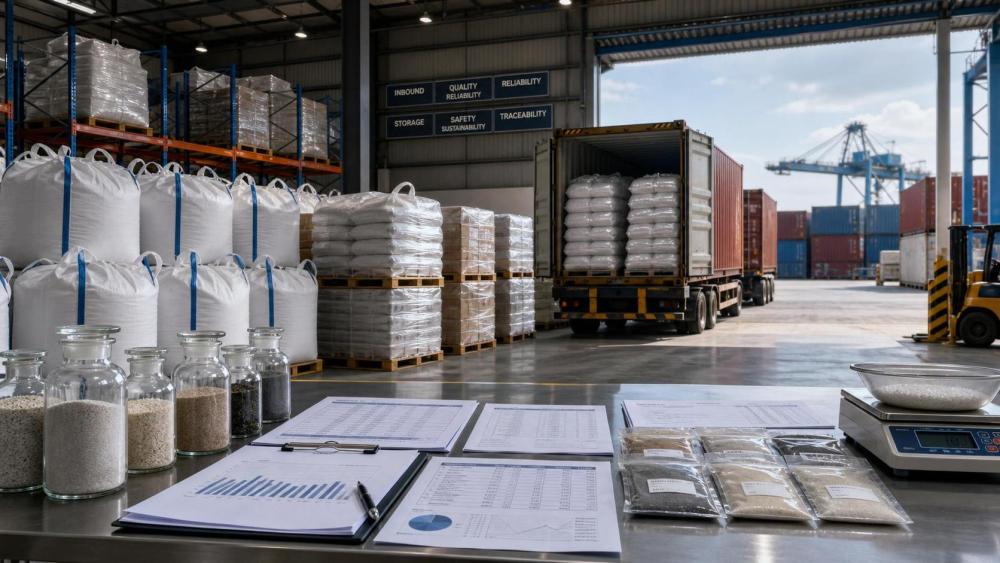
Bulk materials behave differently from finished products.
Specifications may look simple on paper, but performance often changes by batch, moisture, purity, particle size, density, or handling method.
That is why industrial sourcing for bulk materials needs more than price benchmarking.
You are comparing operational capability, not just commercial offers.
The more visible trend is that procurement teams now weigh resilience alongside cost.
This also means supplier selection should reflect total landed value, not headline unit price.
If one supplier offers steadier quality and fewer claims, that supplier may be the lower-cost option over a full contract cycle.
Start with a Clear Comparison Baseline
Before reviewing suppliers, define the same baseline for every bidder.
Without that step, industrial sourcing for bulk materials becomes a comparison of inconsistent assumptions.
A strong baseline usually includes:
- Material grade, tolerance, and test method
- Required volume by month, quarter, and season
- Packaging format, labeling, and storage conditions
- Delivery terms, destination, and Incoterms
- Compliance documents and origin requirements
- Acceptable lead time and safety stock expectations
This gives every supplier the same target.
It also reduces the common problem of quotes that seem comparable but are not commercially equivalent.
Compare Material Quality Beyond the Certificate
Quality is one of the first filters in industrial sourcing for bulk materials.
Still, many sourcing decisions rely too heavily on lab sheets and supplier declarations.
That is risky because the real issue is repeatability across shipments.
Ask suppliers for trend data, not just one passing sample.
You want to see batch history, variance ranges, rejection records, and corrective action speed.
Useful quality checkpoints include:
- Consistency of physical and chemical properties
- Sampling frequency and testing discipline
- Traceability by lot, batch, and shipment
- Handling of non-conformance and root cause analysis
- Third-party certification where relevant
When comparing suppliers, a stable process often matters more than a perfect sample.
Assess Production Reliability and Capacity Headroom
Supply reliability is where many bulk sourcing programs either hold up or break down.
A supplier may look competitive today but still lack the ability to support growth or absorb disruptions.
For industrial sourcing for bulk materials, capacity must be reviewed in context.
Check actual output, utilization rate, maintenance cycles, backup equipment, and utility stability.
Also ask how much volume is tied to existing customers.
A factory running near full utilization may offer limited flexibility during demand spikes.
Key questions include:
- Can the supplier support forecast swings without quality drift?
- What is the lead time during peak season?
- Is there a contingency plan for outages or raw material shortages?
- Can the supplier reserve production slots under contract?
These answers tell you whether a supplier can protect continuity, not simply win an RFQ.
Look at Logistics as Part of Supplier Performance
In industrial sourcing for bulk materials, logistics is not a separate issue.
It is part of the supplier’s real delivery capability.
A supplier with acceptable production but weak dispatch coordination can still create expensive downtime.
Review port access, loading efficiency, carrier relationships, packaging protection, and documentation accuracy.
This matters even more for moisture-sensitive, hazardous, temperature-sensitive, or contamination-sensitive materials.
Useful logistics comparison points include:
When freight conditions tighten, the stronger supplier usually shows up through execution, not promises.
Validate Compliance, Traceability, and Market Access
Compliance has become a major decision factor in global sourcing.
For industrial sourcing for bulk materials, missing paperwork can stop a shipment as easily as a production delay.
Depending on the material and region, review export licensing, REACH, RoHS, SDS, ESG disclosures, and origin traceability.
More buyers are also checking carbon exposure and supplier governance.
That is especially relevant when future procurement decisions may be affected by CBAM or customer audit pressure.
The practical question is simple.
Can this supplier support your target markets without repeated exceptions, rework, or border friction?
Calculate Total Cost, Not Just Unit Price
Price still matters, but it should be placed in a broader cost model.
This is where industrial sourcing for bulk materials often becomes more strategic.
Include freight, duties, inventory carrying cost, quality loss, sampling cost, claims handling, and production disruption exposure.
Also compare payment terms, currency risk, and contract flexibility.
In many cases, a slightly higher supplier price is offset by shorter lead times and fewer operational losses.
A useful supplier scorecard can weigh:
- Unit price and price stability
- Delivered cost by route and mode
- Quality failure cost
- Working capital impact
- Risk-adjusted continuity value
That model gives procurement teams a cleaner basis for final comparison.
Use a Practical Supplier Evaluation Process
A structured process keeps industrial sourcing for bulk materials disciplined and defensible.
It also helps internal stakeholders align faster.
- Pre-qualify suppliers using core technical and compliance filters.
- Request standardized quotations and supporting documents.
- Run sample, pilot, or trial shipment validation.
- Score quality, capacity, logistics, compliance, and total cost.
- Audit high-priority suppliers, remotely or on site.
- Negotiate service levels, escalation paths, and review cadence.
This process is especially useful when comparing suppliers across regions.
It turns supplier selection from a reactive purchase into a repeatable sourcing decision.
Final Decision: Choose the Supplier That Lowers Future Friction
The best outcome in industrial sourcing for bulk materials is not the cheapest quote on day one.
It is the supplier that performs reliably under normal pressure and abnormal pressure.
That includes stable material quality, realistic capacity, workable logistics, strong compliance, and transparent communication.
From a decision standpoint, the strongest supplier usually reduces future friction across the whole chain.
That is what protects margin, delivery performance, and planning confidence.
So when comparing supplier options, build a scorecard, test assumptions, and look past the opening price.
A disciplined industrial sourcing for bulk materials strategy will produce better supply decisions over time.
Weekly Insights
Stay ahead with our curated technology reports delivered every Monday.
Recommended News
 Supply ChainOct 15, 2026How to choose a supply chain strategy for unpredictable demand
 Supply ChainOct 14, 2026How to assess an industrial equipment supplier's spare parts support
 Supply ChainOct 14, 2026EU Updates CSDDD Guidance on Global Supply Chain Due Diligence
 Global SourcingOct 13, 2026How to assess industrial automation suppliers for legacy integration