
How Can Procurement Analytics Identify Supplier Cost Leakage?
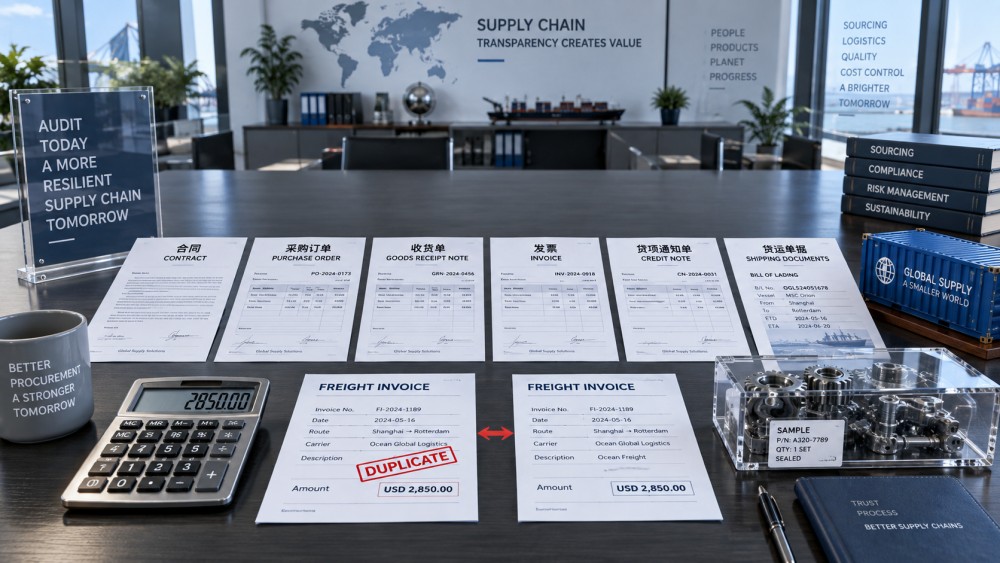
Procurement analytics identifies supplier cost leakage by comparing what was agreed, ordered, received, and paid at transaction level. The analysis becomes useful when contract terms, purchase orders, goods-receipt records, invoices, credit notes, freight documents, and supplier master data are connected rather than reviewed in separate systems. A price difference alone does not prove overcharging; it must be tested against quantity tiers, approved substitutions, currency clauses, delivery terms, quality outcomes, and the date on which each commercial condition applied.
Leakage often remains hidden because each document can appear valid in isolation. An invoice may match a purchase order that was created with an outdated price. A freight surcharge may match a carrier bill but conflict with the agreed Incoterm. A higher unit price may reflect a legitimate material-grade change, or it may be a result of a supplier using an expired quotation. Analytics exposes these relationships and directs investigation toward exceptions with enough commercial context to be resolved.
Start with a transaction trail, not a spend total
High-level spend reporting can show that a supplier's annual cost increased, but it cannot explain whether the increase came from volume, specification changes, logistics, currency, or avoidable commercial drift. A useful leakage model follows the individual purchasing event from source to settlement:
- Contract or quotation: unit price, currency, validity period, rebate schedule, minimum order quantity, tooling charge, packaging requirement, freight responsibility, and payment terms.
- Purchase order: ordered item, revision level, quantity, delivery location, requested date, buyer-entered price, and approved change reference.
- Receipt and inspection record: accepted quantity, rejected quantity, partial delivery, substitute material, dimensional or performance deviation, and return status.
- Invoice and payment data: billed quantity, unit price, tax treatment, freight line, duty line, miscellaneous charges, credit deductions, payment date, and exchange rate used.
Matching these records establishes where a discrepancy entered the process. If the contract and purchase order agree but the invoice is higher, the issue is likely invoice compliance or a post-order claim. If the invoice matches the purchase order but both exceed the contract, attention shifts to price maintenance, approval discipline, or a missing commercial amendment. This distinction matters because recovering an overpayment does not correct the control that allowed it.
Price variance needs a valid comparison basis
The most visible form of supplier cost leakage is a billed unit price above the applicable agreement. However, unit-price comparisons become unreliable when the item master treats materially different goods as equivalent. A steel plate with a different thickness tolerance, coating weight, heat-treatment requirement, or test certificate may have a legitimate price premium. The same is true for machined parts where a drawing revision changes surface finish, thread treatment, inspection scope, or packaging protection.
Analytics should therefore compare like with like. The matching key may need to include supplier part number, internal part number, engineering revision, unit of measure, currency, delivery term, production site, and contract effective date. For commodity-linked materials, the agreed index formula and timing convention are equally important. Comparing a monthly index-based price with a fixed-price order without separating the formula component can create a false exception.
A practical variance calculation separates the invoice value into components:
Breaking the value into components prevents a broad “price increase” label from masking different causes. It also avoids challenging charges that are supported by an approved change while overlooking a duplicate freight bill embedded in the same invoice.
Patterns that often reveal leakage
Repeated small variances deserve attention when they occur across many invoices or sites. A minor unit-price difference on low-value consumables may be caused by rounding, but the same difference across recurring releases can signal that a price update was not loaded into the ordering system. Analytics should group exceptions by supplier, item family, plant, purchasing group, contract, and reason code. The pattern is often more informative than the largest single invoice.
Duplicate billing is another common pattern, particularly where invoices arrive through multiple channels or where a shipment is split across several documents. Exact duplicate detection uses invoice number, amount, date, and supplier identifier. Stronger analysis also searches for near-duplicates: the same purchase order, shipment reference, quantity, and value with a slightly altered invoice number or a separately billed freight line. A duplicate is not always an error. Progress billing, deposit invoices, and final invoices can legitimately relate to the same order, but the payment schedule should show how each document is meant to be cleared.
Quantity leakage appears when billed quantity exceeds accepted quantity, when unit-of-measure conversion is wrong, or when scrap and yield terms are applied inconsistently. A supplier may bill material by kilograms while the purchase order is measured in pieces. If the conversion factor is based on nominal weight but actual finished dimensions differ, the variance may be explainable. It becomes a leakage issue when the conversion is uncontrolled, outdated, or applied selectively.
Unauthorized surcharges often hide in vague invoice descriptions such as administration, fuel adjustment, urgent handling, palletization, documentation, or minimum-load fees. Such labels should not automatically be rejected. Some are valid under a contract or confirmed service request. The analytical test is whether the charge has a defined trigger, an agreed calculation method, and evidence that the trigger occurred. A fuel surcharge tied to a published mechanism is different from an unannounced percentage added to every invoice.
Missed credits can be more difficult to identify than overbilling because the absence of a document is the issue. Analytics can compare debit notes, quality claims, return authorizations, short deliveries, service-level failures, and rebate thresholds against credit notes actually received. A rejected batch, for example, may create a supplier obligation only after disposition is confirmed. Linking quality and finance records prevents premature claims while showing where a valid credit has stalled.
Freight terms can distort the apparent supplier price
Cross-border purchases require separate treatment of product cost and landed-cost elements. A supplier's ex-works price may be lower than an alternative's delivered price, yet the first option can become more expensive after pickup, export documentation, main carriage, insurance, customs clearance, inland transport, and handling. Leakage analysis should not treat all freight as a supplier overcharge merely because it appears on an invoice.
The first question is the delivery term in force for that order. The next is whether the billed service belongs to the supplier's responsibility under that term. A charge can also be commercially valid but operationally avoidable, such as air freight caused by a late release, incomplete export paperwork, or packaging that did not meet carrier requirements. In that case, the invoice may be correct while the cost belongs in a supplier performance review rather than an invoice dispute.
Freight benchmarks are most useful when normalized by route, shipment mode, weight or volume, accessorial services, and shipment timing. Comparing container freight with urgent air shipments, or comparing a remote delivery location with a port delivery, produces noise rather than evidence. The goal is to identify unexplained deviation after these conditions are accounted for.
Separate commercial leakage from operational loss
A late delivery, a rejected component, and an invoice variance can all increase total procurement cost, but they require different evidence and remedies. Commercial leakage occurs when the payable amount conflicts with an agreement, approved order, receipt, or valid adjustment. Operational loss occurs when an otherwise valid cost results from poor execution: expedited transport, excess inspection, line stoppage, rework, premium packaging, or emergency substitution.
Keeping these categories separate improves accountability. An accounts-payable exception can be blocked or corrected through a credit note. A recurring expedited freight cost may require changes to supplier scheduling, forecast release practices, packaging specifications, or lead-time assumptions. Combining both categories in one leakage total can make reporting look larger while making corrective action less precise.
Use supplier performance data carefully
Performance data adds context to cost exceptions, but it should not be used as a shortcut for assigning blame. A supplier with low on-time delivery may appear alongside high premium-freight charges, yet the root cause could be late engineering approval, an unstable forecast, constrained inbound material, or a customs hold. The useful connection is chronological: did the service failure precede the charge, was responsibility recorded, and did the contract define a remedy?
Quality data needs the same discipline. A higher price for a replacement lot may be legitimate if the original material was accepted and a later design change required a new grade. It is more concerning when replacement charges recur after supplier-caused defects and no corresponding credit, warranty provision, or concession appears. Analytics should retain claim status and disposition, rather than treating every nonconformance report as a recoverable amount.
Build exception logic around dates and approvals
Many false positives arise because systems record several relevant dates: quotation issue date, contract start date, order release date, shipment date, receipt date, invoice date, and payment date. The applicable price may be based on the order date, the shipment date, or a monthly index period. The rule must be explicit before exceptions are calculated.
Approval records are equally important. A price above contract may be valid because of a documented engineering change, a temporary capacity premium, a revised lot size, or an approved alternate source. Without linking exceptions to approval references, the report becomes a queue of disputes that were already authorized. Conversely, repeated “manual approval” entries without a linked amendment can reveal a control gap: the commercial record is being bypassed rather than updated.
A useful workflow ranks exceptions by recoverability and recurrence. Clear duplicate invoices, billed quantities above accepted receipts, and expired-contract prices are usually easier to validate than broad benchmark gaps. Recurring smaller discrepancies should be assigned to the owner of the affected control, such as contract administration, purchase-order governance, receiving accuracy, or freight management. Resolution should record the reason, financial disposition, and corrective action so that the same anomaly does not return as a new finding in the next review cycle.
Reliable procurement analytics does not depend on finding one dramatic overcharge. Its value comes from preserving the commercial context of each transaction, distinguishing valid variation from leakage, and showing where a process permits avoidable cost to repeat.
Weekly Insights
Stay ahead with our curated technology reports delivered every Monday.
Recommended News
 Industry StandardsOct 03, 2026How to build an environmental compliance standards reporting process
 Industry StandardsOct 02, 2026What evidence should an industrial certification audit include?
 Market TrendsOct 01, 2026How technical specification trends data can reveal supplier capability gaps
 Supply ChainSep 30, 2026What are the essential steps in a procurement risk management process?