Are Supplier Certificates Enough to Prove Safety Compliance?
Supplier certificates are rarely enough, on their own, to prove safety standards compliance. A genuine document can cover a management system, a tested sample, or a defined product family while leaving the delivered goods outside its scope. Reliable evidence must connect the applicable safety requirements to the exact product, its manufacturing configuration, and the shipment being accepted.
A certificate carries more weight when its issuer is verified, its scope matches the product and destination, and its supporting records identify what was evaluated. Where a certification scheme includes factory surveillance and production controls, it provides broader assurance than a single laboratory test. Even then, changes in components, manufacturing location, or intended use can break the connection between certified design and supplied product.
Start with the claim the document actually supports
The word “certificate” appears on documents with very different evidentiary value. Before assessing authenticity, establish what the document claims to prove. A valid document can still be irrelevant to the safety question under review.
A material certificate showing chemical composition, for example, does not establish the safety of an assembled pressure-containing component. Geometry, joining quality, heat treatment, and operating conditions also affect performance. Likewise, a certified electrical component does not automatically establish the safety of the finished equipment containing it.
Define the product and destination before reviewing certificates
A useful review begins with a short product identity record: model, drawing revision, material specification, critical components, manufacturing site, intended application, and destination market. Record operating limits that affect safety, such as supply voltage, temperature, pressure, load, or exposure to moisture.
These details determine whether the supplied evidence answers the right question. Equipment evaluated for indoor use does not establish suitability for outdoor exposure. A test performed on one material grade does not automatically support a substitute with different flammability, corrosion resistance, or mechanical properties.
Destination requirements also need an explicit basis. Identify the applicable product rules and conformity assessment route using current official sources. Separate mandatory requirements from contractual standards and voluntary certification. A technically credible certificate from another market does not establish that the destination’s required assessment route, documentation, or markings have been satisfied.
The resulting acceptance criteria should be concrete enough to resolve disagreements before shipment. “Provide safety certificates” leaves too much open. A stronger requirement names the product configuration, applicable requirements, supporting reports, traceability expectations, and changes that require renewed review.
Authenticate the issuer and confirm the scope
Verify the document through the issuer’s independently located website, directory, or contact channel. A link or QR code printed on a questionable certificate can lead to a convincing imitation. Search by certificate number and compare the registered holder, product description, covered sites, status, and scope with the supplied document.
Where no public record exists, request confirmation directly from the issuer. The confirmation should address the specific document and its coverage. A general statement that an organization is a customer does not establish that a particular certificate is authentic or currently valid.
Accreditation adds another layer of verification where relevant. Confirm that the accreditation covers the type of testing or certification being claimed. A laboratory’s accreditation for one technical field does not establish competence for every test it offers. Also establish whether the applicable conformity route requires a specifically recognized or designated body; general accreditation alone does not answer that question.
Read attachments and schedules. Product families, excluded variants, approved factories, and conditions of use are often defined outside the front page. Similar model numbers are insufficient when the differing suffix identifies another power rating, enclosure, material, or safety-critical accessory.
Dates require interpretation. A laboratory report records work performed at a particular time and does not necessarily have a universal expiry date. Its continuing relevance depends on product changes, applicable requirements, and scheme rules. Conversely, an unexpired certificate can lose relevance if production moves to an uncovered site or a covered design changes.
Connect the tested sample to the delivered goods
The most consequential gap is often the missing link between the evaluated sample and routine production. Request the complete relevant test report, including sample identification, photographs, configuration details, methods, results, deviations, and referenced attachments. A cover page showing “pass” rarely provides enough information to assess coverage.
For an electrical assembly, compare the report’s component list with the production bill of materials. Changes to insulation, protective devices, connectors, enclosure resin, or power supplies can affect safety even when external dimensions remain identical. For fabricated metal products, examine whether the evaluated material grade, thickness, joining process, and post-processing match the ordered construction.
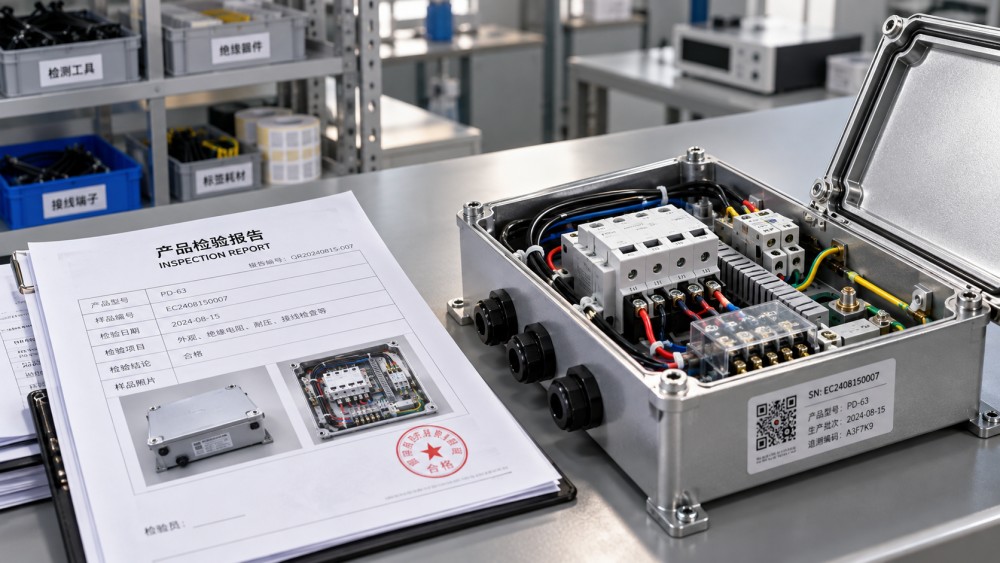
Traceability should establish a usable path from the purchase specification through production records to the shipment. The appropriate identifier varies: serial numbers for individual equipment, lot codes for components, or heat references for metal stock. The identifier must appear consistently enough to connect the physical goods with their supporting records.
Private-label arrangements deserve particular attention. A certificate in the original manufacturer’s name is not automatically invalid, but the relationship between the certified model and the supplied model needs documentation. Packaging artwork or a commercial invoice alone does not establish technical equivalence.
Read test conditions alongside the results
A passing result answers the question posed by the test. Establish whether that question matches the intended application. Examine conditioning, mounting orientation, applied load, environmental exposure, and any external protective measures used during testing.
For example, a test conducted with a specified protective enclosure does not establish equivalent performance when the product is supplied without it. A material result measured before a different coating or heat treatment also needs reassessment if that processing affects the relevant property. Record such differences as specific evidence gaps rather than rejecting every variation automatically.
Distinguish tests omitted because they were legitimately inapplicable from tests omitted because they were outside the laboratory’s instructions. A report covering selected clauses supports only that stated scope. Unresolved failures, deviations, and conditional passes require an explanation tied to the actual product configuration.
Choose verification that addresses the remaining uncertainty
Additional verification should target the gap in evidence. Repeating tests already supported by credible, applicable records adds little if the unresolved issue is unauthorized component substitution or shipment identity.
- Uncertain product identity: compare markings, construction, dimensions, and critical components against the approved technical file. Keep photographs and identifiers from the inspected goods.
- A safety-related material property without traceable supporting evidence calls for suitable testing on identified production material. Sample preparation and test methods must suit the property being assessed.
- Inconsistent production: examine process controls, routine test records, equipment calibration, and handling of nonconforming goods. A factory assessment is useful when it investigates the process responsible for the suspected variation.
- When shipment integrity is uncertain, inspection can establish lot identity, quantities, visible condition, and selected characteristics. Its value depends on access, sampling, and the characteristics actually examined.
Sampling must reflect both the likelihood of variation and the consequences of failure. Random selection across the lot provides different assurance from testing a sample specially prepared by the supplier. Record who selected samples, where they came from, and how their identity was preserved.
Pre-shipment inspection has limits. Visual examination cannot establish internal insulation performance, chemical composition, or fatigue resistance. Conversely, laboratory testing of a few samples does not establish that every unit was assembled correctly. Combine methods when they address different failure mechanisms.
Make the release decision explicit
Document the acceptance decision against the original criteria. Each material requirement should have a supporting record, a clear scope, and a connection to the supplied product. An evidence register can remain simple: requirement, document reference, covered configuration, unresolved gap, and disposition.
Release is supportable when the required conformity route is satisfied, the technical evidence covers the supplied configuration, and shipment identity is established to the agreed level. A minor administrative discrepancy can be corrected through issuer confirmation when it does not undermine product identity or technical coverage.
Hold release when a missing report, unresolved model difference, or unidentified production lot prevents a meaningful conclusion. An altered certificate or a document denied by its supposed issuer warrants rejection of that evidence and investigation of the affected goods. More paperwork from the same unverified source does not resolve the problem.
Commercial urgency does not change what the evidence proves. If acceptance criteria permit a conditional decision, specify the outstanding issue, restrictions, responsible review function, and evidence needed to close it. Conditional release must still respect applicable mandatory requirements; a contractual concession cannot replace them.
Preserve the evidence when production changes
A completed qualification review becomes less useful if the approved configuration is not controlled. Define notification and review triggers for changes to manufacturing sites, safety-critical materials, components, tooling, joining methods, firmware affecting protective functions, and subcontracted processes.
The response should match the technical effect of the change. A packaging artwork correction does not require the same review as replacing an enclosure material. A component substitution supported by its own certificate still needs assessment within the finished assembly, including ratings, installation conditions, and interaction with other protective measures.
Retain the reviewed document versions and the configuration accepted with them. When a later shipment arrives, the practical question becomes whether anything relevant has changed since approval. That connection between documented assessment and current production is what allows a supplier certificate to remain useful evidence of safety compliance.
Have questions about this sector analysis, or seeking best practices specific to your niche? Drop us a line below and let the senior consultants at GTIIN assist you.
“We respect your privacy. Your information is strictly confidential.”
Weekly Insights
Stay ahead with our curated technology reports delivered every Monday.
Recommended News
 Global SourcingNov 02, 2026How to assess database coverage in a trade intelligence platform
 Market TrendsNov 02, 2026CFLP Forecasts 17.6% Rise in China's Average Commodity Price Index for 2026
 Industry StandardsNov 01, 2026How to build an ESG compliance framework for your business
 Supply ChainNov 01, 2026China-Peru FTA Upgrade Takes Effect, Adding Global Supply Chain Chapter