Advancing Avian Welfare: Engineering Standards in Commercial Chicken Cage Systems
In the modern era of commercial agriculture, the mass production of dietary protein is under intense, unprecedented global scrutiny. Driven by evolving consumer expectations, stringent governmental regulations, and the aggressive lobbying of animal welfare organizations, the commercial egg industry is undergoing a profound structural and philosophical transformation. The historical paradigm, which prioritized absolute maximum yield per square meter above all other variables, is rapidly becoming obsolete and legally indefensible in many international markets.
Today, commercial farm directors, agricultural engineers, and global procurement officers must navigate a complex, highly regulated landscape of animal welfare standards. Transitioning a massive agricultural facility to meet these modern compliance metrics requires far more than operational adjustments; it necessitates a fundamental re-engineering of the primary containment infrastructure. This comprehensive technical report explores the rigid industry standards, spatial engineering metrics, and behavioral design requirements that dictate the fabrication and implementation of globally compliant, welfare-optimized commercial layer systems.
The Regulatory Evolution: Moving Beyond the Conventional Battery
To comprehend the current engineering standards governing avian infrastructure, one must first trace the regulatory evolution that has reshaped the industry over the past two decades. The catalyst for this transformation was the widespread implementation of regulations similar to the European Union's Council Directive 1999/74/EC, which mandated the phase-out of conventional, barren battery cages.
The primary engineering critique of the conventional barren system was its extreme spatial restriction. These systems typically allocated a mere 400 to 550 square centimeters of floor space per bird, severely inhibiting the expression of natural, highly motivated behaviors such as wing-flapping, foraging, and dust-bathing. Furthermore, the lack of dedicated nesting areas induced profound physiological stress and chronic frustration within the flock.
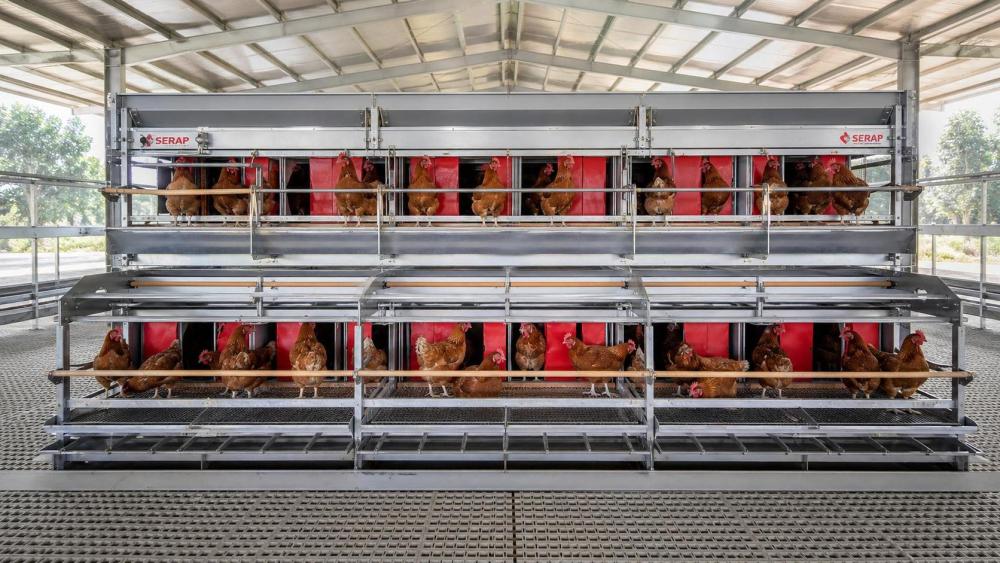
In response to these sweeping legislative changes, agricultural engineers developed the "Furnished" or "Enriched" colony system. This modernized structural paradigm represents the current baseline for compliance in heavily regulated markets. Engineering a compliant enriched system requires a meticulous integration of specific spatial allowances and behavioral amenities, ensuring that the biological needs of the flock are met without sacrificing the operational efficiencies of high-density vertical rearing.
Spatial Engineering: Calculating Minimum Welfare Dimensions
The most heavily audited metric in any commercial avian welfare standard is the spatial allowance provided to each individual bird. Modern industry standards, such as those mandated by the British Retail Consortium (BRC) or various humane certification boards, strictly define the minimum geometric dimensions of the containment module.
A fully compliant enriched system typically requires a minimum of 750 square centimeters of total usable area per bird. However, total area is insufficient; the internal architecture of the Chicken cage must be vertically engineered to allow for full postural expression. This dictates a minimum internal height clearance, often mandated to be at least 45 centimeters across the entire usable floor area, ensuring that a mature layer can stand fully erect, stretch her neck, and engage in comfort behaviors without her comb impacting the upper wire mesh ceiling.
Procurement directors evaluating new infrastructure must meticulously audit the manufacturer’s CAD blueprints to verify these geometric tolerances. Purchasing a high-density system that fails to meet these rigid spatial parameters by mere centimeters will result in immediate audit failures, rendering the eggs legally unsalable in premium retail markets and crippling the facility's Return on Investment (ROI).
Behavioral Amenities: The Engineering of Nests and Perches
Beyond basic geometric space, true welfare compliance requires the integration of specific, biologically necessary amenities designed to facilitate natural flock behaviors. The two most critical engineering challenges in an enriched system are the design of the nesting area and the structural integration of perches.
The Nesting Enclosure:A laying hen possesses an intense, instinctual motivation to seek out a secluded, darkened environment prior to oviposition (egg-laying). Denying this instinct causes severe pre-lay pacing and chronic psychological stress. Compliant systems must incorporate an enclosed nesting box within the larger colony module. Engineering this nest requires opaque or semi-opaque partitioning materials and a specialized, comfortable floor mat (often manufactured from pliable, easy-to-clean astroturf or perforated rubber) to encourage nesting behavior while ensuring the freshly laid egg can still safely roll out to the automated collection belt.
Structural Perching:In their natural environment, avian species seek elevated perches for nocturnal roosting, a behavior critical for mitigating stress and improving bone density. Welfare standards explicitly dictate the minimum linear perching space required per bird (typically 15 centimeters). Engineering these perches is highly complex; they must be structurally robust enough to support the dynamic weight of multiple birds simultaneously, positioned at a height that prevents cloacal pecking from birds below, and manufactured from a material (such as flattened oval steel or specialized textured plastic) that prevents crippling foot lesions, such as bumblefoot.
Foraging and Dust-Bathing: Integrating the Scratch Mat
A significant challenge in modernizing vertical rearing systems is facilitating the highly motivated behaviors of foraging and dust-bathing. In a traditional wire-floor environment, these behaviors are entirely thwarted.
To achieve full welfare compliance, modern enriched colony systems incorporate dedicated "scratch areas." This requires engineering a solid, non-wire section of the floor plan, typically covered by a textured mat. Advanced automated systems are designed to mechanically dispense small, precise quantities of friable material (such as specialized feed crumble or sterile wood shavings) directly onto this scratch mat on a daily basis.
This engineering integration allows the flock to engage in natural pecking, scratching, and simulated dust-bathing behaviors. The presence of this environmental enrichment drastically reduces the incidence of harmful, redirected behaviors, such as aggressive feather pecking and cannibalism, which are prevalent in chronically stressed, barren environments.
The Intersection of Welfare and Biosecurity Engineering
While upgrading infrastructure to meet welfare standards is a moral and legal imperative, facility directors must ensure that these behavioral amenities do not compromise the facility's strict biosecurity protocols.
Integrating solid scratch mats and enclosed nesting boxes fundamentally alters the airflow dynamics and waste management efficiency of the containment module. Solid surfaces can accumulate manure and harbor dangerous pathogens if not meticulously designed. Therefore, compliant systems must utilize highly engineered, perforated floor mats that allow for rapid waste drainage while still providing a comfortable substrate for the birds.
Furthermore, the materials used for perches and nest partitions must be entirely non-porous and highly resistant to the aggressive chemicals and scalding water utilized during the facility's high-pressure Clean-In-Place (CIP) sanitation turnarounds. A system that improves behavioral welfare but introduces a permanent vector for salmonella or avian influenza represents a catastrophic failure in agricultural engineering.
Conclusion
The modernization of commercial egg production is no longer defined solely by maximizing vertical density and automating logistics; it is fundamentally defined by uncompromising adherence to global animal welfare standards.
By deeply understanding the regulatory evolution from barren cages to enriched colonies, meticulously verifying spatial engineering geometries, and intelligently integrating essential behavioral amenities like nests and perches, commercial farm directors can future-proof their operations. Ultimately, procuring and implementing fully compliant avian infrastructure is not just a regulatory obligation; it is a strategic investment that maximizes flock health, secures access to premium global retail markets, and ensures the long-term ethical and financial sustainability of the enterprise.
Weekly Insights
Stay ahead with our curated technology reports delivered every Monday.
Recommended News
 Supply ChainOct 15, 2026How to choose a supply chain strategy for unpredictable demand
 Supply ChainOct 14, 2026How to assess an industrial equipment supplier's spare parts support
 Supply ChainOct 14, 2026EU Updates CSDDD Guidance on Global Supply Chain Due Diligence
 Global SourcingOct 13, 2026How to assess industrial automation suppliers for legacy integration