Raw Material Evaluation: Criteria for Approving a New Polymer Grade
A new polymer grade should be approved only when it meets the application’s critical requirements, runs within a controlled production window, and comes with sufficient evidence of lot-to-lot consistency. Matching tensile strength and melt flow rate on a supplier’s datasheet is a screening result—not proof of interchangeability.
Effective raw material evaluation connects resin properties to finished-part failure modes. The decision is not simply whether the candidate performs well in a laboratory, but whether normal variation in moisture, processing conditions, material batches, and service exposure could push the product outside its acceptable limits.
Define what approval must protect
Before requesting samples, translate the application into measurable acceptance criteria. An existing resin specification is a useful starting point, but it may omit characteristics that the incumbent material satisfies without anyone explicitly measuring them. A replacement can meet every listed property and still cause warpage, weak weld lines, poor adhesion, or premature cracking.
Separate requirements that cannot be traded off from properties that can be optimized. Regulatory suitability, electrical safety, pressure containment, and minimum structural performance are hard gates where applicable. Color, cycle time, and cosmetic quality may allow adjustment, but only within agreed product and manufacturing limits.
Set these criteria before reviewing trial results. Otherwise, a promising candidate can encourage retrospective relaxation of limits, making the final decision difficult to defend.
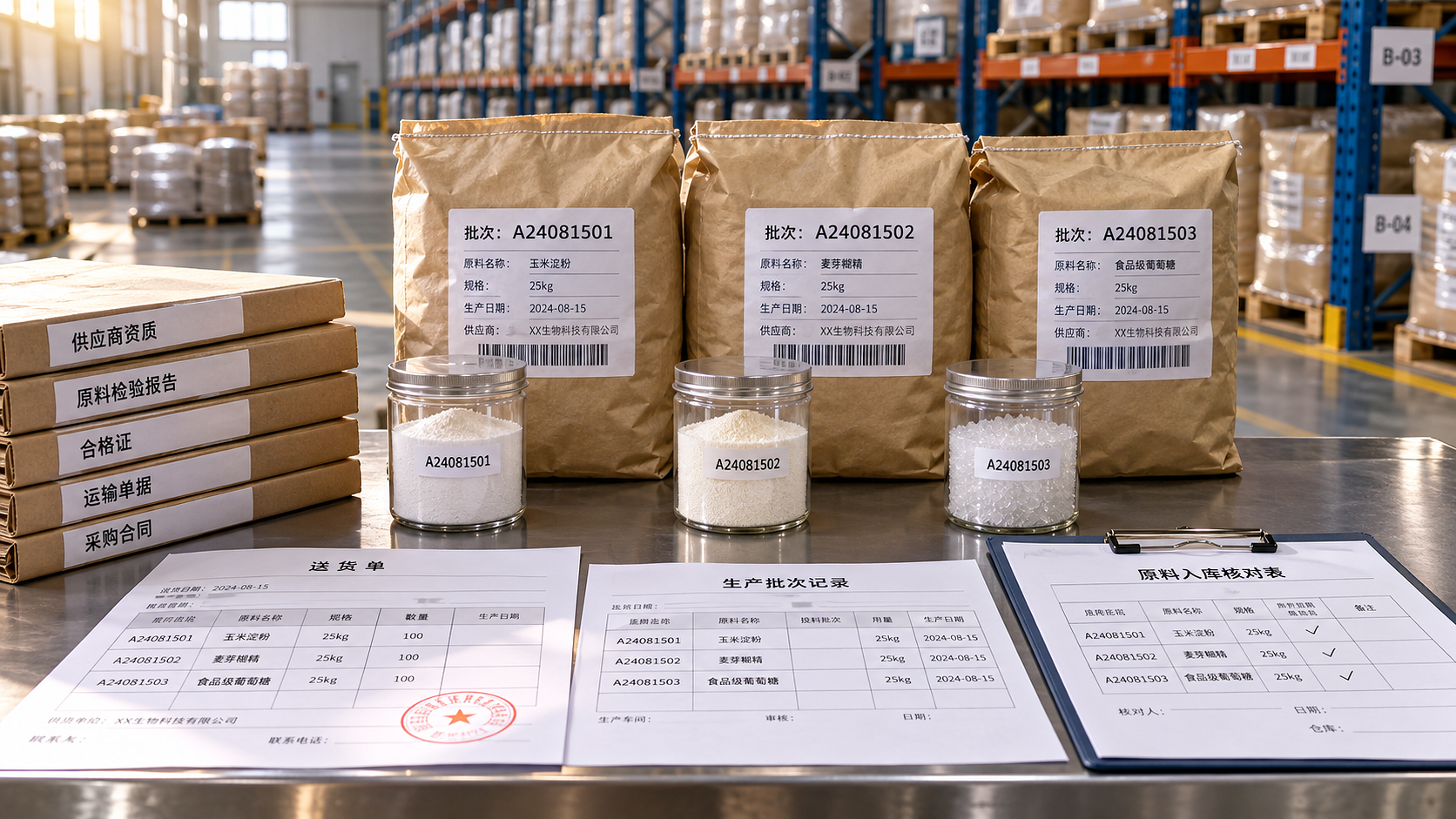
Establish material identity before comparing performance
Confirm the exact grade, manufacturing location, color designation, reinforcement level, and relevant additive package. The same polymer family can contain grades with different molecular structures, stabilizers, impact modifiers, lubricants, or flame-retardant systems. Those differences can affect processing, bonding, aging, and compliance even when headline mechanical properties look similar.
Distinguish typical datasheet values from contractual specification limits. Typical values describe expected performance under stated conditions; they do not necessarily define what the supplier guarantees for every shipment. Obtain the proposed purchase specification, certificate of analysis, test methods, and available batch data. Identify which characteristics are tested per lot and which are controlled through formulation or periodic verification.
Analytical checks should resolve specific uncertainties. Fourier-transform infrared spectroscopy can support polymer identification; differential scanning calorimetry can reveal thermal transitions and crystallization behavior; thermogravimetric analysis or ash testing can help assess inorganic content. These methods provide complementary evidence, not a complete formulation disclosure or a universal proof of equivalence.
Where proprietary formulation details cannot be disclosed, agree on the characteristics and changes that must remain controlled. An approval based on an exact additive recipe has little practical value if that recipe is neither available nor covered by an enforceable change-control arrangement.
Read flow and thermal data as processing evidence
Melt mass-flow rate or melt volume-flow rate is useful for incoming control and initial comparison, provided the temperature, load, and method match. Results obtained under different conditions are not directly comparable. ASTM D1238 and ISO 1133 methods require attention to the applicable procedure and material-specific conditions; simply quoting a standard number is insufficient.
Even equal flow values do not establish equal processing behavior. A single-point test does not describe viscosity across the shear rates encountered in gates, runners, dies, or thin sections. Molecular-weight distribution, branching, reinforcement, and additives can change filling pressure, melt elasticity, and orientation without producing an obvious difference in the reported flow index.
Use rheological characterization where the process is sensitive to these differences. For injection molding, examine filling behavior, pressure demand, and packing response. For extrusion, consider pressure stability, melt strength, drawdown, and dimensional control. The required evidence should follow the conversion process rather than a generic resin test package.
Thermal data need similar discipline. Melting temperature, glass-transition temperature, heat-deflection temperature, and thermal stability describe different behaviors. Heat-deflection temperature is not a continuous-use temperature rating, and a decomposition result from a laboratory heating program does not establish a safe production residence time.
Drying requirements belong in the qualification criteria. For hydrolysis-sensitive polymers, excessive moisture can reduce molecular weight during processing even when visible defects are absent. Verify an appropriate moisture measurement method and acceptance limit, together with drying temperature, time, conveying conditions, and protection against moisture pickup.
Test the material in the state the product will experience
Mechanical comparisons are meaningful only when specimen preparation, conditioning, geometry, test speed, and temperature are aligned. ASTM and ISO results should not be treated as interchangeable without examining their procedural differences. Dry-as-molded data can be particularly misleading when the finished product will absorb moisture in service.
Select tests around credible failure mechanisms. A housing exposed to cleaners may need environmental stress-cracking evaluation under assembly strain. A loaded component at elevated temperature needs creep evidence, not just a higher short-term tensile result. A snap-fit may depend more on strain capability, notch sensitivity, and repeated assembly performance than on stiffness.
For reinforced polymers, account for fiber orientation and processing-induced fiber-length changes. Standard specimens can present a favorable orientation that does not represent a weld line, rib junction, or heavily loaded corner in the actual component. Finished-part testing is therefore essential where geometry governs failure.
Aging should reflect the relevant combination of exposure and load. Heat, humidity, ultraviolet radiation, chemicals, and mechanical stress can interact. An accelerated test is useful only when its severity and failure mechanism remain relevant to service conditions; increasing temperature alone does not automatically create a valid lifetime prediction.
Retained performance also needs an absolute limit. A material that retains a high percentage of a weak initial property may still fail the application, while a stronger material with greater percentage loss may remain acceptable. Evaluate both the change and the resulting usable performance.
Require a production window, not a successful demonstration
Laboratory approval should lead to a controlled manufacturing trial using representative tooling, equipment, auxiliaries, and downstream operations. Include an incumbent-material baseline where practical so that differences are not confused with machine condition, ambient conditions, or measurement drift.
Record actual melt and mold temperatures, drying conditions, fill time, pressure, screw speed, back pressure, residence time, and other relevant variables—not just machine setpoints. Evaluate startup, stable running, interruptions, and restart behavior when these conditions form part of normal production.
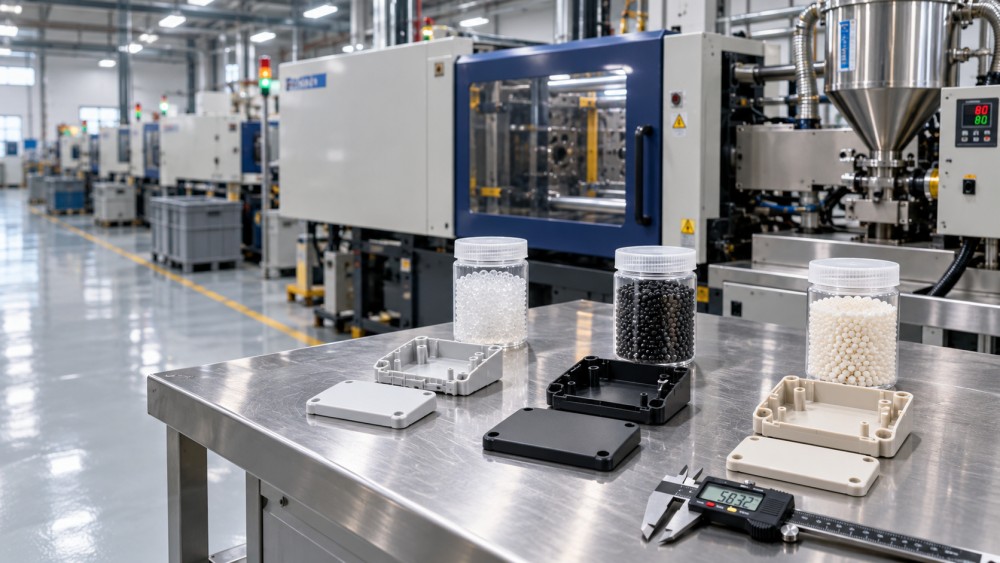
The trial should establish whether acceptable quality persists across realistic process variation. A resin that produces good parts only at one tightly controlled setting may create unacceptable scrap when moisture, ambient temperature, or equipment response changes. Deliberate process-window testing can expose this sensitivity before release.
Inspect dimensions after the conditioning period relevant to the product, not only immediately after molding. Crystallization, stress relaxation, and moisture absorption can alter dimensions later. Check weld-line integrity, surface defects, assembly forces, leak performance, and other functional characteristics that standard test bars cannot represent.
Include downstream operations such as welding, printing, painting, adhesive bonding, sterilization, or contact with process fluids where applicable. Additives that improve mold release can interfere with surface adhesion. A grade that processes successfully may still be unsuitable for the complete manufacturing route.
If regrind is permitted, qualify the allowed proportion and handling conditions rather than assuming virgin-resin results apply. Where the candidate requires modified settings, document whether the change remains inside existing process limits or creates a separate manufacturing qualification.
Demonstrate consistency beyond the sample shipment
A development sample demonstrates feasibility; it does not establish commercial consistency. Qualification material should represent the intended production source and formulation. Pilot material, specially selected lots, and routine commercial output should not be treated as equivalent without supporting evidence.
Use independent production lots to assess meaningful sources of variation. The number of lots and measurements should reflect application risk, supplier history, process maturity, and the available margin to failure. Multiple specimens from one bag help characterize within-sample variation but cannot substitute for independent lots.
Review distributions and trends rather than averages alone. A candidate with acceptable average impact strength but wide dispersion may be less dependable than one with a slightly lower average and adequate margin throughout the observed range. Investigate unusual results instead of averaging them away.
Process capability indices can support approval only when the process is sufficiently stable, the measurement system is suitable, and the dataset is adequate. A small qualification trial cannot establish long-term capability simply by producing a favorable index.
Translate critical findings into incoming controls. This may include moisture, flow behavior, filler content, contamination, color, or a functional proxy linked to performance. Testing every property on every delivery is not necessarily useful; controlling the characteristics that detect consequential variation is.
Keep compliance and supply controls tied to the approved grade
Compliance evidence must apply to the exact material designation and intended use. A generic statement for a polymer family does not establish suitability for food contact, medical use, drinking-water contact, or a regulated electrical application. Relevant restrictions can depend on additives, colorants, contact conditions, thickness, temperature, and destination market.
For example, a UL 94 classification must be checked against the recognized grade, color coverage, and tested thickness; it does not by itself establish finished-product compliance. Likewise, a safety data sheet communicates hazard information but is not proof of food-contact suitability or conformance with every applicable substance restriction.
Approval should also define the authorized manufacturing locations, traceability expectations, and notification requirements for changes to formulation, feedstock, production process, or test methods. A technically acceptable grade can become a qualification risk if material from an unassessed source is supplied under the same purchasing description.
Make the release decision specific and bounded
The approval record should identify the evidence supporting each critical requirement, unresolved limitations, and the conditions under which use is permitted. Define the exact grade and source, applicable parts or product families, processing limits, regrind allowance, incoming checks, and events that trigger reassessment.
Conditional approval is appropriate only when the remaining uncertainty is bounded—for example, restricting a material to a validated color or application while additional testing continues. It should not be used to bypass unresolved safety, regulatory, or critical functional requirements.
The defensible outcome is not necessarily an unrestricted approval. It may be approval for a defined process and application, a request for additional evidence, or rejection because the material’s operating margin is too narrow. A new polymer grade is ready for release when its demonstrated performance, variation, and supply controls fit the product’s actual limits—not merely when its datasheet resembles the incumbent’s.
Tags
Weekly Insights
Stay ahead with our curated technology reports delivered every Monday.
Recommended News
 Global SourcingOct 25, 2026How to find active suppliers in a trade intelligence platform dashboard
 Supply ChainOct 25, 2026Trade Tariffs Cause Whiplash at Port Milwaukee, Disrupting Cargo Flows
 Supply ChainOct 24, 2026How to use traceability to verify supply chain sustainability claims
 Market TrendsOct 24, 2026FedEx Report: AI Drives Asia-Pacific Chip and Digital Infrastructure Supply Chain Demand