How importers can compare landed costs when sourcing globally
The lowest supplier quote can become the more expensive purchase once freight, customs charges, and delivery costs are included. A useful comparison brings every offer to the same destination, in the same currency, for the same quantity of usable goods. It also separates predictable costs from assumptions that could change before the shipment arrives.
That is the practical starting point for global sourcing for importers. Compare what it takes to make equivalent goods available at your receiving location, then assess whether payment terms, delivery reliability, and quality risks change the decision. A cheaper factory price matters only when the savings survive that comparison.
Define the purchase before comparing the prices
Supplier quotations are often based on different assumptions. One may include export packing and delivery to a port; another may cover only collection from the factory. Even apparently identical products can have different inspection requirements, packaging dimensions, or minimum order quantities.
Set a common purchasing specification before building the cost sheet. Record the product grade, dimensions, tolerances, required documentation, packaging, order quantity, and delivery location. For machinery, specify included accessories and any installation requirements. For bulk materials, establish the measurement basis and acceptable variation in moisture, composition, or weight.
These details affect both price and logistics. A compact package may reduce freight costs, while inadequate protection can increase damage. A lower-priced material that produces more scrap may have a higher effective cost in production.
Use a consistent comparison unit: per accepted component, per usable kilogram, or per complete machine package. Keep the quoted purchase quantity visible alongside that unit cost so a large minimum order does not disappear behind an attractive price.
Bring every quotation to the same delivery point
Incoterms allocate delivery obligations, costs, and transport risk between buyer and seller. They do not make two prices directly comparable unless the named places and remaining charges are clear.
Record the Incoterm, its version, and the exact named place on each quotation. “FOB” without a named port or “DAP” without a precise delivery location leaves important assumptions unresolved.
Ask for an itemized breakdown when the quotation leaves material charges unclear. A freight-inclusive offer may exclude terminal handling or delivery appointments. Conversely, adding a separate freight estimate to a price that already includes that transport leg would overstate the cost.
For containerized shipments, FCA can better match a handover to the carrier before vessel loading than FOB. The appropriate term follows the actual delivery arrangement, rather than the wording most familiar to the supplier.
Build a landed-cost sheet that exposes missing charges
A practical calculation is:
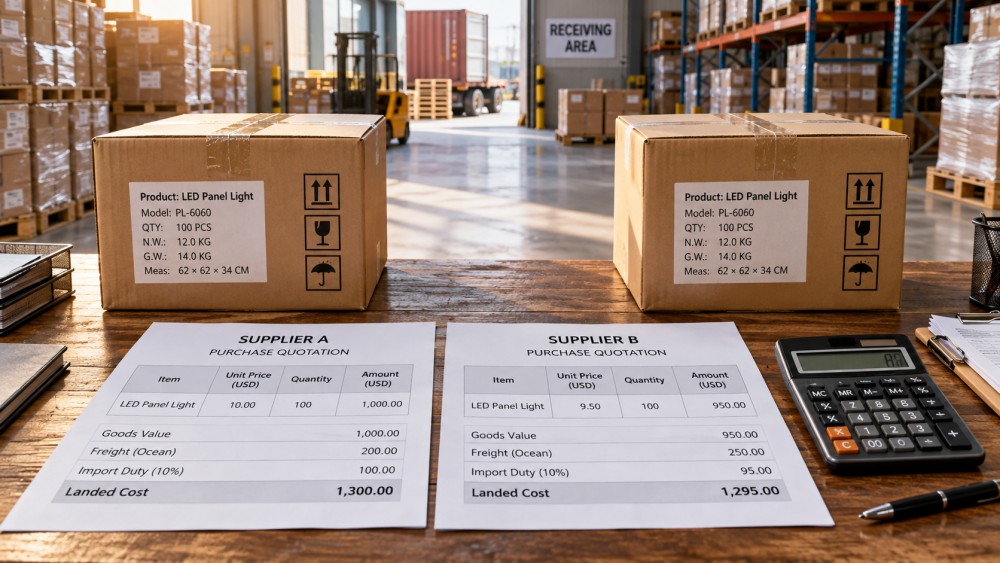
Landed cost per usable unit = total attributable acquisition and delivery costs ÷ expected usable quantity received.
Define the endpoint explicitly, such as goods delivered to your warehouse receiving area. State whether unloading, inspection, and put-away are included. Without this boundary, separate teams can produce different totals while each believes its calculation is complete.
The cost sheet should follow the shipment from supplier to destination:
- Goods and preparation: product price, export packaging, labeling, inspections, and order-specific tooling or setup charges.
- Origin movement: collection, inland transport, export documentation, clearance, and origin terminal charges where applicable.
- International transport: freight, carrier surcharges, cargo insurance, and planned transshipment costs.
- Import entry: customs duty, applicable trade measures, brokerage, entry fees, and required inspections.
- Destination delivery: terminal handling, inland transport, delivery appointments, unloading, and necessary handling equipment.
Keep a source, date, currency, and inclusion note beside each amount. Mark whether it comes from a supplier quote, freight quotation, broker calculation, or internal estimate. This makes it easier to update a single changing input without rebuilding the comparison.
Avoid overlapping charges. Forwarder quotations may bundle items that another quotation lists separately. Compare the services covered before comparing the totals, especially when one offer appears unusually inexpensive.
Calculate customs charges from the right information
Duty estimates depend on product classification, customs value, origin, and the applicable treatment in the importing market. A supplier’s suggested tariff code is a useful starting point, but classification needs to match the product’s actual characteristics and use.
Provide the customs broker with descriptions detailed enough to support the calculation: materials, function, composition, technical specifications, and photographs or drawings where useful. A vague description such as “machine parts” can hide a significant difference in duty treatment.
Country of shipment and country of origin are separate fields. Goods routed through a trading hub do not automatically acquire that country’s origin. Preferential duty treatment depends on satisfying the relevant origin rules and holding the required evidence; it should not be assumed simply because a trade agreement exists.
Customs value may also differ from the invoice total. Depending on the importing jurisdiction, freight, insurance, certain tooling contributions, royalties, or other adjustments can affect the valuation basis. Applying a duty rate to the supplier price alone can therefore produce a misleading estimate.
Keep recoverable import taxes separate from permanent costs. Where import VAT or a similar tax is recoverable, it can still create a cash requirement without becoming a lasting product cost. Show the expected recovery treatment and timing separately. Nonrecoverable taxes belong in the economic comparison.
Use shipment assumptions that match the actual order
A freight rate is meaningful only alongside its shipment details. Obtain quotations using the same cargo dimensions, gross weight, packaging, routing, shipment window, and delivery address. Include any dangerous-goods, temperature-control, or unusual handling requirements.
Small shipments can carry substantial minimum charges. A low ocean freight figure may represent only part of a less-than-container-load movement, with consolidation and destination fees added later. Air freight can depend on chargeable weight derived from both size and actual weight. Packaging changes can therefore alter transport costs without changing the product quantity.
Compare realistic shipment sizes. Dividing a full-container freight rate by a quantity you cannot order or consume creates a saving that the purchasing plan cannot deliver. Equally, repeated small shipments may cost more than a consolidated order but reduce inventory exposure.
For mixed loads, allocate shared freight and handling costs using a defensible basis. Volume or chargeable weight often reflects transport consumption better than invoice value. Apply duties by the relevant product lines rather than spreading them evenly across the shipment.
Request transit assumptions as well as prices. The comparison should cover time from goods readiness to usable receipt, including consolidation, clearance, and final delivery. Port-to-port transit alone does not describe when stock becomes available.
Show cash flow and operating risk beside landed cost
Landed cost answers what it costs to acquire and deliver the goods. It does not fully explain how a sourcing option affects working capital or operational continuity. Keep these effects visible in adjacent calculations so they influence the decision without becoming an unexplained allowance.
A supplier requiring an early deposit ties up cash before shipment. A longer replenishment cycle can increase pipeline inventory and the stock needed to maintain service. Compare payment milestones and inventory exposure using your business’s financing assumptions.
Quality should be treated with similar discipline. If there is reliable acceptance or yield history, compare cost per usable unit. Where that evidence is missing, show a quality scenario separately rather than inventing a defect rate. Include identifiable inspection, sorting, rework, or replacement costs when they apply.
Delivery uncertainty may also change the economics. A low-cost route that regularly requires emergency replenishment can erode the initial saving. Base any expected expediting allowance on relevant evidence, and distinguish it from a stress scenario.
Storage, demurrage, and detention need explicit treatment when delays could trigger them. Review the quoted free time and release arrangements, particularly where documentation or inland capacity is uncertain. These charges are easier to manage when their causes are visible before booking.
Test whether the cheapest option stays cheapest
A single total can imply more certainty than the inputs support. Build a base case from current quotations, then test changes that could realistically affect the order:
- Exchange rates: apply one comparison date and include conversion or hedging costs where relevant. A quote in your home currency may already include a supplier’s exchange-risk allowance.
- Freight: test an increase on the transport portion, keeping product costs unchanged unless there is a separate reason to adjust them.
- Order volume: compare the intended purchase with a smaller shipment or delayed consolidation.
- Lead time: assess the extra inventory or expedited replenishment needed if receipt slips.
- Duty treatment: calculate a separate case where a documented preference is unavailable or an applicable trade measure changes the cost.
Use break-even analysis to make the result actionable. Ask how much additional freight, currency movement, or delay would eliminate one supplier’s advantage. A narrow saving dependent on several favorable assumptions deserves different treatment from an advantage that remains substantial across realistic scenarios.
Trade intelligence can help identify which assumptions need attention, including freight conditions, export restrictions, and industrial supply shifts. It adds context to the cost model; shipment-specific quotations and customs calculations supply the amounts used in the purchase decision.
Make the award conditional on the assumptions that matter
The final comparison should show landed cost per usable unit, total cash required, expected availability, and the main unresolved exposures side by side. If one option has a lower landed cost but demands a much larger order, the inventory commitment should be visible at the point of approval.
Before placing the order, close the gaps that could reverse the decision: delivery scope, packing dimensions, classification, origin documentation, freight validity, and destination charges. Put agreed commercial details into the purchase order and booking instructions so the comparison survives execution.
After receipt, reconcile estimated and actual costs by category. Investigate whether a variance came from a changed rate, an omitted fee, a shipment deviation, or a quality issue. Feed those findings into the next comparison. A landed-cost model becomes more useful when each completed shipment improves the assumptions behind the next purchase.
Weekly Insights
Stay ahead with our curated technology reports delivered every Monday.
Recommended News
 Global SourcingOct 25, 2026How to find active suppliers in a trade intelligence platform dashboard
 Supply ChainOct 25, 2026Trade Tariffs Cause Whiplash at Port Milwaukee, Disrupting Cargo Flows
 Supply ChainOct 24, 2026How to use traceability to verify supply chain sustainability claims
 Market TrendsOct 24, 2026FedEx Report: AI Drives Asia-Pacific Chip and Digital Infrastructure Supply Chain Demand