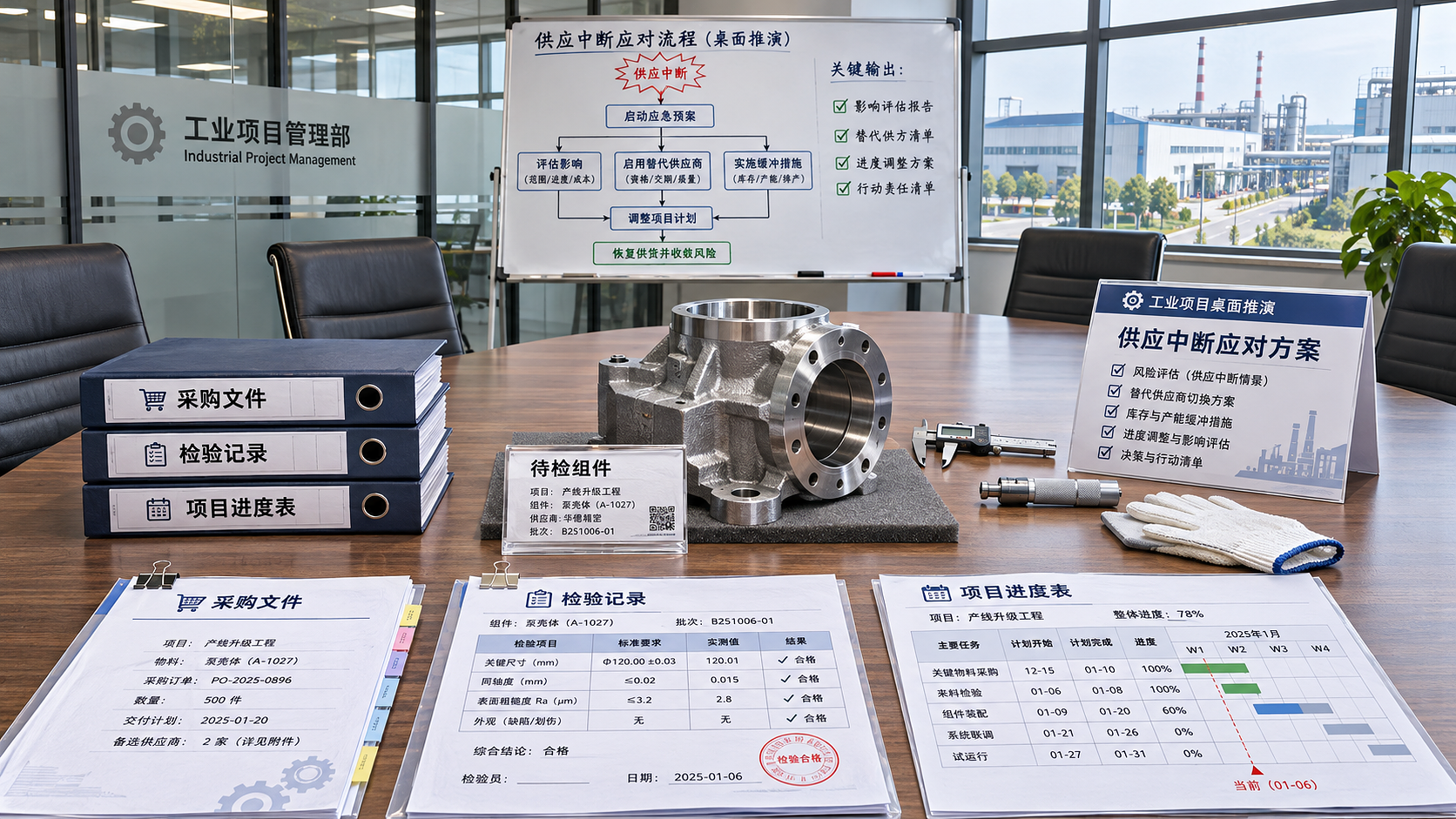
How to test a supply chain disruption management plan
A supply chain disruption management plan is only as reliable as its performance under pressure. For project managers and engineering leaders, an untested response can mean missed milestones, material shortages, and escalating costs. The practical test is not whether a plan lists the right risks, but whether people can make workable decisions with incomplete information, protect the critical path, and recover within limits the project can actually tolerate.
Testing does not have to begin with a large simulation. A focused exercise around one critical component can expose gaps in supplier capacity, engineering approval, logistics, or decision authority. The key is to make the scenario realistic enough that participants must use the plan rather than describe what they hope would happen.
Start with the project’s real exposure
Choose the material, equipment package, or service whose interruption would most affect a committed milestone. It may be a long-lead electrical component, a fabricated assembly, a specialist coating, or a shipment that must arrive before a narrow installation window. The highest-value purchase is not necessarily the highest-risk item; a relatively inexpensive part can stop commissioning if nothing else fits.
Trace the selected item from its upstream source to the point of use. Include manufacturing sites, critical sub-suppliers where known, freight routes, customs clearance, inspection points, storage, and the engineering approvals needed before installation. Note which details are confirmed and which rely on a supplier’s statement or an outdated schedule.
This is where a project team should look beyond its purchase orders. Two approved suppliers may use the same foundry, port, or specialist processor. If that dependency is not visible, a supposedly diversified sourcing strategy may fail in one event. Trade intelligence and supplier research, including resources such as the Global Trade Insights & Industry Network (GTIIN), can help frame questions about markets and routes; project-specific supplier confirmation is still necessary.
Set recovery targets before running the exercise
A test needs an agreed definition of acceptable recovery. Work backward from the milestone that matters: the date by which the item must be available, inspected, released, and ready for use. Allow for installation and testing, not just delivery to the site gate. Compare that requirement with the time needed to detect a problem, decide on a response, secure supply, and move material.
Define targets for notification, escalation, decision-making, and physical recovery. These should come from the project schedule, contractual obligations, available float, and cost tolerance—not from an arbitrary response-time benchmark. A team may be able to respond quickly but still miss the milestone if an alternative component needs lengthy qualification.
Record the baseline before the exercise starts: current inventory, open orders, confirmed production status, delivery dates, available budget, and known alternatives. If the data cannot be located promptly, that is already a useful finding. Do not quietly repair missing information midway through the test and then treat the result as normal operating performance.
Build a scenario that forces actual decisions
Use a plausible event with a clear starting point and uncertain consequences. For example, a supplier reports that a critical fabricated assembly will miss its dispatch date because a sub-supplier has stopped production. The initial notice does not confirm how much work is complete or when production will resume. Meanwhile, installation crews and a lifting contractor are scheduled against the original delivery date.
This is a hypothetical exercise, not a forecast. Its value lies in the decisions it triggers. The project manager must determine whether to wait, resequence work, use an alternate source, or seek a design change. Procurement needs evidence of available capacity; engineering needs to establish whether a substitute is technically acceptable; logistics must check whether any revised route can support the required delivery window.
Give participants the information they would realistically have at each stage. Later injects might reveal that an alternate supplier can manufacture the assembly but cannot provide a required inspection record, or that a proposed route requires different handling equipment. Avoid making every development catastrophic. A credible exercise tests how people manage uncertainty, including the possibility that the original supplier may recover sooner than expected.
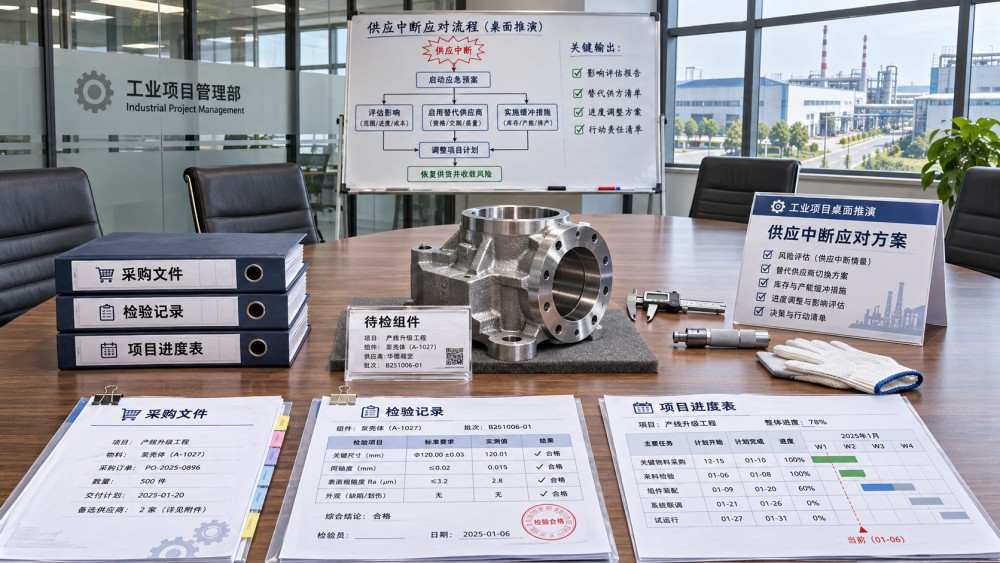
A simple timeline is often more useful than a lengthy script:
- Trigger: Who receives the first warning, and what evidence is available?
- Assessment: Which milestones, work packages, and customer commitments may be affected?
- Decision point: What options are credible, who can authorize them, and by when?
- Execution: What purchase, technical, transport, and site actions must happen in sequence?
- Recovery: What evidence shows that delivery and project work have returned to an acceptable path?
Run the test with the people who would own the response
Bring together project controls, procurement, engineering, logistics, quality, site operations, and whoever controls contingency spending. Include a supplier, freight provider, or contractor when their participation is feasible and the information-sharing terms are clear. Someone independent of the decision team should facilitate and record what happens.
A tabletop exercise is a sensible starting point: participants work through the scenario using the current plan, contact lists, schedules, and approval rules. Ask them to identify the document they would open, the person they would call, and the decision they would request. “We would expedite it” is not a response until someone can explain what is being expedited, by whom, at what cost, and with whose approval.
Follow the tabletop with targeted practical checks. Verify that critical contacts are reachable through the intended channels. Ask a supplier to confirm current lead-time assumptions and the process for allocating constrained capacity. Have logistics develop a route using the actual dimensions, handling requirements, destination, and expected documentation. These checks need not involve placing an order or moving goods; make clear to external parties when a request is an exercise.
For high-consequence projects, a controlled drill may go further: prepare a purchase-order change, trace an approval through the live workflow without issuing it, or rehearse a site resequencing decision. Protect commercial and operational systems with clear exercise boundaries. No test should accidentally trigger a real shipment, payment, or design release.
Challenge the alternatives, not just the contact list
A backup supplier on a spreadsheet is not necessarily a usable backup. Ask whether the supplier can make the required specification, has capacity during the relevant period, can obtain its own inputs, and will accept the proposed commercial terms. Check tooling, minimum order requirements, inspection access, packaging, and delivery responsibilities. Where an existing agreement is absent, distinguish a budgetary indication from a firm commitment.
Engineering approval deserves particular attention. A substitute material or component may appear equivalent by description while differing in tolerances, operating conditions, interface dimensions, traceability, or required testing. Establish who can approve a deviation and whether the customer, designer, regulator, or other project authority must also agree. Applicable requirements depend on the product, destination, and contract; they should be checked against current project documents and local rules.
The same scrutiny applies to logistics. Air freight may shorten transit but be unsuitable for oversized equipment, hazardous goods, or items with restrictive handling requirements. A different port may introduce inland transport constraints or documentation changes. Compare the complete door-to-site path, including clearance and unloading, rather than a carrier’s transit time alone.
Sometimes the better response is not a substitute. If a delay is short and the component is difficult to qualify, resequencing adjacent work may be less risky than introducing a new supplier. The exercise should expose that trade-off, including added labor, congestion at site, warranty implications, and the possibility that delayed work consumes float needed elsewhere.
Measure what happened, including the time between decisions
Capture timestamps and evidence during the exercise rather than relying on impressions afterward. Compare the observed or substantiated response with the recovery targets agreed at the start. For a tabletop, distinguish an action actually completed during the session from an estimate of how long it would take in real conditions.
- Detection and escalation: Time from the simulated warning to the right decision-makers receiving a usable assessment.
- Decision latency: Time needed to compare options and obtain technical, commercial, and financial authorization.
- Recovery feasibility: Whether the proposed source and route can meet the required site-ready date, with supporting assumptions identified.
- Schedule impact: Changes to the critical path, available float, installation sequence, and linked milestones.
- Cost exposure: Estimated premiums, idle resources, storage, rework, and potential contractual consequences, with uncertain amounts identified.
- Information quality: Missing or contradictory supplier, inventory, specification, or shipment data that delayed a decision.
Be careful with averages. A fast initial response can conceal a long wait for an engineering waiver or spending approval. Equally, a recovery date based solely on a supplier’s indicative lead time is an assumption, not a verified outcome. Mark it as such and assign someone to validate it.
Turn findings into changes that can be retested
Hold a short debrief while the sequence is fresh. Separate failures in the written plan from failures in its execution. A missing escalation threshold calls for a plan change; an outdated contact number calls for a maintenance process. A substitute that cannot meet the specification may require supplier development or a design decision, not another reminder to the procurement team.
For each corrective action, name an owner, a due date, the evidence required for closure, and a retest method. Prioritize gaps that could prevent recovery before the project’s latest acceptable date. If a solution needs budget or customer approval, record that dependency rather than treating the action as complete when a request is submitted.
Repeat a focused test after a major supplier, design, route, schedule, or organizational change. Recheck assumptions when a critical order is placed or a project enters a new delivery phase. The next exercise does not need to replay everything: it can test whether the revised approval path works, whether a backup source can provide required documentation, or whether the new route accommodates the actual equipment.
Before closing the file, ask one question: if the disruption happened tomorrow, which recovery step still depends on an unverified promise? That answer is a practical starting point for the next round of work.
Have questions about this sector analysis, or seeking best practices specific to your niche? Drop us a line below and let the senior consultants at GTIIN assist you.
“We respect your privacy. Your information is strictly confidential.”
Weekly Insights
Stay ahead with our curated technology reports delivered every Monday.
Recommended News
 Market TrendsNov 13, 2026IEA Sees Oil Surplus in Late 2026 as Gulf Exports Recover
 Supply ChainNov 13, 2026How to test a supply chain disruption management plan
 Market TrendsNov 12, 2026China and US in Close Contact on Reciprocal Tariff Reduction Framework
 Global SourcingNov 12, 2026How to check industrial automation controls for machine compatibility