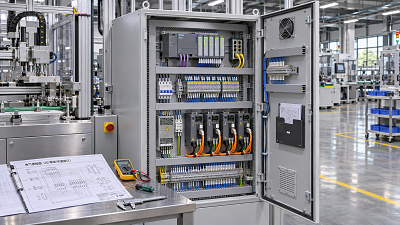
How to check industrial automation controls for machine compatibility
Selecting industrial automation systems controls without verifying machine compatibility can lead to communication failures, costly retrofits, and safety risks. A controller may meet the headline specifications yet still fail to read an encoder, exchange data with a drive, or support the required safety architecture. For technical evaluators, the task is to trace every important machine interface back to documented evidence before a purchase order is issued.
The most reliable assessment combines machine documentation, supplier data, and practical tests. It should cover normal production, startup, shutdown, faults, maintenance access, and foreseeable changes—not just whether the controller can switch an output.
Start with the machine, not the controller catalog
Define what the machine must do and what is expected to remain in service. For a retrofit, collect electrical schematics, I/O lists, network diagrams, drive parameters, safety circuit drawings, and the current control program where available. Record actual component part numbers and firmware versions; the name of a product family alone is rarely enough to establish compatibility.
For a new installation, ask the machine builder for an interface control document and a sequence of operations. Identify cycle time, positioning accuracy, required production modes, environmental conditions, and upstream and downstream connections. Where drawings are incomplete, a physical inspection can reveal undocumented relays, added sensors, or field wiring that no longer matches the original design.
Create an interface register that pairs each machine requirement with a proposed control component and evidence of support. Mark every item as verified, conditional, or unresolved. A conditional item might work only with a particular firmware release or an additional interface module. An unresolved item should have an owner and a test date, rather than being absorbed into a general integration allowance.
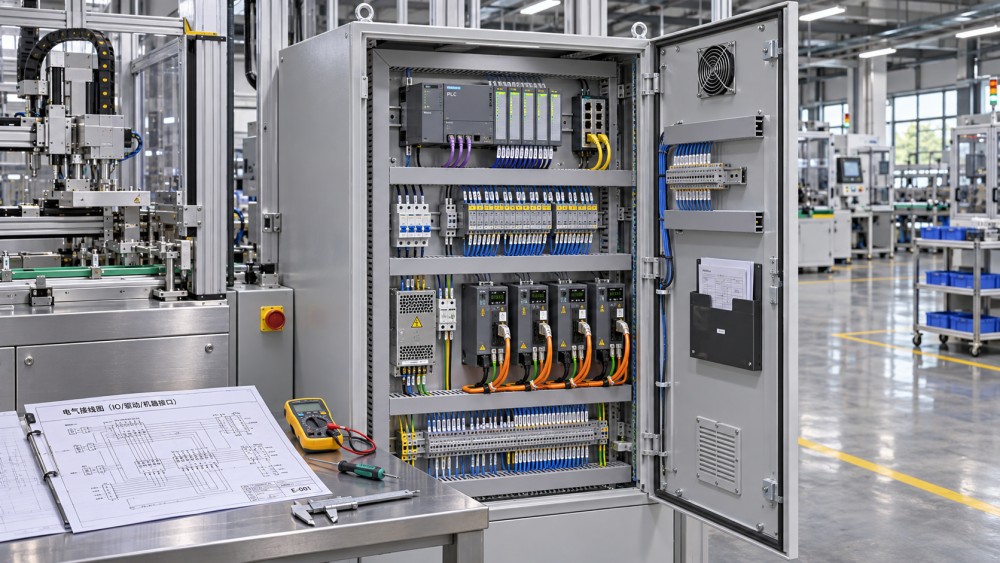
Check electrical and I/O compatibility point by point
Voltage matching is the beginning of an electrical review, not the end. Compare the machine supply with the controller and panel requirements, including voltage range, frequency, available current, protective devices, grounding arrangements, and any control transformer capacity. For imported equipment, confirm that the intended installation supply and local electrical requirements are addressed in the design.
Then inspect each field interface. A 24 V DC sensor is not automatically suitable for every 24 V input: input thresholds, current requirements, wiring arrangements, and sensor output type still matter. Verify whether digital devices use sourcing or sinking connections and whether outputs can handle the load type and inrush current. Solenoids, contactors, and lamps may require interposing relays or suppression devices.
Analog signals need the same attention. Confirm signal type and range, resolution, input impedance or load limits, isolation, shielding, and scaling. A 4–20 mA transmitter and a 0–10 V input are not interchangeable without an appropriate interface. Also check how the controller detects a broken wire or an out-of-range signal; a plausible but incorrect reading can be harder to diagnose than a clear fault.
For motion applications, verify encoder signal format, supply, channel count, maximum frequency, cable length, and the compatibility of any feedback interface. Count available I/O by type and location, not just as a total. Allow documented capacity for known expansion, but avoid assuming that an empty rack slot or network node automatically provides the required power or performance.
Test network compatibility beyond the protocol name
Two devices advertising the same industrial Ethernet or fieldbus protocol may still require specific device profiles, configuration files, firmware versions, or controller functions to work together. Ask the supplier to identify the exact interoperability combination: controller model and firmware, network module, drive or device revision, and configuration software version.
Consider the difference between exchanging status information and controlling a time-critical process. A gateway may translate data between protocols, but it can add latency, restrict diagnostics, or fail to pass every drive function. If a gateway is proposed, identify which signals cross it, how communication faults are handled, and whether its performance has been demonstrated for the application.
For motion coordination, ask about synchronization methods and timing across the complete architecture, including switches and remote I/O. A published minimum network update time is not proof that the full machine will meet its cycle requirement. Validate timing under representative traffic and operating conditions.
Assess software, motion, and the real-time workload
Controller memory and processor speed are useful screening figures, but they do not replace an application review. List the tasks the control system must execute: sequencing, motion control, high-speed counting, data logging, recipes, vision triggers, and communications with supervisory systems. Establish which tasks have hard timing requirements and which can tolerate delay.
Check whether the programming environment supports the required functions and whether the engineering team can maintain the application. Review software licensing, programming access, backup and restore procedures, version control, and the availability of diagnostic tools. For an existing program, confirm whether source files and relevant comments are available; a runtime backup may not be sufficient for modification.
Drive compatibility deserves a separate review. The ability to send a speed reference does not necessarily mean that the controller supports homing, coordinated motion, fault reset, parameter access, or the feedback needed for the machine sequence. Ask for a function-by-function mapping, particularly when retaining existing drives or replacing a controller from another supplier.
If production data must reach a manufacturing execution system or another plant application, agree on the interface, data model, update frequency, and responsibilities for configuration. Also verify user authentication, remote access controls, patching responsibilities, and network segmentation with the site’s cybersecurity team. Compatibility includes the ability to operate within the plant’s security rules.
Treat safety as a separate engineering decision
A standard controller that can read an emergency-stop contact does not, by itself, establish a suitable safety function. Begin with the machine risk assessment and define each required safety function, such as emergency stopping, guard interlocking, safe speed monitoring, or prevention of unexpected startup. Determine the required performance level or safety integrity level using the applicable assessment method.
Then evaluate the complete safety-related control system: sensing devices, logic, outputs, actuators, wiring, fault response, and validation. Depending on the machine and jurisdiction, relevant standards may include ISO 12100 for risk assessment, ISO 13849-1 and ISO 13849-2 for safety-related control systems and their validation, or IEC 62061 for functional safety of machinery control systems. Electrical equipment requirements may also involve IEC 60204-1. Confirm the current applicable editions and local legal obligations rather than assuming a component certificate covers the whole machine.
Ask suppliers for the safety documentation and parameters needed for the design, including supported configurations and diagnostic assumptions. Qualified personnel should assess the architecture and validate the completed safety functions. Never bypass guards or safety devices simply to demonstrate that a new controller communicates with existing equipment.
Compare candidates with a compatibility matrix
Once the interfaces are mapped, use the same criteria for each control option. Separate mandatory requirements from preferences: a system that cannot meet a required safety function or control deadline should not be rescued by a favorable score for convenience. The matrix below illustrates how to record decisions without treating supplier claims as test results.
Include the cost and schedule consequences of conditional compatibility. A lower-cost controller may require new I/O, a protocol gateway, panel modifications, software licenses, and additional commissioning. Conversely, retaining an older device may reduce immediate changes while introducing a spare-parts or support risk. Compare the complete scope, not just the controller price.
Turn open questions into acceptance tests
Before procurement is finalized, agree on who will resolve each open item and what constitutes a pass. A factory acceptance test can exercise representative hardware and software before shipment; a site acceptance test checks the installed system with actual wiring, plant networks, and machine loads. Where a full machine test is impractical, a bench test of the most uncertain interfaces can still expose problems early.
Include normal sequences, maximum expected operating conditions, power loss and recovery, communication interruption, device replacement, alarm handling, and backup restoration. Test safety functions according to the approved validation plan. Record test conditions and results, including firmware and configuration versions, because a successful demonstration is only meaningful for the configuration tested.
For cross-border sourcing, clarify documentation language, electrical assumptions, local support, software licensing territory, and responsibility for compliance at the destination. Obtain drawings and configuration files as deliverables, not informal promises. The final selection should leave the operations team with a maintainable machine and a clear record of what has—and has not—been verified.
A compatible control system is therefore more than a collection of matching components. It is an evidenced fit between machine functions, electrical interfaces, communications, safety requirements, and the people who must support the installation. Closing those gaps before commitment gives technical evaluators a stronger basis for both procurement and commissioning.
Have questions about this sector analysis, or seeking best practices specific to your niche? Drop us a line below and let the senior consultants at GTIIN assist you.
“We respect your privacy. Your information is strictly confidential.”
Weekly Insights
Stay ahead with our curated technology reports delivered every Monday.
Recommended News
 Global SourcingNov 12, 2026How to check industrial automation controls for machine compatibility
 Supply ChainNov 11, 2026Thailand and US Reach Tariff Agreement in Principle
 Market TrendsNov 11, 2026What does the bulk commodity logistics forecast mean for freight rates?
 Supply ChainNov 10, 2026China Extends Pause on 24% Additional Tariff on US Goods by Two Months