How metallurgical processing in steel affects weldability
Weldability is not an inherent property determined by a steel grade name alone. It is the result of how the steel was made, refined, cast, rolled, cooled, and heat treated before it reaches fabrication. Two plates carrying the same nominal grade designation can behave differently under the same welding procedure if their chemical control, delivery condition, thickness, and through-thickness properties are not equivalent.
The practical question is not simply whether a steel “can be welded.” Most structural and engineering steels can be joined by welding under an appropriate procedure. The relevant question is whether the available material condition can be welded consistently, without unacceptable hydrogen cracking, excessive heat-affected-zone hardness, lamellar tearing, loss of toughness, or property mismatch after welding. Metallurgical processing in steel governs each of these risks.
Weldability begins with composition, but composition is only the starting point
Carbon is the strongest single chemical driver of hardenability in ordinary carbon and low-alloy steels. As carbon rises, the steel is more likely to form hard transformation products, including martensite or martensite-austenite constituents, in rapidly cooled portions of the heat-affected zone (HAZ). High HAZ hardness increases the risk of hydrogen-assisted cold cracking, especially in thick sections, highly restrained joints, or low-temperature fabrication conditions.
Steelmakers therefore control not only carbon, but also alloying elements that influence hardenability and weld metal compatibility. Manganese, chromium, molybdenum, vanadium, nickel, copper, and boron may each affect transformation behavior. Their effects are not identical: nickel can improve low-temperature toughness while contributing less to hardenability than chromium or molybdenum at comparable levels, whereas small boron additions can substantially increase hardenability if not carefully managed.
For preliminary weldability screening, carbon equivalent remains useful. The International Institute of Welding (IIW) expression is widely applied to many carbon-manganese and low-alloy steels:
CEV = C + Mn/6 + (Cr + Mo + V)/5 + (Ni + Cu)/15
For lower-carbon modern steels, the Pcm formula may provide a more sensitive indication of cold-cracking behavior:
Pcm = C + Si/30 + (Mn + Cu + Cr)/20 + Ni/60 + Mo/15 + V/10 + 5B
These values are screening tools, not universal acceptance criteria. A carbon equivalent does not independently determine preheat temperature or prove that a welding procedure is safe. Joint restraint, plate thickness, diffusible hydrogen level, heat input, ambient temperature, consumable selection, and cooling rate all matter. Nevertheless, when comparing alternative supply sources, CEV or Pcm values from actual heat analyses are far more informative than a generic statement that a grade is “weldable.”
Refining practices shape the steel’s response to welding
Primary steelmaking establishes broad chemistry, but secondary metallurgy often decides whether the chemistry is sufficiently clean and stable for demanding fabrication. Ladle refining, vacuum degassing, inclusion modification, and controlled alloy trimming influence the residual elements and non-metallic inclusions that remain in the final product.
Hydrogen, sulfur, phosphorus, oxygen, and nitrogen deserve particular attention. Hydrogen introduced during steelmaking is normally reduced before casting, but hydrogen cracking in fabrication is more directly linked to moisture, contaminants, and welding consumables. Even so, clean steelmaking reduces background variability and supports more stable properties.
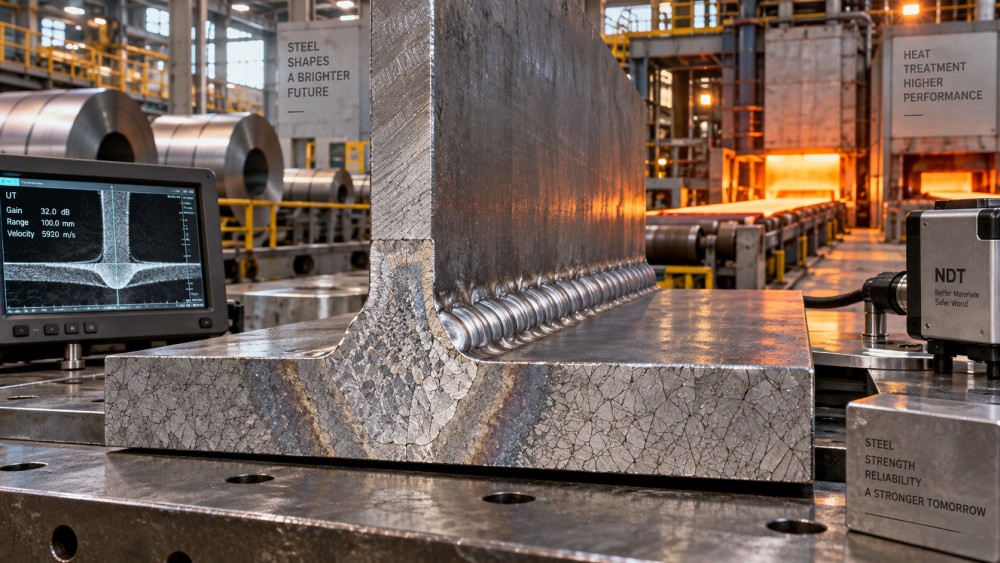
Sulfur control is especially relevant where welded joints impose through-thickness strain. Sulfide inclusions can become elongated during rolling, creating planes of weakness parallel to the plate surface. When a welded attachment or T-joint causes shrinkage stresses through the plate thickness, these inclusions can promote lamellar tearing. Low sulfur content helps, but sulfur level alone is not a complete indicator. Inclusion shape, distribution, calcium treatment, plate reduction ratio, and verified through-thickness ductility are also important.
Phosphorus can increase strength and atmospheric corrosion resistance in certain designed compositions, but excessive or poorly controlled phosphorus can reduce toughness and contribute to segregation. Nitrogen may strengthen some steels, yet uncontrolled nitrogen can affect strain aging and toughness. The metallurgical objective is not to minimize every element indiscriminately; it is to control each element within a composition and processing route designed for the intended property balance.
Deoxidation practice also affects weldability. Fully killed steel, typically deoxidized using aluminum, silicon, or other agents, has more predictable internal soundness than rimmed or semi-killed products. However, aluminum-killed steel is not automatically superior in every welding application. The wider question is whether the steel has controlled cleanliness, fine grain practice, acceptable segregation behavior, and documented mechanical properties in its delivered condition.
Continuous casting and segregation can create local welding risks
Nominal chemistry on a mill certificate represents a heat or ladle analysis, not necessarily the exact composition at every location in a plate. During solidification, alloying elements and impurities can concentrate in interdendritic regions. This microsegregation may persist to some degree after rolling and can be more pronounced near centerline regions in thick products.
Centerline segregation matters because the local hardenability of the HAZ may exceed what the nominal carbon equivalent suggests. A plate can therefore meet its specified chemistry while containing localized regions that respond differently to weld thermal cycles. In heavy plate applications, centerline soundness, sulfur control, reduction practice, and ultrasonic testing requirements may be relevant to the welding risk assessment.
For joints subject to high restraint or cyclic service, it is also important to distinguish surface quality from internal quality. Surface inspection can identify laminations, seams, and rolling defects, but it does not establish through-thickness ductility or reveal all centerline conditions. Where design loading creates Z-direction strain, specifications may need to call for through-thickness properties, often expressed through Z-quality requirements in applicable product standards.
Rolling and controlled cooling determine the starting microstructure
Hot rolling transforms cast steel into plate, strip, bar, or section, while also changing grain size, inclusion morphology, texture, and the distribution of segregated regions. Rolling temperature and reduction schedule affect recrystallization and grain refinement. Controlled rolling and thermomechanically controlled processing (TMCP) can produce fine-grained steels with relatively low carbon equivalent and favorable strength-toughness combinations.
This is one reason modern high-strength structural steels cannot be evaluated by yield strength alone. A conventional normalized steel and a TMCP steel may have similar minimum yield strength but reach it through different metallurgical routes. The TMCP product may achieve strength from fine grain size and precipitation control rather than from higher carbon or alloy content. That can improve weldability, particularly by limiting HAZ hardening. Yet its performance still depends on compliance with the recommended welding heat-input range.
Excessively high heat input can coarsen grains in the HAZ and reduce toughness. Extremely low heat input can increase cooling rate and create a hard HAZ. The usable welding window is therefore linked to the processing route. A fabrication procedure qualified on one delivery condition should not be assumed valid for another merely because the grade designation appears similar.
Rolling direction is also consequential. Longitudinal and transverse tensile properties are commonly specified, but through-thickness behavior is different. Welded details that pull perpendicular to the plate surface can expose weakness associated with elongated inclusions. In such cases, selecting a plate with suitable Z-direction reduction-of-area properties is more meaningful than relying on ordinary tensile results.
Heat treatment changes both strength and the margin for welding
Normalizing, quenching and tempering (Q&T), stress relieving, annealing, and accelerated cooling produce different microstructures and different responses to a weld thermal cycle. Their effects cannot be reduced to a simple rule that softer steel is more weldable or that stronger steel is more difficult to weld.
Normalized steels generally have a relatively uniform ferrite-pearlite or fine-grained microstructure and are often straightforward to weld within their specified composition range. Q&T steels obtain high strength from a carefully developed tempered martensitic or bainitic structure. Their weldability can be good, but the welding thermal cycle may locally soften the tempered region adjacent to the HAZ, alter toughness, or create a hard coarse-grained HAZ depending on chemistry and cooling rate.
Stress relief after welding requires separate evaluation. Post-weld heat treatment can reduce residual stresses and temper hard HAZ regions, but it can also reduce strength in some high-strength steels or change the properties of weld consumables. The material manufacturer’s limits on post-weld heat treatment, combined with the governing fabrication code, should take precedence over generic assumptions.
A further distinction is between mill heat treatment and thermal cutting or forming performed by the fabricator. Flame cutting can produce a hardened edge on susceptible steels. If a weld is placed near an unmachined thermally cut edge, the local condition may differ materially from the parent plate condition represented by the certificate.
The heat-affected zone is where processing history becomes visible
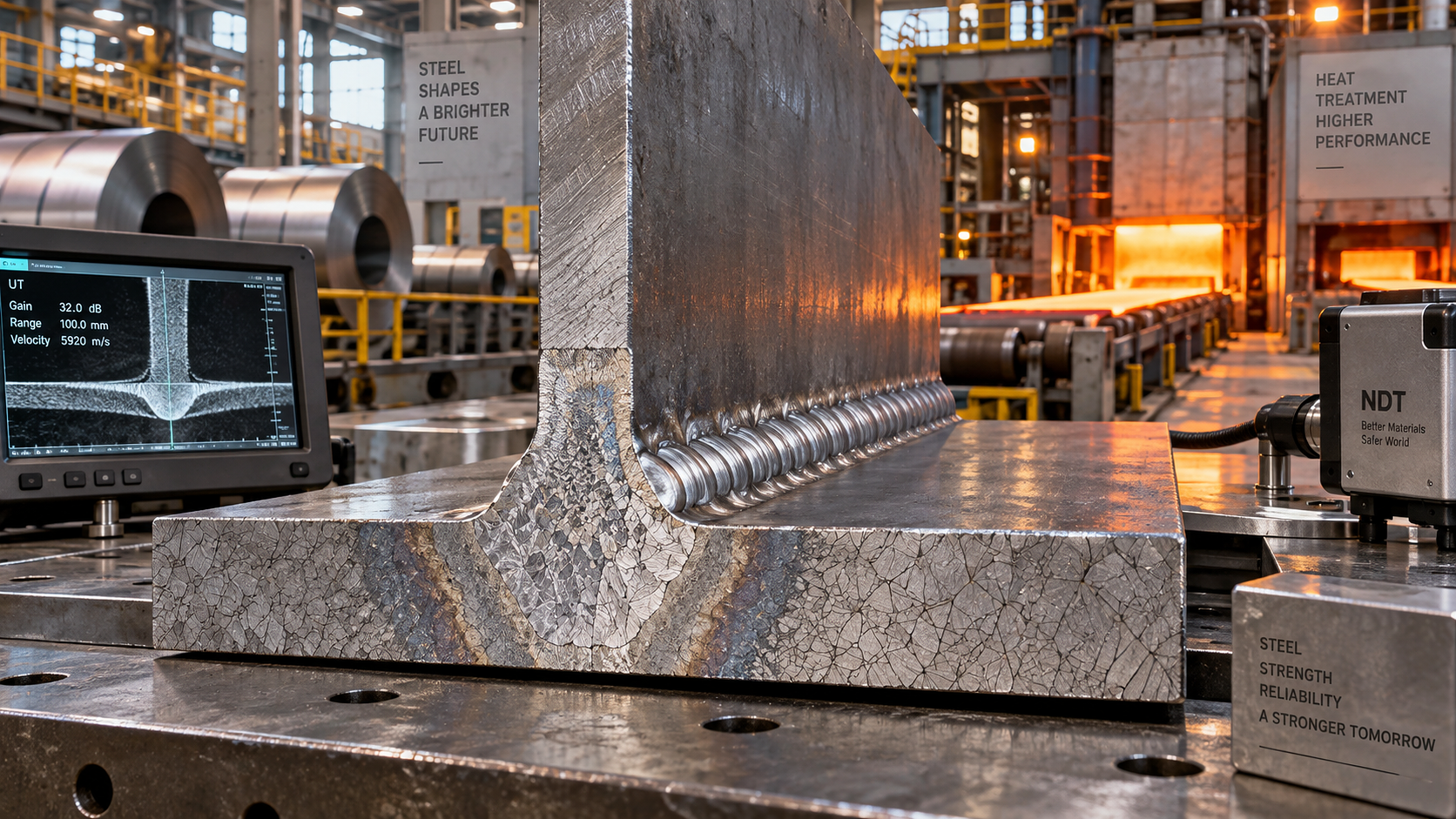
The weld metal is deposited during fabrication, but the parent steel’s metallurgical history is most directly tested in the HAZ. This zone does not melt completely; instead, it experiences a steep temperature gradient and rapid heating-cooling cycle. Different HAZ subzones can form coarse grains, fine grains, partially transformed structures, or tempered regions within a short distance of the fusion line.
Cooling rate is central. It is affected by plate thickness, joint geometry, preheat, interpass temperature, heat input, ambient conditions, and heat dissipation into the surrounding steel. A procedure that performs well on thin plate may create an unacceptably hard HAZ in thicker material because the thicker plate removes heat more rapidly. Conversely, excessive heat input in a thick, toughness-critical joint may reduce HAZ toughness through grain coarsening.
Hydrogen-assisted cracking requires a combination of susceptible microstructure, diffusible hydrogen, tensile stress or restraint, and sufficiently low temperature for cracking to develop. Removing one contributor reduces risk. This is why welding controls are interconnected: low-hydrogen consumables, dry storage, suitable preheat, controlled interpass temperature, joint fit-up, and sensible weld sequencing can all be as important as nominal steel chemistry.
Hardness surveys are commonly used to assess whether a qualified procedure is producing excessive local hardening. The applicable acceptance limits depend on the material, service condition, and governing code or specification. A hardness number should not be interpreted in isolation: its location, test method, load, microstructure, and relation to crack susceptibility matter.
Certification review should focus on delivered condition, not grade labels
Technical evaluation is stronger when it links the purchase specification to welding procedure qualification. The material test certificate should identify the heat or cast, product dimensions, delivery condition, chemical analysis, and mechanical test results. Under EN 10204, a 3.1 inspection certificate provides manufacturer-declared test results validated by an authorized inspection representative independent of the manufacturing department. The certificate type alone does not establish weldability, but traceable heat-level data are necessary for meaningful review.
For fabrication governed by recognized welding standards, material grouping may also be relevant. ISO/TR 15608 provides a grouping system for metallic materials used with welding procedure qualification, while ISO 15614 sets requirements for welding procedure tests in many applications. In structural work, AWS D1.1 and EN 1011-2 are frequently referenced, but applicability depends on the project jurisdiction, material standard, service environment, and contract requirements. A code reference should never substitute for checking the exact grade, thickness range, and delivery condition permitted by that code or procedure qualification record.
Several certificate details deserve closer attention than they often receive: maximum permitted versus actual carbon equivalent; ladle analysis versus product analysis; impact-test temperature and orientation; plate thickness represented by the tests; sulfur level; heat treatment or TMCP designation; ultrasonic examination requirements; and any specified through-thickness properties. For high-integrity work, these details often explain more about fabrication risk than the grade name printed on a purchase order.
Common evaluation errors
One recurring error is to compare only minimum yield strength and tensile strength. This overlooks the different chemistry and processing routes that can lead to the same mechanical values. Another is to use a maximum carbon equivalent from a product standard as though every delivered heat has that value. Actual heat chemistry may be lower, but it must be verified rather than assumed.
It is equally risky to treat low carbon equivalent as a blanket approval for welding. Low CEV reduces one source of hardenability risk; it does not resolve poor joint design, high restraint, wet consumables, unsuitable heat input, or lamellar tearing susceptibility. A low-carbon plate can still require demanding controls in a heavy, restrained, or fatigue-critical fabrication.
The most reliable assessment treats metallurgical processing in steel as part of the welding procedure envelope. Steelmaking chemistry establishes hardenability and cleanliness; casting and rolling influence segregation and directional properties; thermomechanical processing or heat treatment establishes the base microstructure; and the welding cycle then determines whether that microstructure remains acceptable around the joint. When those links are reviewed together, weldability becomes a verifiable engineering condition rather than a broad claim attached to a steel grade.
Weekly Insights
Stay ahead with our curated technology reports delivered every Monday.
Recommended News
 Industry StandardsOct 11, 2026How metallurgical processing in steel affects weldability
 Supply ChainOct 10, 2026How an industrial relocation strategy assessment reduces supply chain risk
 Global SourcingOct 09, 2026What to look for in a customs compliance management system
 Market TrendsOct 08, 2026What the global manufacturing outlook means for exporters' order planning