Using MOQ Pricing Benchmark Data to Avoid Costly Supplier Quotes
Using MOQ pricing benchmark data before a quote gets approved
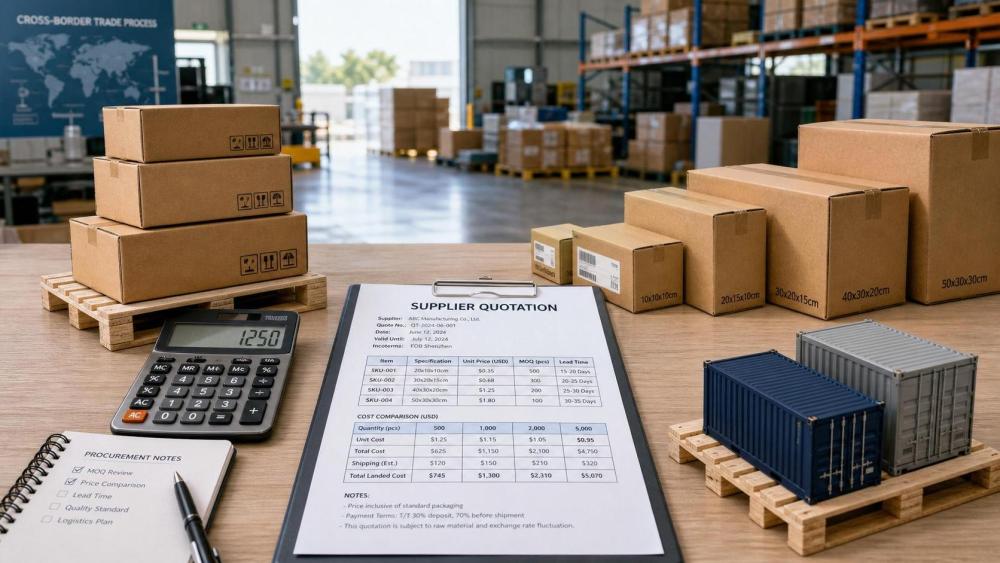
A supplier quote is rarely just a purchasing detail. It often reveals pricing discipline, sourcing risk, and how much uncertainty is already built into the budget.
That is why MOQ pricing benchmark data matters. It gives a reference point before approvals turn into committed spend, landed inventory, and avoidable variance.
In cross-border trade, minimum order quantity affects far more than unit price. It changes freight efficiency, working capital exposure, and the room available for negotiation.
A quote that looks acceptable at first glance may still be structurally weak. The MOQ may be inflated, the price curve may be inconsistent, or the assumptions may not match market conditions.
GTIIN tracks industrial sourcing signals across sectors, regions, logistics lanes, and compliance environments. That wider view helps benchmark data become a decision tool, not just a spreadsheet reference.
The practical question is simple: how can MOQ pricing benchmark data help prevent costly supplier quotes? The answer becomes clearer when the quote is tested from several angles.
What does MOQ pricing benchmark actually tell you?
At a basic level, MOQ pricing benchmark data shows how unit pricing behaves at different order thresholds for comparable products, suppliers, and sourcing regions.
But useful benchmark data goes beyond unit cost. It also reflects packaging logic, production batching, raw material swings, freight density, and normal commercial discounts.
This matters because MOQ is often used in two very different ways. Sometimes it reflects genuine factory economics. Other times it acts as a margin shield.
When benchmark ranges are available, it becomes easier to separate operational necessity from commercial padding. That distinction is especially important in industrial categories with volatile input costs.
In practical use, a strong MOQ pricing benchmark should help answer four questions:
- Is the quoted MOQ normal for this product type?
- Does the unit price drop logically as volume increases?
- Are freight and packaging assumptions aligned with the order size?
- Does the supplier’s structure fit current regional market conditions?
Without that context, approvals rely too heavily on quote presentation. With it, pricing discussions become evidence-based and easier to defend internally.
When does a supplier quote start to look risky?
Not every high quote is unreasonable. The issue is whether the quote fits a believable cost structure for the MOQ being requested.
A risky quote usually shows tension between volume, price, and explanation. The supplier may offer a large MOQ, yet provide only a minor unit-price improvement.
Another warning sign appears when the MOQ is justified by setup cost, but competing benchmark data suggests the same category is commonly produced in smaller runs.
The table below helps turn those warning signs into a faster review framework.
This is where quote review becomes more disciplined. The aim is not to reject high prices automatically, but to challenge weak pricing logic early.
How do you judge whether the benchmark is strong enough to trust?
A benchmark is only as good as its context. A broad average without product detail can mislead just as easily as a polished supplier quote.
The more useful approach is to compare quotes against layered benchmark inputs. Product category alone is not enough.
In actual sourcing work, the most reliable MOQ pricing benchmark usually includes these filters:
- Material grade, tolerance, and finish requirements
- Manufacturing method and tooling complexity
- Exporting country, trade lane, and shipping mode
- Order frequency, not just one-time volume
- Compliance costs, testing, and packaging standards
GTIIN’s value in this area comes from connecting micro-level cost drivers with broader market signals. That includes freight cycles, customs latency, industrial standards, and regional supply shifts.
So the benchmark does not sit in isolation. It is interpreted through sourcing conditions that often explain why two similar quotes diverge.
If the data source cannot explain those differences, treat the benchmark as directional, not approval-grade.
Can MOQ pricing benchmark data improve negotiations without damaging supplier relationships?
Yes, when used carefully. Good benchmark data should sharpen the discussion, not turn it into a confrontation over who is “right.”
Suppliers are more responsive when the challenge is specific. Instead of saying the quote is too high, point to the exact part that appears out of range.
For example, the unit cost may be acceptable, but the MOQ may still create unnecessary inventory exposure. That opens room to ask for mixed-size production, staged releases, or revised packaging.
A useful negotiation sequence often looks like this:
- Confirm whether the quoted MOQ is driven by tooling, material, or line setup.
- Compare the offered price curve with benchmark volume breaks.
- Separate ex-works price from freight, compliance, and packaging assumptions.
- Ask which part can change if order cadence improves.
- Request a revised structure, not just a headline discount.
This tends to produce better outcomes than pressing only for a lower number. It also creates a clearer record for approval review later.
Where do teams usually misread MOQ benchmark data?
One common mistake is treating all benchmarks as current. In volatile categories, even a recent benchmark can become stale after freight spikes or raw material moves.
Another mistake is comparing unlike orders. A benchmark for standard export packing should not be used against a quote with custom labeling, traceability, or special compliance testing.
There is also a tendency to focus only on unit cost. That can hide the bigger issue, which is cash tied up in an oversized MOQ.
More careful reviews usually check three layers at once:
- Commercial reasonableness: does the quote fit the benchmark range?
- Operational fit: can the quantity be absorbed without excess inventory?
- Strategic timing: does the quote reflect current market direction?
This is especially relevant across multiple industrial sectors. Metals, machinery parts, packaging materials, electronics components, and agricultural inputs each behave differently under MOQ pressure.
That is why a benchmark framework tied to sector intelligence is more useful than a generic “market average.”
What is the most practical next step before sign-off?
Before approving any cross-border quote, build a short review sheet around MOQ pricing benchmark data. Keep it concise, but force the main assumptions into view.
That sheet should capture quoted MOQ, benchmark MOQ range, expected price curve, freight basis, compliance costs, and the reason for any variance.
If a supplier sits outside the benchmark, that does not end the process. It simply means the exception should be explained in operational terms, not sales language.
A disciplined review usually leaves fewer surprises after approval. It also improves future negotiations because each quote is compared against a more structured history.
The real advantage of MOQ pricing benchmark work is not just avoiding one bad deal. It is building a repeatable way to test quote quality across categories and regions.
For the next sourcing cycle, start by mapping your top quoted items, identifying where MOQ pricing benchmark gaps still exist, and checking which suppliers require deeper cost validation through market, freight, and compliance data.
Weekly Insights
Stay ahead with our curated technology reports delivered every Monday.
Recommended News
 Supply ChainOct 15, 2026How to choose a supply chain strategy for unpredictable demand
 Supply ChainOct 14, 2026How to assess an industrial equipment supplier's spare parts support
 Supply ChainOct 14, 2026EU Updates CSDDD Guidance on Global Supply Chain Due Diligence
 Global SourcingOct 13, 2026How to assess industrial automation suppliers for legacy integration