
Tariff Barriers Database: What to Check Before Entering a New Export Market
Tariff Barriers Database: What to Check Before Entering a New Export Market
Before committing resources to a new export destination, business evaluation teams need more than headline duty rates.
A reliable tariff barriers database helps uncover hidden import taxes, product-specific restrictions, licensing rules, and market-entry risks that can quickly erode margins.
This guide shows what to verify first, how to compare markets, and where trade friction usually appears.
Start With the Real Landed Cost, Not the Posted Tariff
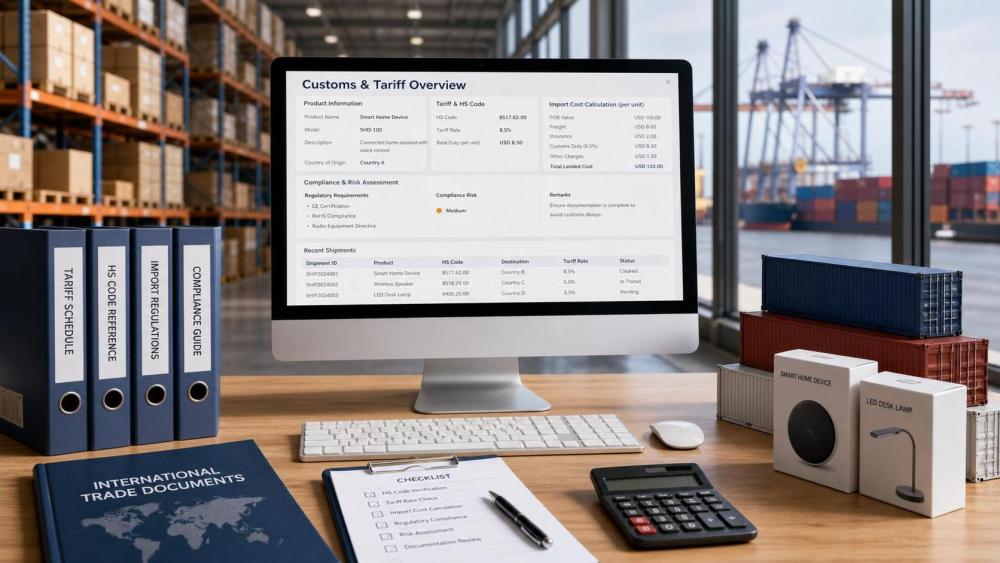
The first job of a tariff barriers database is to move past the headline customs duty.
In many markets, the listed tariff is only one part of the landed-cost equation.
You also need to check value-added tax, excise tax, para-tariffs, customs fees, inspection charges, and port handling costs.
A good tariff barriers database should connect these charges to the exact HS code and destination market.
That matters because small differences in product classification can change total cost fast.
In practice, teams should verify five cost points before shortlisting a market.
- Base import duty by HS code
- Preferential tariff under FTA or trade agreement
- Import VAT and recoverability rules
- Additional fees at customs clearance
- Anti-dumping or safeguard duties
If the tariff barriers database cannot show all five clearly, it is not enough for a market-entry decision.
From a margin perspective, hidden fees often matter more than the visible duty rate.
Check Product Classification Before Anything Else
Many export projects go wrong because the product was classified too broadly.
A tariff barriers database is only useful when the HS mapping is accurate enough for the actual product.
The risk grows when goods have mixed materials, embedded electronics, chemical content, or dual industrial uses.
This is where business evaluation teams should slow down and validate classification logic.
Review the product’s composition, function, technical parameters, and packaging form.
Then compare them with customs notes, explanatory notes, and destination-country subheadings.
A strong tariff barriers database should also flag country-specific code extensions.
These local extensions often trigger different taxes, certifications, or import approvals.
More importantly, classification affects later steps such as labeling, inspection, and licensing.
Useful validation questions
- Is the HS code based on core function or material content?
- Does the market use national subcodes beyond the global HS structure?
- Can the same product be treated differently by end use?
- Has a customs ruling already been issued for similar goods?
Map Non-Tariff Barriers Alongside the Tariff Barriers Database
A tariff barriers database becomes far more valuable when it also points to non-tariff restrictions.
These controls are often the real reason a market looks open on paper but fails in execution.
Common examples include import licensing, product registration, local testing, packaging mandates, and language labeling rules.
Some sectors also face sanitary, phytosanitary, safety, or environmental entry conditions.
That means a low-duty market can still be expensive, slow, or commercially unrealistic.
In actual operations, these barriers create time costs before they create direct financial costs.
A practical tariff barriers database should help answer three questions quickly.
- Can the product enter freely, or is prior approval required?
- Which compliance documents must be prepared before shipment?
- How long does market entry typically take under normal conditions?
This also means screening for document mismatch risk, especially where customs systems are strict.
If compliance timing cannot be estimated, sales forecasts should be treated cautiously.
Verify Trade Remedies and Policy Volatility
Another key use of a tariff barriers database is spotting unstable policy environments.
Some markets keep standard tariffs low while using trade remedies more aggressively.
Anti-dumping duties, countervailing duties, and safeguard actions can change the commercial case overnight.
That is especially relevant for steel, chemicals, machinery, electronics, and commodity-linked products.
A robust tariff barriers database should include policy history, active investigations, and recent review outcomes.
The stronger signal is not only the current duty, but the direction of regulation.
If a sector has repeated complaints, local producer pressure, or election-driven protectionism, risk is already rising.
For screening purposes, compare markets using a simple policy-risk table.
Test Operational Feasibility Beyond Regulation
Even the best tariff barriers database cannot replace operational due diligence.
A market may be legally open but commercially difficult because clearance is slow or documentation is inconsistent.
This is where teams should combine tariff data with customs latency, port performance, and broker capability.
In real trading conditions, timing failure can destroy the economics of a market faster than duty itself.
Perishable products, project cargo, and components for just-in-time production are especially exposed.
A workable evaluation model should include these operating checks.
- Average customs release time by port or airport
- Document error tolerance in practice
- Inspection frequency for the target product group
- Availability of local importers, agents, or distributors
- Dispute handling speed for valuation or classification issues
This is also why GTIIN-style market intelligence matters.
Trade data becomes much more useful when paired with supply chain signals and sector-specific execution context.
Use a Tariff Barriers Database to Compare Markets Side by Side
Once the core checks are complete, the tariff barriers database should support a side-by-side decision model.
This avoids choosing a market only because its top-line tariff looks attractive.
A simple weighted scorecard often works better than a long narrative memo.
Score each target market on cost, compliance, policy stability, logistics, and speed to first shipment.
Then pressure-test the result against best-case and worst-case assumptions.
A practical decision framework
- Confirm the exact product classification.
- Extract all tariff and fee layers from the tariff barriers database.
- Check non-tariff restrictions and compliance lead time.
- Review trade remedy exposure and policy volatility.
- Estimate operational friction and customs timing.
- Rank markets by landed margin and execution certainty.
This process gives decision-makers a more realistic view of market attractiveness.
It also helps prevent wasted sales effort in markets that are technically open but commercially weak.
Final Check Before Market Entry
A tariff barriers database should be treated as a decision tool, not just a reference library.
Used well, it helps clarify whether a new export market is profitable, compliant, and operationally realistic.
The critical point is to verify full landed cost, accurate classification, non-tariff barriers, policy risk, and execution timing together.
That broader view is what turns trade data into a defensible market-entry decision.
Before approving the next target country, run the product through a tariff barriers database and challenge every assumption behind the forecast.
The markets that look slightly harder at first often become the better choices once the real barriers are visible.
Have questions about this sector analysis, or seeking best practices specific to your niche? Drop us a line below and let the senior consultants at GTIIN assist you.
“We respect your privacy. Your information is strictly confidential.”
Weekly Insights
Stay ahead with our curated technology reports delivered every Monday.
Recommended News
 Supply ChainNov 10, 2026China Extends Pause on 24% Additional Tariff on US Goods by Two Months
 Industry StandardsNov 10, 2026Which imports are subject to EU carbon border compliance?
 Global SourcingNov 09, 2026USTR Extends 178 China Section 301 Tariff Exclusions to January 2027
 Supply ChainNov 09, 2026How can a tariff risk management dashboard track cost exposure?



