China Registration Rule Takes Effect for Imported Food Plants
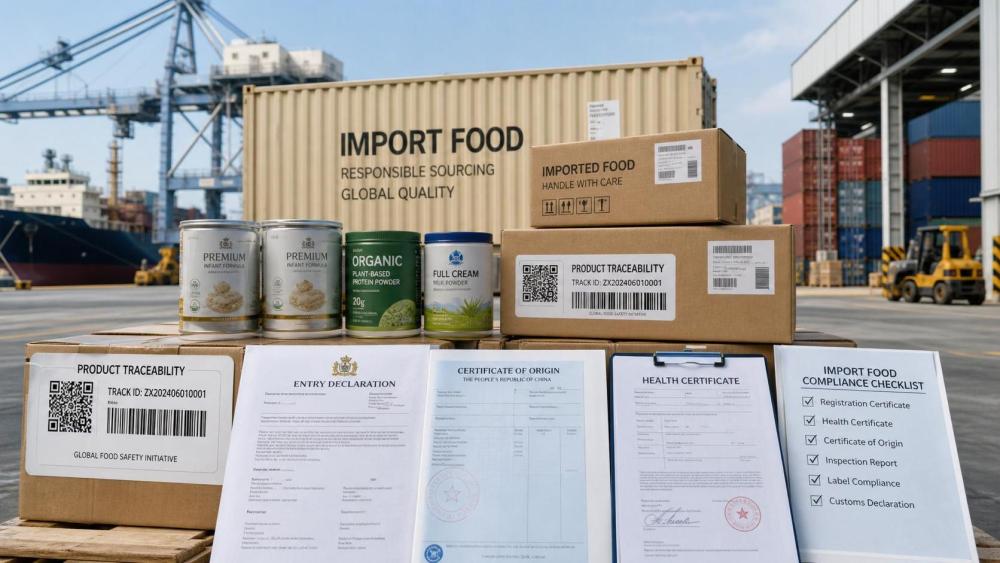
From June 1, 2026, overseas factories producing imported food must complete registration in China and obtain a dedicated registration number before customs clearance, based on the implementation of GACC Order No. 280 and Announcement No. 27 of 2026. The required number must be declared during customs filing, while source qualification traceability checks are also being extended to cosmetics, health products, and maternal and infant categories. For importers, cross-border sellers, brand owners, and supply chain operators, this is not only a customs compliance issue but also a direct test of upstream supplier eligibility and product continuity.
What the new requirement now makes explicit
The confirmed change is that all overseas manufacturing plants for imported food must complete registration in China and receive an exclusive registration number.
As of June 1, 2026, that registration number must be filled in during customs declaration. If the overseas factory has not been registered, the goods cannot complete customs entry.
The same regulatory move also brings cosmetics, health products, and maternal and infant categories into source qualification traceability review. According to the provided information, goods from unregistered factories may be removed from platform listings and refused entry by customs.
Where disruption is most likely to appear
Import traders face a direct clearance threshold
From an industry perspective, direct importers are the first group affected because customs declaration now depends on whether the overseas factory has completed registration and whether the corresponding number can be accurately submitted. The main impact is concentrated in shipment preparation, document matching, and clearance execution. What deserves closer attention is whether existing suppliers are already compliant and whether product batches can still move on schedule.
Platform sellers and brand operators must revisit source eligibility
For businesses selling imported food, cosmetics, health products, or maternal and infant goods through online channels, the issue extends beyond border clearance. The provided information indicates that goods from unregistered factories may be delisted by platforms. Analysis shows that this raises immediate pressure on supplier onboarding, SKU review, and traceability document management.
Supply chain and service providers may see higher document coordination demands
Customs brokers, sourcing agents, and other supply chain service providers may be affected through a heavier compliance coordination role. The practical impact is likely to appear in supplier verification, registration number collection, declaration data accuracy, and communication across multiple parties. Observably, service errors may no longer be limited to paperwork delays but could affect whether a shipment proceeds at all.
What companies should check now
Confirm whether factory registration is already complete
The most immediate operational priority is to verify whether each overseas food manufacturing plant has completed registration in China and obtained its exclusive number. For businesses managing multiple factories or contract manufacturing arrangements, the critical point is the factory level rather than only the brand or trading entity level.
Review whether declaration data and source documents match
Because the registration number must be declared at customs, companies should pay closer attention to the consistency between factory information, customs filing data, and internal product records. Analysis shows that a compliance requirement can quickly become an execution issue if the declared information does not align with the actual manufacturing source.
Separate food registration issues from wider traceability checks
The confirmed facts distinguish between a mandatory registration requirement for imported food plants and source qualification traceability checks that also cover cosmetics, health products, and maternal and infant categories. What deserves closer attention is the difference between a formal access condition and broader traceability review in day-to-day operations, because the business response may differ by category.
Prepare for supplier and customer communication in advance
Where upstream factories are not yet fully verified, companies may need contingency communication with suppliers, customers, and channel partners. Observably, the practical risk is not only refusal at the border but also listing disruption and delivery uncertainty if source qualifications cannot be validated in time.
Why the market is likely to keep watching this closely
Analysis shows that this development is more than a procedural reminder. It makes upstream factory qualification a visible checkpoint in both customs clearance and channel compliance. That gives the rule broader commercial significance than a back-office filing detail.
It is more appropriate to understand this as an already effective compliance requirement for imported food, while the wider impact on related categories should still be followed through actual enforcement and platform review practices. In that sense, the event is both a current operational threshold and a longer-term signal that source traceability is moving closer to front-end market access.
How this update is best understood for now
At this stage, the clearest takeaway is that factory-side registration and source verification have become core checkpoints for imported goods entering China, especially for food. A neutral reading is that the rule should not be treated as a short-lived adjustment. At the same time, the full business impact across categories, channels, and service providers still requires continued observation based on how compliance checks are carried out in practice.
Basis of this article and follow-up verification
This article is generated from the user-provided news title, event date, and event summary. For developments of this kind, commonly relevant source types may include official notices, company disclosures, industry association updates, authoritative media reporting, and standards-related documents.
A specific official source link was not provided in the input, so further verification remains necessary. Follow-up attention should remain on official wording, implementation details in actual declaration practice, and any category-specific clarification affecting food, cosmetics, health products, and maternal and infant goods.
Weekly Insights
Stay ahead with our curated technology reports delivered every Monday.
Recommended News
 Supply ChainJun 24, 2026Supply Chain Disruption Intelligence: Early Warning Metrics That Actually Matter
 Industry StandardsJun 24, 2026Industrial Safety Standards Explained: Key Compliance Gaps and Audit Priorities
 Market TrendsJun 24, 2026Global Export Trends in Southeast Asia: What 2026 Data Means for Market Entry
 Supply ChainJun 24, 2026Sustainable Supply Chains Procurement: How to Cut Risk Without Raising Cost