China Tightens Drone Export Declarations from June 25
Effective June 25, 2026, China’s customs rule change brings a more detailed export declaration requirement for drones, shifting the issue from routine paperwork to a practical compliance checkpoint for exporters, overseas importers, customs handling parties, and supply chain coordinators. The requirement to use a precise 10-digit HS code and disclose the actual domestic manufacturer matters because it directly affects clearance accuracy, traceability expectations, and whether shipments can move without delay or face detention or return.
What the new filing requirement confirms
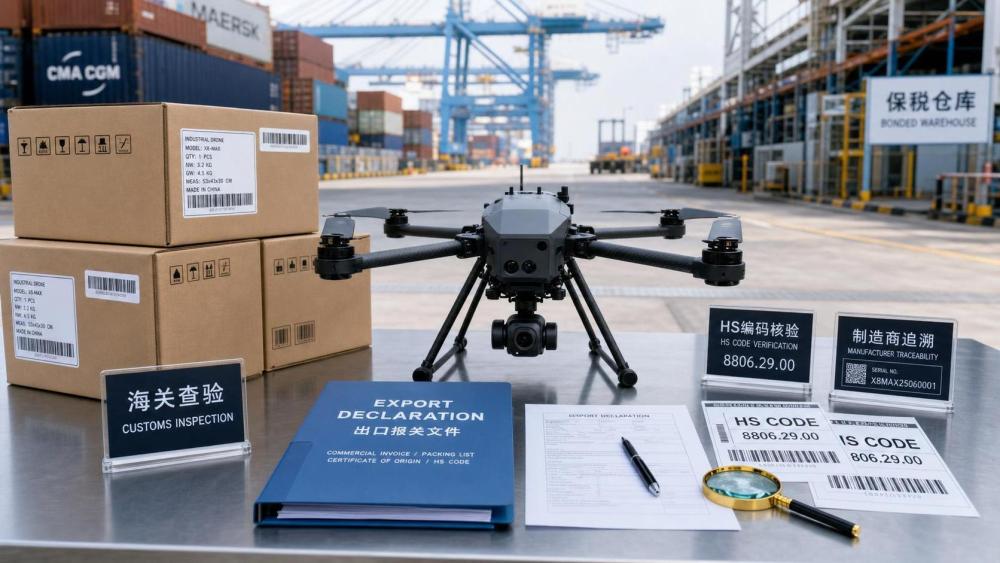
The confirmed change is that a new rule of the General Administration of Customs of China takes effect on June 25, 2026 for drone exports. Under the new requirement, exports can no longer rely on simplified declaration treatment. Export filings must include an exact 10-digit HS code and the name of the actual domestic manufacturer. The information provided also indicates that non-compliant declarations may lead to cargo being held at port or returned.
Where the pressure is likely to appear first
Export execution moves closer to product-level compliance
From an industry perspective, exporters are likely to feel the most immediate pressure because the new rule changes the threshold for filing accuracy. The impact is not limited to customs submission itself; it also affects internal product classification, document preparation, and coordination between sales, logistics, and factory-side teams. What deserves closer attention is whether the exporter can match each shipment to the correct 10-digit HS code and the correct domestic producer information before cargo is handed over for export processing.
Overseas importers face a higher traceability expectation
Analysis shows that overseas buyers and importers may also be affected even though the filing obligation sits on the export side. If declaration information is incomplete or inconsistent, the result can extend into downstream clearance and delivery arrangements. The key issue is not only whether goods depart, but whether shipment records, supplier identity, and product classification remain consistent enough to support import-side compliance review and acceptance.
Manufacturing and supply chain partners become more visible in trade documents
Observably, the requirement to name the actual domestic manufacturer raises the practical importance of factory identity within export documentation. For manufacturers, trading companies, and supply chain service providers, this may increase the need for clearer coordination over who made the product, how that information is recorded, and how supporting documents align with shipment data. This is especially relevant where commercial contracting, production, and export handling are managed by different parties.
What companies should check now
Review HS code accuracy before shipment booking
Analysis shows that companies involved in drone exports should first recheck whether their current product classification process can support 10-digit declaration accuracy. This is not simply a filing formality; it is a precondition for compliant export documentation under the new rule.
Verify manufacturer information across transaction records
What deserves closer attention is whether the actual domestic manufacturer stated in export documents can be matched consistently across internal records, commercial paperwork, and shipment-related materials. Where multiple entities are involved in production and export execution, inconsistencies may create added clearance risk.
Reassess delivery planning and customer communication
From an operational perspective, companies may need to reassess delivery timelines and buyer communication for drone-related orders. Because the input information states that non-compliant declarations may result in port detention or return, shipment scheduling and customer-side expectations may require closer management until execution practice becomes clearer.
Follow later wording and implementation signals closely
Observably, the currently confirmed information establishes the filing requirement and the compliance consequence, but it does not provide detailed implementation language in the input. Companies therefore need to continue monitoring how the rule is expressed in practice, especially in relation to documentation standards, review consistency, and any follow-up compliance guidance connected to export handling.
Why this should be read as an execution signal
It is more appropriate to understand this as an already effective compliance change rather than a distant policy direction, because the effective date is clear and the filing obligations are specific. At the same time, analysis shows that the market still needs to observe how uniformly the requirement is implemented in day-to-day export operations. The most important near-term signal is that drone export declarations are being treated with greater precision in classification and origin-side accountability.
How to read the development at this stage
At this stage, the rule change is best read as a concrete tightening of export declaration requirements for drones, with direct implications for customs compliance, traceability, and shipment execution. A cautious and neutral interpretation is that the change has already crossed from policy wording into operational impact, while the finer points of implementation still merit close observation by exporters, buyers, and supply chain participants.
Basis of this article and points for continued verification
This article is generated based on the user-provided news title, event date, and event summary. For events of this kind, relevant source types commonly include official notices, releases from regulatory authorities, customs or trade administration information, industry association updates, standards-related documents, and reporting by authoritative media. A specific official source link was not provided in the input, so further verification remains necessary. What still requires continued observation includes any detailed policy wording, implementation interpretation, compliance review practice, changes in procurement or tender documentation, market feedback, and how companies carry out the new filing requirement in actual export operations.
Weekly Insights
Stay ahead with our curated technology reports delivered every Monday.
Recommended News
 Global SourcingJun 25, 2026Procurement Strategy for Manufacturers: Cost Risks to Watch
 Industry StandardsJun 25, 2026Materials Engineering Standards in Europe: What to Check First
 Global SourcingJun 25, 2026When to Hire an Industrial Cost Benchmarking Consultant
 Supply ChainJun 25, 2026Port Congestion Report: What Delays Mean for Lead Times