What Drives CNC Beam Saw Cost Over Its Operating Life Cycle?
The purchase price is only the opening number
A CNC beam saw can look straightforward on a capital request: machine price, freight, installation, and perhaps a dust-extraction connection. The financial outcome is more complicated. Over its operating life, the equipment’s cost is shaped by throughput stability, labor content, material yield, maintenance discipline, software integration, downtime exposure, and the fit between the saw’s configuration and the factory’s actual order mix.
For a finance approver, the central question is not whether one quotation is lower than another. It is whether the lower-priced machine will create recurring operating costs or production constraints that outweigh its initial saving. Conversely, a highly specified saw may carry features that never earn their cost if the plant processes modest volumes, runs relatively simple panel formats, or cannot support the required material flow.
The most useful evaluation separates one-time acquisition cost from the cost of owning a cutting process. That distinction helps avoid approving a machine based on quoted price alone while overlooking expenses that appear later in labor planning, maintenance budgets, production scheduling, and reject handling.
What belongs in the life-cycle cost model?
A practical model should begin with the full cost to make the machine operational, then follow the costs required to keep it productive. The model does not need to predict every future expense with false precision. It should identify the assumptions that have the greatest effect on payback and test them against realistic operating conditions.
Comparing supplier offers becomes more credible when each quotation is normalized around the same production requirement. A comparison should state the panel materials, maximum and minimum sheet sizes, expected daily cutting volume, working shifts, cut-list complexity, required labeling, loading method, and whether the machine must interface with existing design or production software. Without this common basis, a lower figure may simply represent a smaller scope.
Machine configuration affects operating cost long after commissioning
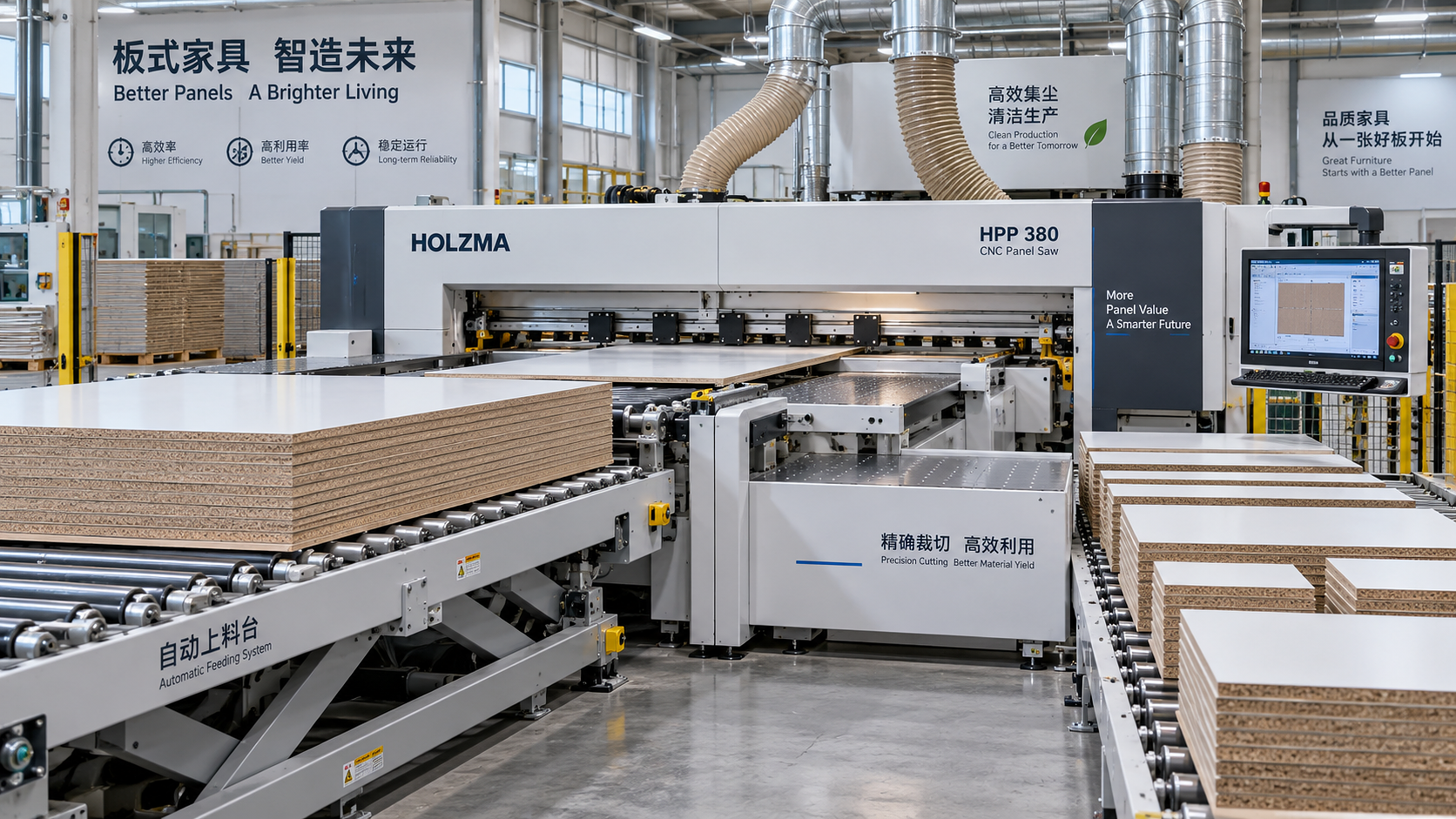
Beam saws vary considerably in their mechanical layout and automation level. A basic configuration may be appropriate for a shop with predictable production, limited panel handling needs, and available labor. In a high-volume cabinet, furniture, interior fit-out, or laminated-board operation, manual loading and unloading can become the real constraint even when the saw itself cuts quickly.
The pusher system, pressure beam, main saw carriage, scoring arrangement, side alignment, clamps, and tables influence repeatability and usable output. A machine that performs well on a demonstration cut may still struggle in daily operation if panels are warped, surfaces are delicate, sheets are frequently changed, or the cutting schedule contains many small batches. Financial review should therefore focus on production conditions rather than only on headline speed.
Higher automation can reduce handling time and limit the chance of panel damage during loading. Yet it also introduces more sensors, drives, conveyors, control components, and calibration points. The correct decision is not automatically “more automation.” It is whether the expected volume, labor availability, and production rhythm justify the added capital, maintenance capability, and downtime exposure.

Labor savings depend on the material flow, not the saw alone
Labor assumptions are often the weakest part of a capital justification. A supplier may describe a machine as requiring one operator, while the actual process still needs personnel to stage sheets, identify materials, remove offcuts, move cut parts to edging or drilling, and resolve exceptions. The relevant metric is the total labor required to produce a completed, traceable set of parts—not only the number of people standing at the saw.
In operations with frequent décor changes or short runs, labeling and job sequencing may be as important as feed speed. Incorrect labels can create downstream sorting errors that consume more time than any saving at the cutting station. Where a beam saw is connected to optimization software, the approval team should ask who maintains panel data, material codes, grain directions, and cut-list revisions. Automation does not remove data-management work; it changes where that work is performed.
Labor savings are more defensible when the business can demonstrate a constraint. Examples include recurrent waiting time at the cutting station, excessive handling of full sheets, overtime caused by cut-list backlogs, or repeated manual measurement and sorting. If production demand is intermittent, a fully automated loading system may have limited economic value even if it is technically attractive.
Yield, quality, and rework are financial variables
Panel material is often a major component of finished-product cost. The beam saw influences yield through optimization quality, kerf control, trim allowances, cut sequence, and the ability to manage remnants. It also affects quality through chip-free edges, dimensional consistency, squareness, and the stability of repeat cuts. These outcomes depend on material type, blade selection, scoring setup, machine adjustment, and operator practice.
Finance teams should be cautious about assigning a savings figure to “better yield” without a baseline. A useful approach is to review historical purchase quantities, scrap categories, remnant usage, re-cut frequency, and the cost of parts rejected downstream. Separate unavoidable trim waste from waste caused by poor nesting, incorrect cut data, edge damage, or rework. This creates a more credible estimate than applying a broad percentage improvement to all material purchases.
Quality also has a scheduling effect. A damaged or incorrectly sized panel may require replacement material, another cutting cycle, renewed edging, and reassembly. When decorative surfaces or matched grain patterns are involved, a replacement may also disrupt the planned sequence. The cost is not merely the value of one panel; it can include lost production capacity and delayed shipment.
Maintenance cost is driven by operating conditions and support design
A beam saw is a production asset with moving assemblies, drives, pneumatic or electrical components, bearings, guides, sensors, and cutting tools. Maintenance cost depends heavily on how the machine is used and maintained. Cutting abrasive panel products, operating in a dusty environment, allowing poor dust extraction, or using unsuitable blades can increase wear and affect cut quality.
Approval documents should distinguish between routine consumables and rare but high-impact failures. Blades, scoring tools, lubricants, filters, and selected wear parts may be planned operating expenses. A failed electronic drive, control module, pusher component, or safety device can be more disruptive if it cannot be sourced quickly. Ask for a recommended spare-parts list, expected maintenance intervals, remote diagnostic arrangements where available, documentation language, and the process for obtaining technical support after warranty expiry.
Preventive maintenance should be budgeted as production protection rather than treated as a discretionary expense. Missed inspections can lead to deteriorating accuracy, unreliable material handling, or unexpected stoppages. The value of a maintenance agreement, internal technician training, or critical-spares inventory depends on how expensive an unplanned interruption would be and whether alternative cutting capacity exists.
Compare quotations on the same operating basis
A quote comparison should convert commercial proposals into a shared scope sheet. This is the purpose of reviewing the CNC beam saw price and cost guide alongside the supplier documents: the listed price should be tested against what is included, excluded, and assumed in the installation and operating plan.
For each offer, finance and operations can record the following items:
- Machine dimensions, cutting capacity, and supported panel formats;
- Included saw units, scoring capability, clamps, tables, labeling, and handling equipment;
- Control software, optimization functions, interfaces, licenses, and recurring software charges;
- Blade and tooling scope, training days, commissioning responsibility, and acceptance criteria;
- Electrical, pneumatic, extraction, foundation, and site-access requirements;
- Warranty terms, exclusions, service travel costs, spare-parts lead times, and payment milestones;
- Lead time, shipment terms, packaging, import obligations where relevant, and installation schedule.
This exercise often identifies hidden differences between offers. One quote may include automated loading and unloading while another assumes manual feeding. One may include commissioning and operator training, while another treats them as separate services. A lower machine price can remain a valid choice, but only after these differences have been made visible and evaluated against the operating plan.
Downtime deserves an explicit financial assumption
Downtime is frequently discussed but rarely quantified in approval papers. The effect varies sharply by factory. A site with spare cutting capacity, flexible delivery dates, and simple products may absorb an interruption. A plant where one saw feeds several downstream work cells can face idle labor, rescheduling, expedited material movement, and delivery risk.
Rather than claiming a universal downtime cost, the reviewer can calculate a site-specific range. Start with the contribution associated with the constrained production hours, then add identifiable recovery costs such as overtime, subcontract cutting, premium freight, or additional setup. The resulting number should be used to compare service arrangements, critical spares, redundancy options, and the risk of buying a machine without established local support.
Acceptance testing matters here. Before final payment, the parties should agree on the materials, panel dimensions, cut patterns, accuracy expectations, safety functions, software workflow, and training deliverables that will be checked. Any safety evaluation should be matched to the machine’s destination and the buyer’s legal obligations. ISO 12100:2010 provides a general framework for machinery risk assessment and risk reduction, while electrical equipment requirements are commonly assessed against IEC 60204-1 in applicable jurisdictions. These references do not replace local regulatory review or the buyer’s site-specific safety procedures.
Residual value and obsolescence should not be ignored
A beam saw may retain value when it is well maintained, documented, and suited to common panel-processing requirements. Residual value is harder to predict when controls are proprietary, software cannot be supported, machine dimensions limit relocation, or the asset was configured for a narrow application. Finance teams do not need to assign an optimistic resale value to justify a purchase. It is usually safer to treat any residual value conservatively and focus on the asset’s productive service life.
Obsolescence can also occur before mechanical wear becomes critical. New customer requirements may demand barcode-based tracking, tighter integration with production planning, different panel formats, or more flexible batch processing. The approval decision should consider whether the machine can accommodate foreseeable workflow changes without requiring a complete replacement.
A stronger approval case connects equipment cost to production reality
The most reliable CNC beam saw decision is built from a defined workload, a normalized quotation, and a transparent list of operating assumptions. A finance approver should be able to see where the proposed return comes from: fewer handling hours, better material control, higher available cutting capacity, reduced rework, lower exposure to stoppages, or a combination of these factors.
When the assumptions are documented, the organization can test them after commissioning and improve future capital decisions. The best-priced machine is not always the least expensive asset over its life, and the most automated machine is not always the soundest investment. The appropriate choice is the one whose capability, support requirements, and operating cost match the plant’s actual production risk.
Tags
Weekly Insights
Stay ahead with our curated technology reports delivered every Monday.
Recommended News
 Market TrendsOct 08, 2026What the global manufacturing outlook means for exporters' order planning
 Supply ChainOct 08, 2026What Drives CNC Beam Saw Cost Over Its Operating Life Cycle?
 Supply ChainOct 07, 2026How disruption alerts in logistics reduce the risk of missed deliveries
 Industry StandardsOct 06, 2026How to use a sustainability standards checklist to verify suppliers