Steam Turbine Spares Planning: Lead Times and Interchangeability
A steam turbine outage can overrun even when the replacement part is already on site. A bearing may fit its housing but have the wrong clearance specification. A valve assembly may share a drawing number while carrying an incompatible revision. A replacement rotor may arrive without the records needed for engineering release.
Effective spares planning therefore needs two separate controls: a realistic estimate of the time required to make a part usable, and documented confirmation that it is suitable for the specific turbine. For maintenance teams, the practical objective is not simply to hold more inventory. It is to prevent procurement delays, compatibility questions, and missing acceptance evidence from reaching the outage critical path.
Start with the failure consequence, not the spare-parts catalog
A recommended spare-parts list is a useful starting point, but it cannot fully reflect a plant’s operating arrangements. A turbine driving an essential process compressor has a different outage consequence from a generator that can be taken offline while purchased power supports production. Redundant equipment, seasonal demand, and opportunities for controlled shutdown all affect the inventory decision.
Build the spares register around failure scenarios. For each component, ask whether its failure stops the machine, whether deterioration can reasonably be detected before failure, and whether an approved repair route exists. Then compare the expected recovery time with the interruption the plant can tolerate.
These are planning categories, not universal stocking rules. A low-cost proprietary trip-system component may justify more attention than an expensive casing item. Conversely, keeping a major assembly in storage may be difficult to justify where a genuinely independent standby train can carry the duty.
Measure lead time to installation readiness
A quoted delivery date may describe dispatch from the manufacturer rather than the date a spare becomes available for installation. Maintenance planning should distinguish manufacturing completion, delivery to site, inspection release, and readiness for service.
For a made-to-order part, the schedule may include drawing clarification, material procurement, manufacturing, inspection, document review, preservation, and transport. Any required site machining or assembly preparation adds another dependency. These stages can overlap, but they should not disappear inside an unexplained delivery promise.
Ask for a milestone schedule that identifies the event starting the delivery clock. “After order” is ambiguous if production actually begins only after drawing approval, receipt of a sample, or confirmation of material requirements. Also establish which dates depend on purchaser responses and which inspection activities require advance notice.
When reviewing replacement options with a steam turbine supplier, provide the turbine identification, operating duty, and installed configuration rather than relying on a general product description. A product-family match can establish relevance, but it does not prove that a particular spare is available, interchangeable, or suitable for an existing machine. Those points require part-specific confirmation.
Do not populate the register with generic lead-time assumptions presented as facts. Use current quotations or confirmed repair schedules, record their dates, and state whether material or manufacturing capacity has actually been reserved. A historical delivery can inform planning without becoming a guarantee for the next order.
A useful planning relationship is: required order release date = required installation date minus supply time, transport, receiving inspection, site preparation, and a justified contingency. Base the contingency on unresolved dependencies rather than adding the same allowance to every item.
Interchangeability requires more than dimensional fit
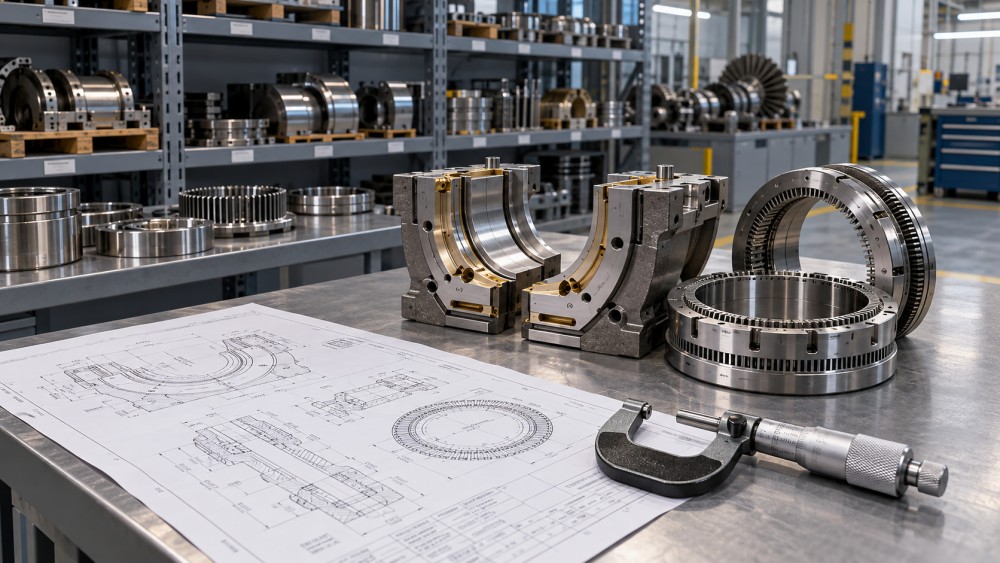
Two parts can look identical and still require different engineering treatment. Maintenance teams should separate three questions: does the part fit, does it perform the required function, and is its use approved for this machine and duty?
Dimensional comparison addresses only the first question. Functional suitability may depend on material, thermal expansion, surface treatment, running clearance, steam conditions, lubrication arrangements, or control behavior. Approval also requires a traceable decision about which turbine configurations can use the part.
The following checks provide a practical basis for a compatibility review. Exact acceptance criteria should come from the applicable drawings, purchase specification, and machine-specific maintenance documentation.
- Bearings: Verify journal interface, housing fit, locating features, oil-feed arrangement, specified clearance, and any instrumentation provisions.
- Labyrinth seals: Check segment arrangement, retention features, tooth geometry, material, and specified clearances for the relevant locations.
- Valve assemblies: Review pressure-boundary suitability, seat and stem geometry, actuator interface, travel, and the specified operating and failure response.
- Rotating parts: Establish material and geometry requirements, shaft and coupling interfaces, inspection evidence, and the machine-specific review needed before release.
- Electronic modules: Confirm signal compatibility, power supply, firmware, configuration, and integration with the installed protection or control system.
A matching catalog number is helpful evidence, but revision history still matters. Request a written supersession statement identifying whether the new revision is directly interchangeable, interchangeable only as part of a kit, or dependent on associated modifications.
Record any restrictions explicitly. “Interchangeable after modification” is not equivalent to “ready to install.” The spare-parts record should identify the modification, required supporting parts, approval authority, and work instructions. Otherwise, the next maintenance team may treat a conditional substitution as an unrestricted one.
Control shared spares at the configuration level
Shared inventory can reduce duplication across similar turbines, but similarity is an unreliable basis for pooling. Machines from the same product family may have different steam conditions, speed ranges, extraction arrangements, valve equipment, or previous modifications.
Create an interchangeability matrix linking each stocked item to specific equipment tags and configuration records. Give each relationship an explicit status: approved without modification, approved with defined work, awaiting review, or not interchangeable. An empty field should not imply approval.
The evidence should include the part number and revision, relevant drawing references, applicable machine identifiers, and approval record. Where installed components have changed during earlier outages, reconcile the equipment history against the original bill of materials. A purchase record alone may not show what was ultimately fitted.
This discipline is useful during new industrial power projects as well. Selection decisions should include the availability of configuration records, recommended maintenance spares, and support for future substitutions. Common components can simplify maintenance, but only where commonality has been established technically rather than inferred from similar ratings or appearance.
Design standards also need careful interpretation. API Standard 611 addresses general-purpose steam turbines for petroleum, chemical, and gas industry services; API Standard 612 addresses special-purpose steam turbines in those services. Neither standard’s designation, by itself, proves that spare parts from different machines are interchangeable. Use the project’s specified edition and equipment documentation when defining requirements. Sources: American Petroleum Institute, API Standard 611 and API Standard 612.
Make the purchase order define acceptance
A purchase description such as “bearing to suit turbine” leaves too much unresolved. The order should identify the machine, part and revision, quantity, technical references, required documentation, preservation requirements, and acceptance responsibilities. For an alternative part, include the approved substitution basis rather than relying on correspondence that may never reach the receiving team.
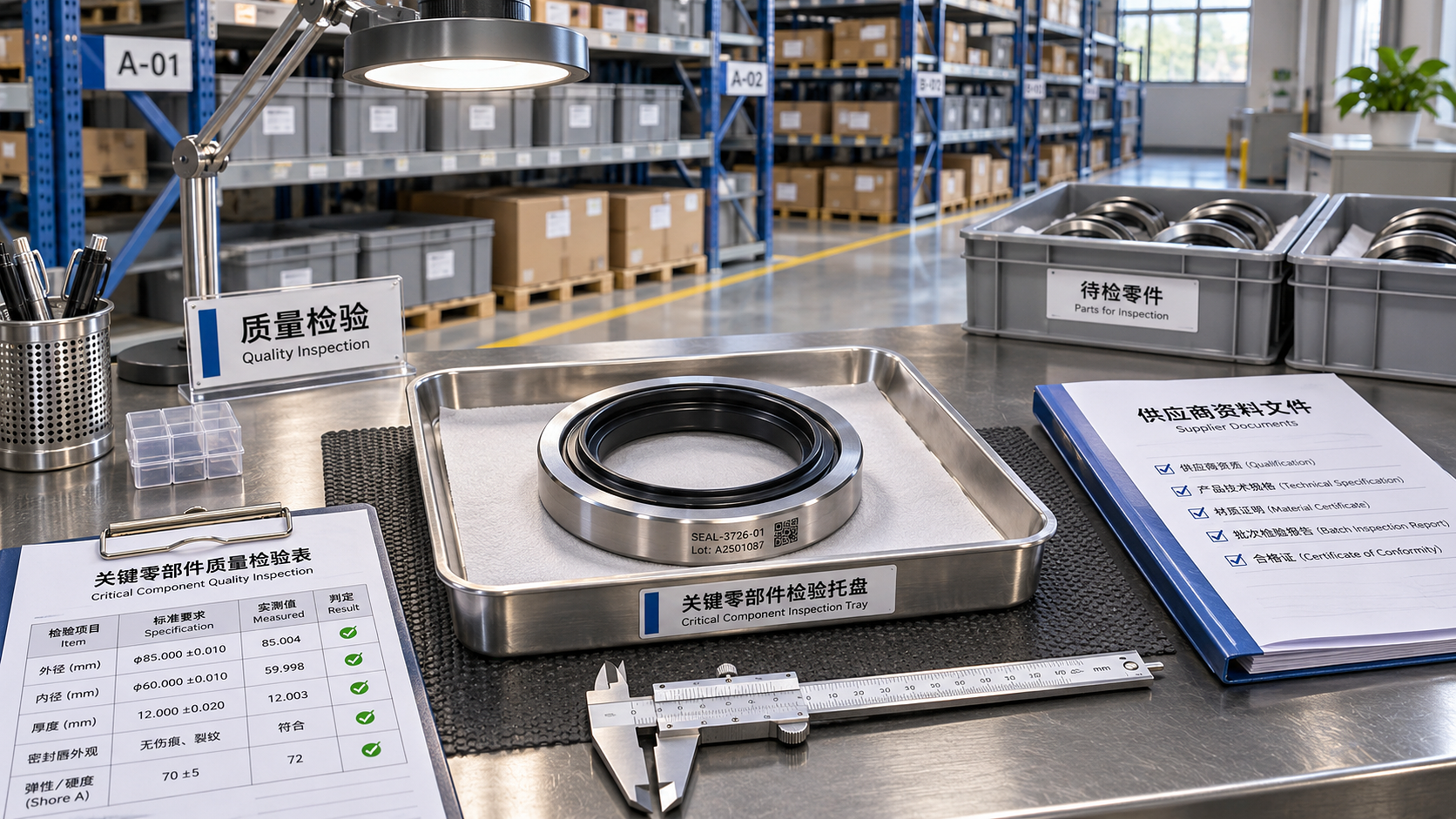
Inspection requirements should follow the component’s function and purchase specification. Depending on the item, evidence might include material certification, dimensional results, specified examination reports, or functional test records. Do not impose an identical document package on every spare: a gasket kit and a rotor assembly require different levels of review.
Define the release process before delivery. Who checks the certificates? Who resolves a drawing discrepancy? Can the part enter available inventory while documentation is incomplete? A physically received but unapproved item should remain visibly segregated from serviceable stock.
For emergency procurement, shorten avoidable administrative delays rather than silently removing technical requirements. A pre-agreed inspection plan and named engineering reviewers can support faster decisions. Where a deviation is proposed, record its technical basis, restrictions, and authorization before installation.
Keep stored spares genuinely ready for use
Availability deteriorates if preservation is neglected. Storage requirements depend on the component, packaging, environment, and manufacturer’s instructions. Maintain a preservation record covering receipt condition, storage location, periodic checks, and any renewal of protective measures.
Elastomers, sealants, and packaged consumables may have manufacturer-defined shelf lives or storage limits. Electronic spares may require controlled handling and protection from moisture or electrostatic damage. Major assemblies need their own documented preservation arrangements; avoid inventing a generic handling routine where the manufacturer specifies a particular method.
Check completeness as well as condition. A replacement assembly may be unusable without its matching fasteners, seals, keys, or installation tooling. Keep those dependencies visible in the inventory system, particularly when items are stored separately or borrowed for another job.
Inventory availability is not authorization to install. Site energy-control procedures still apply to maintenance work. For US facilities within its scope, OSHA’s control-of-hazardous-energy requirements address isolation and verification before servicing; local legal requirements and site procedures must determine the applicable approach elsewhere. Source: US Occupational Safety and Health Administration, 29 CFR 1910.147, particularly paragraphs (c) and (d).
Close the loop after each outage
After maintenance, update the register with what was actually installed, consumed, repaired, rejected, or returned to storage. Record discrepancies between quoted and achieved delivery milestones, including time spent resolving documentation or compatibility issues. These records are more useful for the next outage than an unqualified supplier delivery figure.
Review priorities when operating duty, redundancy, or equipment configuration changes. A shared spare may cease to be interchangeable after one turbine is modified. A previously acceptable repair route may no longer meet the plant’s recovery requirement.
The working test is straightforward: for each failure-critical item, can the maintenance team identify an approved replacement, establish its condition and configuration, and make it available within the tolerated interruption? Where the answer is uncertain, the next action should be specific—obtain a drawing, resolve a revision, qualify a repair route, or change the stocking decision—before the outage makes that uncertainty expensive.
Have questions about this sector analysis, or seeking best practices specific to your niche? Drop us a line below and let the senior consultants at GTIIN assist you.
“We respect your privacy. Your information is strictly confidential.”
Tags
Weekly Insights
Stay ahead with our curated technology reports delivered every Monday.
Recommended News
 Market TrendsNov 08, 2026How to use industrial commodity market analysis to forecast costs
 Supply ChainNov 07, 2026EU Opens Safeguard Investigation into PET Resin Imports
 Industry StandardsNov 07, 2026Which ISO quality management standard can a company be certified to?
 Supply ChainNov 06, 2026How to use a supply chain risk analysis model to prioritize suppliers