How to identify evidence gaps in an industry standards assessment
How to identify evidence gaps in an industry standards assessment
A missing test report is easy to spot; evidence that looks complete but fails to demonstrate conformity is harder to detect. For quality control and safety managers, an assessment for industry standards requires more than collecting certificates and inspection records—it demands checking whether each applicable requirement is supported by current, relevant, and traceable evidence.
The practical challenge is separating three situations: evidence has not been supplied, supplied evidence is inadequate, or the underlying activity does not meet the requirement. Those situations call for different responses. Requesting another document will not fix an uncontrolled process, while automatically rejecting a supplier over a retrievable record may be disproportionate.
Start with the requirement, not the document folder
An evidence gap exists when available information does not adequately support a conclusion against an applicable requirement. It is not simply an empty space on a checklist. A signed inspection sheet can still leave a gap if it identifies neither the inspected batch nor the acceptance criteria.
Before reviewing records, define the assessment boundary: product or process, manufacturing site, relevant activities, destination market, contractual obligations, and the applicable standard and edition. Check amendments and transition provisions where relevant. The newest published edition is not automatically the edition required by a contract or regulatory framework.
Keep management-system requirements, product requirements, and legal obligations distinct. An ISO 9001 certificate, for example, does not by itself establish that a particular shipment meets a product specification. Likewise, a successful product test does not demonstrate that routine production controls remain effective.
Where a requirement is considered inapplicable, record the technical rationale and who approved it. An unexplained “not applicable” entry can hide a scope error before evidence review even begins.
Build a requirement-to-evidence map
Break each applicable clause into assessable obligations. A requirement covering equipment suitability, maintenance, and verification may need several evidence sources; one equipment register is unlikely to demonstrate all three. Map obligations individually rather than attaching the same procedure to an entire section of the standard.
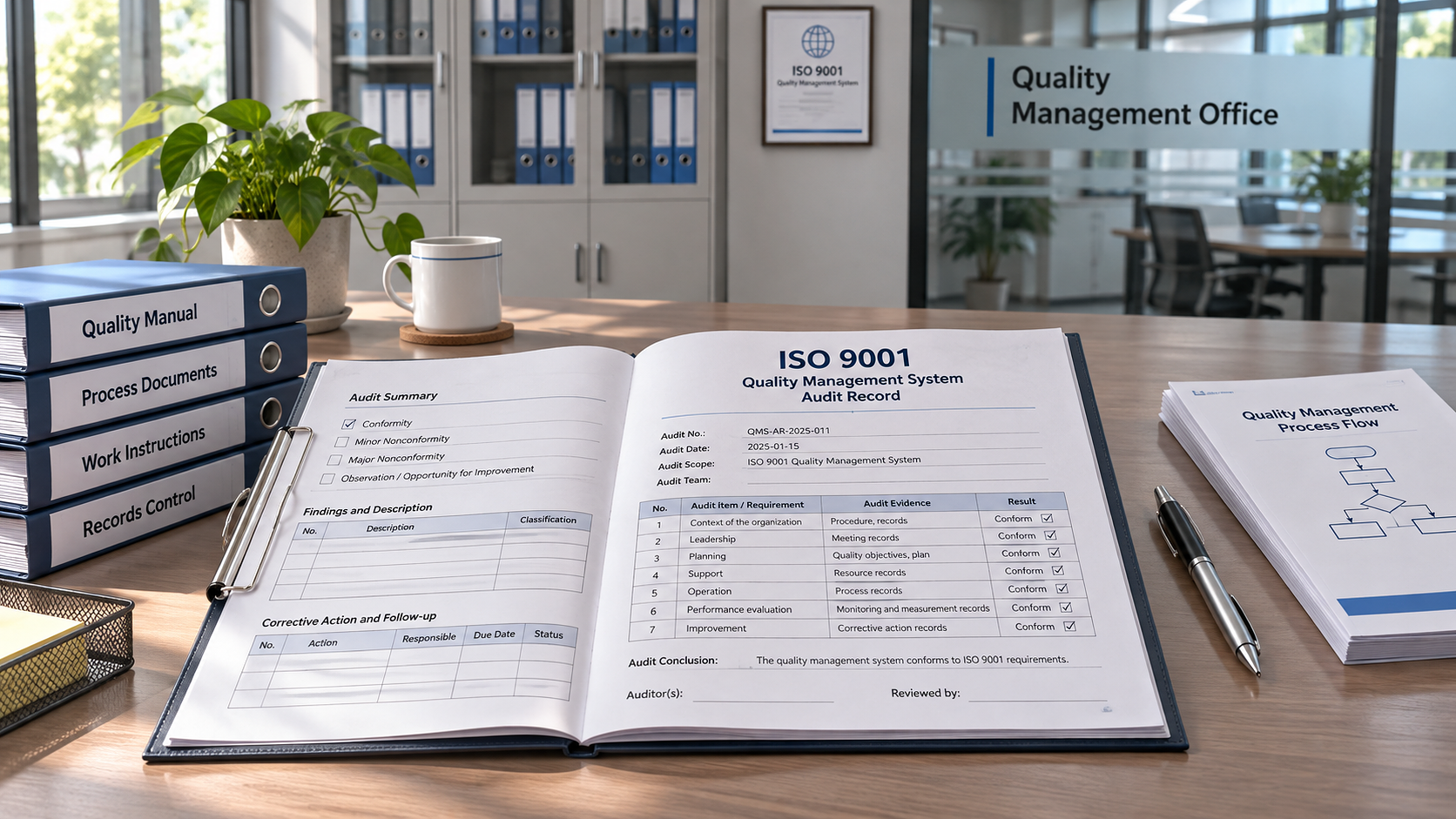
A useful assessment matrix includes the requirement reference, expected evidence, actual record identifier, covered product or process, review finding, responsible owner, and closure criteria. Include revision and date information where these affect validity. Keep the original record accessible rather than relying only on copied extracts.
The following examples illustrate how a completed-looking file can still leave an unsupported conclusion. They are assessment patterns, not universal evidence requirements.
Think of the evidence chain as requirement → acceptance criterion → activity → result → identifiable product or process → authorized decision. A broken link deserves attention even when every document appears professionally formatted.

Test whether the evidence proves what it claims
Document presence is only the starting point. Assess evidence against five practical questions:
- Relevance: Does it cover the actual model, material grade, site, process, and operating conditions under review?
- Validity: Was the correct method used, with suitable equipment and an authorized issuer?
- Currency: Does it remain applicable after design, supplier, tooling, software, or process changes?
- Traceability: Can the result be connected to the sample, batch, equipment, and decision it supports?
- Sufficiency: Does the evidence cover the required characteristics and sampling basis, rather than a convenient subset?
Currency is not simply document age. An older qualification report may remain applicable if the relevant configuration and conditions are unchanged and the governing requirements allow it. A recently issued report may be unusable if it tests a different product variant.
For laboratory reports, examine the method, sample description, test conditions, results, and acceptance criteria. Where accreditation is required or relied upon, verify the laboratory’s relevant scope rather than accepting a logo. ISO/IEC 17025 accreditation relates to laboratory competence within a defined scope; it is not blanket approval of every test a laboratory offers.
When a result lies close to a specification limit, check whether measurement uncertainty and the conformity decision rule were addressed as required. A number inside a limit does not always settle the conformity decision without that context.
Follow selected records back to the work
A desk review can show that procedures and records agree with one another. It cannot always show that they agree with production. Trace selected items backward from release to inspection, processing, and incoming material, then follow selected incoming lots forward to their disposition.
Choose samples deliberately. Include relevant shifts, subcontracted operations, recent changes, reworked material, or records near an acceptance boundary where risk justifies it. Record why samples were selected and acknowledge the limits of the review. Sampling supports a bounded conclusion, not certainty about every unit.
Compare documents with interviews and direct observation. If a procedure requires pre-use checks, ask an operator to demonstrate the check and identify the latest record. Differences between the written method and actual practice may reveal implementation failures, unclear instructions, or records that do not capture the work adequately.
Contradictions deserve more scrutiny than tidy consistency. A release record dated before the supporting test, or a batch quantity that cannot be reconciled across production and dispatch, requires explanation. Neither automatically proves misconduct, but neither should be dismissed as harmless administration.
Separate missing evidence from demonstrated failure
Use findings that state what is known. “Conformity not demonstrated because the report cannot be linked to the delivered lot” is more defensible than “material failed” when no failed result exists.
A retrieval gap means an identified record has not yet been obtained. An adequacy gap means the supplied record does not support the required conclusion. An implementation gap means evidence shows that a required control was not performed or was ineffective. These distinctions help assign the right follow-up without prejudging the outcome.
However, missing records can themselves constitute nonconformity when retaining them is an explicit requirement. Distinguish that record-control failure from the still-unresolved question of product conformity. Both may need action, but they are not the same finding.
Write each finding with a requirement reference, the evidence examined, the precise shortfall, and the affected scope. Avoid “documentation insufficient” without explaining what is missing and why it matters.
Prioritize by consequence, exposure, and uncertainty
Do not rank gaps by how easy they are to close. Missing evidence for a safety-critical characteristic warrants different attention from an incomplete administrative field. Consider the potential consequence, quantity or population affected, availability of independent controls, and whether affected goods have already been released.
Risk ranking guides urgency; it does not waive mandatory requirements. Where safety or legal conformity cannot be established, escalate to the authorized quality, safety, or regulatory decision-maker. Depending on the circumstances, proportionate containment may involve segregation, a shipment hold, additional inspection, or suspension of the affected activity.
Retesting is not always an adequate substitute for missing process evidence. For characteristics dependent on controlled processing, or tests that cannot represent the full affected population, a passing sample may leave the central uncertainty unresolved. Define what additional testing can actually demonstrate before commissioning it.
Account for cross-border evidence mismatches
In international sourcing, technically credible evidence can still be unsuitable for the intended market. Check recognized test methods, national adoptions or deviations, required conformity-assessment routes, and any applicable language or documentation obligations. Similar standard titles do not establish equivalence.
Also verify the entities behind the records. A certificate may cover the supplier’s headquarters but not the manufacturing site. A distributor’s declaration may need support from records held by the original manufacturer. Translations should preserve units, qualifications, and limitations rather than merely the headline result.
Global Trade Insights & Industry Network (GTIIN) connects industry standards analysis with global sourcing and supply chain research. That perspective helps teams frame the right questions about market requirements, manufacturing locations, and subcontracted processes. Trade intelligence provides context for an assessment; it does not replace the applicable standard, competent testing, or project-specific legal review.
Close the finding with evidence, not a promise
Every open gap needs an owner, deadline, interim control where necessary, and explicit acceptance criteria. “Supplier to provide documents” is too vague. Specify the record, affected scope, required traceability, and reviewer responsible for deciding whether the submission resolves the finding.
For recurring gaps, look beyond retrieval. Investigate whether purchasing specifications, change control, subcontractor oversight, or record retention allowed the problem to develop. Closure may require both correcting the immediate record and verifying that the revised control works in subsequent activity.
A defensible assessment for industry standards ends with clear boundaries: what has been demonstrated, what remains uncertain, which products or processes are affected, and who can authorize the next decision. Before releasing an affected shipment, make sure the evidence supports that specific release—not merely the supplier’s general reputation or the completeness of its document folder.
Have questions about this sector analysis, or seeking best practices specific to your niche? Drop us a line below and let the senior consultants at GTIIN assist you.
“We respect your privacy. Your information is strictly confidential.”
Weekly Insights
Stay ahead with our curated technology reports delivered every Monday.
Recommended News
 Market TrendsNov 08, 2026How to use industrial commodity market analysis to forecast costs
 Supply ChainNov 07, 2026EU Opens Safeguard Investigation into PET Resin Imports
 Industry StandardsNov 07, 2026Which ISO quality management standard can a company be certified to?
 Supply ChainNov 06, 2026How to use a supply chain risk analysis model to prioritize suppliers