Which Technical Specifications Are Often Missed in Equipment Procurement?
Equipment procurement failures rarely begin with an obviously wrong machine. They begin with a purchase specification that looks complete because it lists throughput, dimensions, power, price, and delivery time, yet leaves out the conditions that determine whether the equipment will run reliably after installation.
The technical specifications most often missed in equipment procurement are operating tolerances, actual material grades, utility and control interfaces, environmental protection ratings, maintainability requirements, and the scope behind claimed certifications. These details can appear secondary during supplier comparison. In service, they often determine commissioning delays, unplanned modification work, spare-parts dependence, regulatory exposure, and the usable life of the asset.
For cross-border purchases, the risk is higher because the buyer may be comparing documents written to different standards, using different test conditions, or describing an optional configuration as though it were included. A sound procurement process therefore needs to compare equipment at the level of operating boundaries and interfaces, not only headline performance.
Rated Capacity Is Commonly Mistaken for Usable Capacity
Capacity is usually the first number on a quotation, and often the least informative one unless the operating conditions are stated beside it. A pump may be rated at a particular flow rate but only at a limited head, a controlled liquid temperature, and a specified viscosity. A conveyor’s maximum throughput may assume uniform material size and uninterrupted feed. A compressor’s output may be quoted at inlet conditions that do not match the site’s altitude, ambient temperature, or humidity.
The missing specification is often the performance curve, derating rule, or duty-cycle limit. Buyers should ask what output is achievable at the actual process conditions rather than accepting a single maximum figure. This applies equally to process equipment, material-handling systems, industrial refrigeration, generators, packaging lines, and automated machinery.
Several questions expose the gap quickly:
- What input material, temperature, pressure, moisture level, viscosity, density, or particle size is assumed in the quoted capacity?
- Can the machine sustain that output continuously, or is the rating based on intermittent operation?
- What happens to performance at site elevation, high ambient temperatures, cold starts, or poor utility quality?
- Which capacity is guaranteed, and which figure represents a best-case test result?
A supplier may be technically correct in quoting a maximum rating, while the buyer is still left with equipment that cannot meet the production plan under normal conditions. Procurement specifications should therefore distinguish between nominal capacity, peak capacity, and guaranteed capacity at defined site conditions.
Tolerances Matter More Than Nominal Dimensions
Nominal dimensions are easy to compare. Tolerances are where fit, alignment, sealing, and repeatability are decided. This issue is especially important when equipment must connect to an existing line, replacement unit, civil foundation, piping network, mold, tooling set, or automated cell.
A drawing that states a shaft diameter, flange size, mounting hole pattern, or discharge opening without tolerance information does not establish interchangeability. The same problem occurs with flatness, concentricity, runout, surface roughness, positional accuracy, and repeatability. A machine may be capable of producing an acceptable part in a controlled demonstration, but perform inconsistently when its motion system, fixtures, or mating components are exposed to normal production variation.
Mechanical tolerances are not the only concern. Process tolerances can be just as consequential. Temperature uniformity across a furnace zone, pressure stability in a hydraulic circuit, fill-weight variation in a packaging system, or measurement repeatability in an inspection station may be more relevant than a broad statement of “high precision.”
Buyers should request the tolerance scheme rather than merely a general accuracy claim. That means identifying the measurement method, reference standard, inspection conditions, acceptance limit, and whether the value applies to every unit or only to a design target. If a requirement is connected to downstream quality, it belongs in the purchase specification and factory acceptance criteria.
Material Descriptions Can Conceal Major Lifecycle Differences
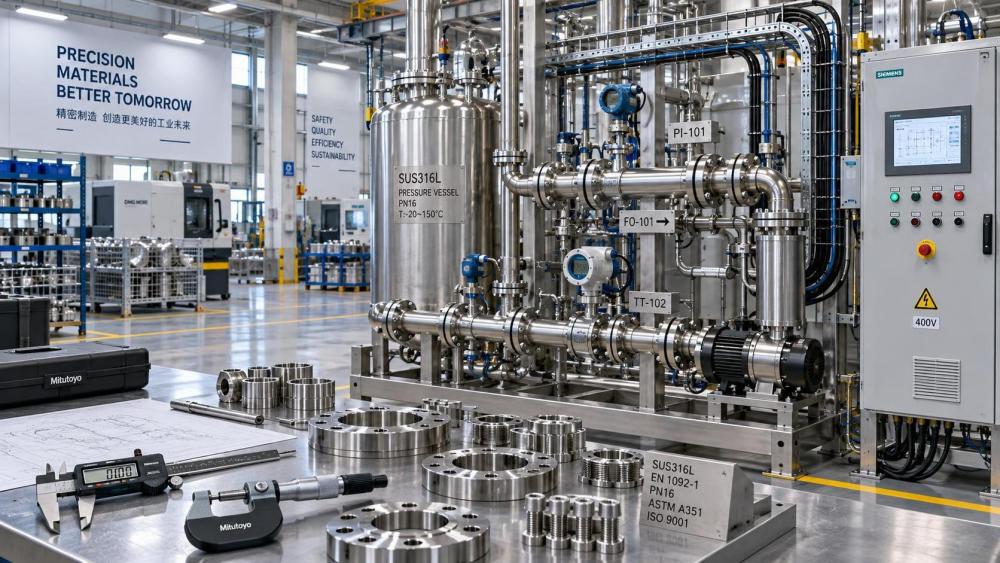
“Stainless steel construction,” “alloy wear parts,” or “corrosion-resistant coating” are not sufficient material specifications. Such phrases may describe a broad intention rather than a verifiable construction standard. The difference between two stainless grades, the heat treatment of a shaft, the thickness of a liner, or the coating preparation method can change corrosion resistance, fatigue performance, cleaning compatibility, and replacement frequency.
Material selection is regularly under-specified in equipment that handles abrasive media, chemicals, food ingredients, pharmaceuticals, high-moisture bulk goods, salt-laden air, wastewater, or outdoor process streams. It is also missed in less obvious locations: fasteners, seals, impellers, valve trim, bearings, cable glands, enclosure hardware, and internal wetted surfaces.
A procurement document should identify materials by a recognized grade or standard where material performance matters. It should also define the applicable components. A requirement for a corrosion-resistant vessel body does not automatically cover nozzles, weld filler, support brackets, inspection ports, or internal fixtures.
For coated equipment, the specification needs more than color and coating type. Buyers should establish surface preparation, dry-film thickness, curing method, expected chemical or environmental exposure, repairability, and inspection requirements. Coating failures frequently begin at edges, joints, fasteners, welds, and damaged transport surfaces rather than on large, easily painted panels.
Material certificates are useful, but they do not replace a clear bill of materials. A certificate only proves something when the buyer can link it to the component, heat number, and specified grade. For critical pressure, sanitary, structural, or corrosive-service applications, traceability should be agreed before production starts.
Interface Compatibility Is Often Treated as an Installation Detail
Equipment can meet its own technical description and still be unsuitable for the plant because its interfaces do not match the surrounding system. This is one of the most expensive omissions because it is often discovered after shipment, when modification options are limited and project schedules are already committed.
Electrical compatibility is more than voltage and frequency. Buyers should verify phase arrangement, earthing system, short-circuit withstand rating, motor starting method, power-quality sensitivity, connector types, cable entry positions, and available panel space. A machine designed for one regional electrical convention may require component replacement, transformer capacity, or control-panel rework elsewhere.
Utility interfaces deserve the same scrutiny. Compressed-air pressure and air quality, cooling-water temperature and flow, steam conditions, vacuum level, gas purity, drainage arrangement, exhaust connection, lubrication supply, and wastewater handling should be included in the equipment data sheet. Stating that a machine “requires compressed air” is not enough when the actual requirement includes dry, oil-free air at a stable pressure and a peak consumption rate that the plant cannot provide.
Control integration introduces another layer. Industrial buyers should clarify:
- Which communication protocols are supported and whether they are native, gateway-based, or optional.
- What signals, tags, alarms, interlocks, and remote-control functions are available to the site control system.
- Whether source files, parameter lists, software licenses, backups, and access credentials are part of the delivery.
- Which party owns responsibility for field commissioning, integration testing, and changes to the PLC, HMI, or safety logic.
A vague commitment to “interface with existing automation” transfers uncertainty into the project. The right comparison is between interface documents: I/O lists, network architecture, functional descriptions, signal ownership, and test responsibilities. Where a supplier proposes proprietary controls, the buyer should understand the consequences for future troubleshooting, upgrades, and spare-module availability.
Environmental Ratings Are Frequently Chosen for the Shipping Location, Not the Operating Location
Equipment may operate indoors on a clean factory floor, outdoors near salt spray, inside a washdown area, in a dusty handling plant, in a high-altitude installation, or under large temperature swings. The equipment specification must describe that environment precisely. A generic “industrial duty” label does not establish whether the enclosure, seals, bearings, sensors, cables, cooling system, or operator interface will withstand it.
Ingress protection is a familiar example. An IP rating has value only when it is appropriate to the actual exposure and applies to the relevant assembly. It does not automatically confirm resistance to detergents, solvents, ultraviolet exposure, impact, condensation, corrosive atmospheres, or pressurized washdown. Similarly, a component’s ambient temperature range may not reflect the temperature inside a poorly ventilated enclosure, under direct sun, or adjacent to a hot process line.
For hazardous or dust-sensitive sites, classification requirements must be established early. The buyer should define the area classification, process media, dust characteristics, gas group where applicable, installation zone, and documentation needed for local approval. Retrofitting suitable motors, sensors, lighting, enclosures, and cable systems after manufacture can be far more difficult than specifying the correct design from the outset.
Environmental specifications should also cover transport and storage where cross-border delivery is involved. Moisture protection, corrosion prevention, vibration restraint, packaging type, preservation period, and storage conditions can affect equipment long before it is commissioned. Precision instruments, control cabinets, lined vessels, optical components, and lubricated assemblies are particularly exposed to poor preservation during extended transit or site delays.
Maintenance Specifications Are Often Reduced to a Spare-Parts List
Maintenance is frequently discussed late in procurement, after the main commercial comparison has been completed. By then, buyers may have selected a machine with difficult access, specialized consumables, undocumented service procedures, or a high dependence on supplier technicians.
A spare-parts list is necessary, but it does not reveal maintainability. Procurement teams should assess the layout of service points, lifting requirements, access clearances, expected replacement intervals, calibration needs, lubrication arrangements, diagnostic capability, and the time required to change common wear parts. A lower-priced machine can impose a higher lifecycle burden if routine work requires extensive disassembly or factory-specific tools.
The comparison should separate three categories: consumables, planned wear parts, and failure-critical parts. Consumables may be easy to source locally. Failure-critical components, such as drives, controllers, proprietary sensors, seals, gearboxes, or specialized bearings, require a more deliberate availability plan. Buyers should also identify which parts are standard industrial items and which are custom to the supplier’s design.
Documentation belongs in this discussion. Useful deliverables include maintenance manuals, recommended service intervals, exploded drawings, electrical schematics, fault codes, software backup procedures, bills of materials, and approved equivalent parts where appropriate. Without these records, the buyer may own the asset but remain dependent on the original supplier for basic service decisions.
Certification Claims Need Scope, Revision, and Responsibility
Certification language can create false confidence when it is copied into a quotation without defining what has actually been assessed. A declaration, a test report, a component certificate, and a third-party product certification are different forms of evidence. Their usefulness depends on the product category, destination market, intended application, and contractual obligation.
Procurement teams should ask which standards apply to the complete equipment, which apply only to selected components, and which version of each standard is being used. They should also determine who is responsible for the final conformity assessment once the equipment is integrated into a larger line or installed with site-specific guarding, controls, or utilities.
This distinction matters because a compliant motor, pressure component, safety relay, or electrical enclosure does not automatically make the completed machine compliant. The finished system may create additional obligations through its guarding, safety circuits, emissions, pressure boundaries, noise profile, electromagnetic behavior, or intended use.
Contract language should define the required documents, the point at which they must be delivered, and the remedies if conformity evidence is incomplete. For equipment moving across borders, buyers also need to align technical certification with customs, local installation, insurance, and customer acceptance requirements. A certificate that satisfies one market may not be sufficient evidence in another.
Turn the Technical Comparison Into a Procurement Control
The practical answer to which technical specifications are most often missed in equipment procurement is not to make every request for quotation longer. It is to convert the specifications that affect site performance into controlled, comparable requirements.
For each critical item, the buyer should record the required value, allowable range, test method, responsible party, and acceptance point. “High-temperature operation” becomes a defined ambient and process temperature range. “Corrosion resistant” becomes specific material grades and exposure conditions. “Compatible with plant controls” becomes a protocol list, I/O responsibility matrix, software-access requirement, and integration test.
That structure also improves supplier comparison. A lower bid may still be the right selection, but only after optional items, assumptions, exclusions, and deviations are visible. The most useful technical review is therefore not a search for the longest specification sheet. It is a disciplined examination of the conditions under which the promised equipment will actually have to work.
Weekly Insights
Stay ahead with our curated technology reports delivered every Monday.
Recommended News
 Supply ChainSep 22, 2026How heavy equipment lifecycle data can reduce unexpected downtime
 Supply ChainSep 21, 2026How export regulations affect logistics lead times and delivery risk
 Industry StandardsSep 20, 2026What evidence is needed to pass a carbon reporting audit?
 Industry StandardsSep 19, 2026When does manufacturing compliance consulting reduce audit risk?