How to compare Southeast Asian suppliers using landed cost analysis
A lower supplier quote does not necessarily produce a lower delivered cost. When comparing manufacturers in Vietnam, Thailand, Indonesia, Malaysia, or other Southeast Asian markets, freight, duties, port charges, and inland transport can reverse the apparent price advantage. The meaningful comparison is the cost of receiving equivalent, usable goods at the same destination—not the price printed on each quotation.
A reliable landed cost analysis starts with consistent specifications, shipment assumptions, and delivery boundaries. It should also distinguish the cost of importing goods from recoverable taxes, inventory financing, and delivery risk. Combining everything into one unexplained figure can obscure the reasons one supplier is genuinely more competitive.
Define the comparison before collecting more prices
Start with a specific buying scenario: the same product specification, order quantity, packaging requirements, destination warehouse, and expected shipment window. A quote for 20,000 units cannot be compared directly with one for 5,000 units if the difference changes production pricing, container utilization, or shipment frequency.
Confirm that “equivalent product” includes the requirements that affect acceptance. Material grade, tolerances, testing, labeling, export packaging, and required conformity documentation should be explicit. A cheaper quotation that excludes mandatory testing is not a lower-cost offer until the missing work is priced.
Use two cost boundaries:
- Landed cost: the purchase price plus the costs required to bring the goods to a named receiving location, including applicable nonrecoverable import charges.
- Decision adjustments: separately identified costs for financing, additional inventory, quality losses, and disruption exposure.
This separation keeps the import calculation auditable while allowing delivery reliability to influence the sourcing decision. It also prevents a speculative disruption estimate from being mistaken for a confirmed freight or customs charge.
Normalize Incoterms rather than comparing quotation totals
An EXW factory quote, an FOB port quote, and a DDP warehouse quote cover different responsibilities. Their headline prices cannot be ranked without reconstructing the costs included in each.
Record the full delivery term, named place or port, and applicable Incoterms version. “FOB Vietnam” is insufficient: the actual loading port affects inland transport, sailing options, and origin charges. For containerized shipments handed to a carrier before loading aboard the vessel, FCA may better reflect the physical handover than FOB.
Incoterms allocate specified costs, responsibilities, and risk; they do not determine tariff classification, payment terms, or ownership transfer. Under CIF, for example, the seller pays carriage and insurance to the named destination port, but risk transfers at shipment rather than warehouse receipt.
For comparison purposes, rebuild every offer to the same endpoint. Do not add origin handling twice if it is already included in the supplier’s price. Equally, do not assume a freight quotation includes destination terminal handling, customs brokerage, or delivery appointments unless those items are stated.
Price the actual route, not the exporting country
A country-level freight assumption is too broad for a supplier award. A factory near an export gateway and an inland factory requiring a feeder connection can have materially different logistics costs, even within the same country.
Ask for a route-specific quotation covering the factory or agreed handover point through to the destination warehouse. Specify shipment weight, packed volume, container type, cargo restrictions, and the intended shipping period. Identify whether the service is direct or transshipped and whether the quoted schedule includes inland movement.
For low-density products, packaging efficiency can matter more than a small unit-price reduction. A supplier whose cartons reduce container utilization increases freight per unit. For heavy products, payload limits and inland road restrictions may determine the usable shipment quantity before container volume is exhausted.
Compare full-container-load and less-than-container-load options using total charges, not ocean freight alone. Consolidation, deconsolidation, minimum fees, and local handling can change the result. Also confirm free-time allowances and the charging basis for storage, demurrage, and detention. Include known unavoidable charges in the base case; test contingent charges separately.
Determine duties from the product and destination—not the shipping address
The relevant duty depends on the importing market, tariff classification, customs value, origin, and any applicable preferential treatment or additional measures. A supplier’s location in Southeast Asia does not establish that its goods qualify for a reduced rate.
Confirm the destination tariff code using the product’s composition, function, and technical characteristics. A supplier’s suggested HS code is a useful starting point, but national tariff subdivisions and classification interpretations require destination-specific review. Where the classification materially changes the award decision, seek qualified customs advice or an available binding ruling.
Preferential duty treatment requires more than a certificate bearing the exporter’s address. The goods must satisfy the relevant agreement’s product-specific origin rules and supporting requirements. Imported components, manufacturing operations, and transport arrangements may affect eligibility. Model the ordinary rate unless the preferential claim can be supported.
Check separately for trade remedies, product-specific duties, quotas, excise charges, and other applicable measures. Shipment through a different country does not itself change origin or remove such obligations.
Customs value also needs its own calculation. Depending on destination rules, freight, insurance, assists, certain royalties, or other adjustments may enter the valuation base. A tooling payment made outside the commercial invoice should not automatically disappear from the analysis.
Keep recoverable import VAT or GST outside the economic landed-cost total where recovery is available and supportable. Nevertheless, show it in the cash-flow schedule: a recoverable tax still consumes working capital until credited or refunded. Any nonrecoverable portion belongs in the cost comparison.
A worked comparison: the lowest quote loses its advantage
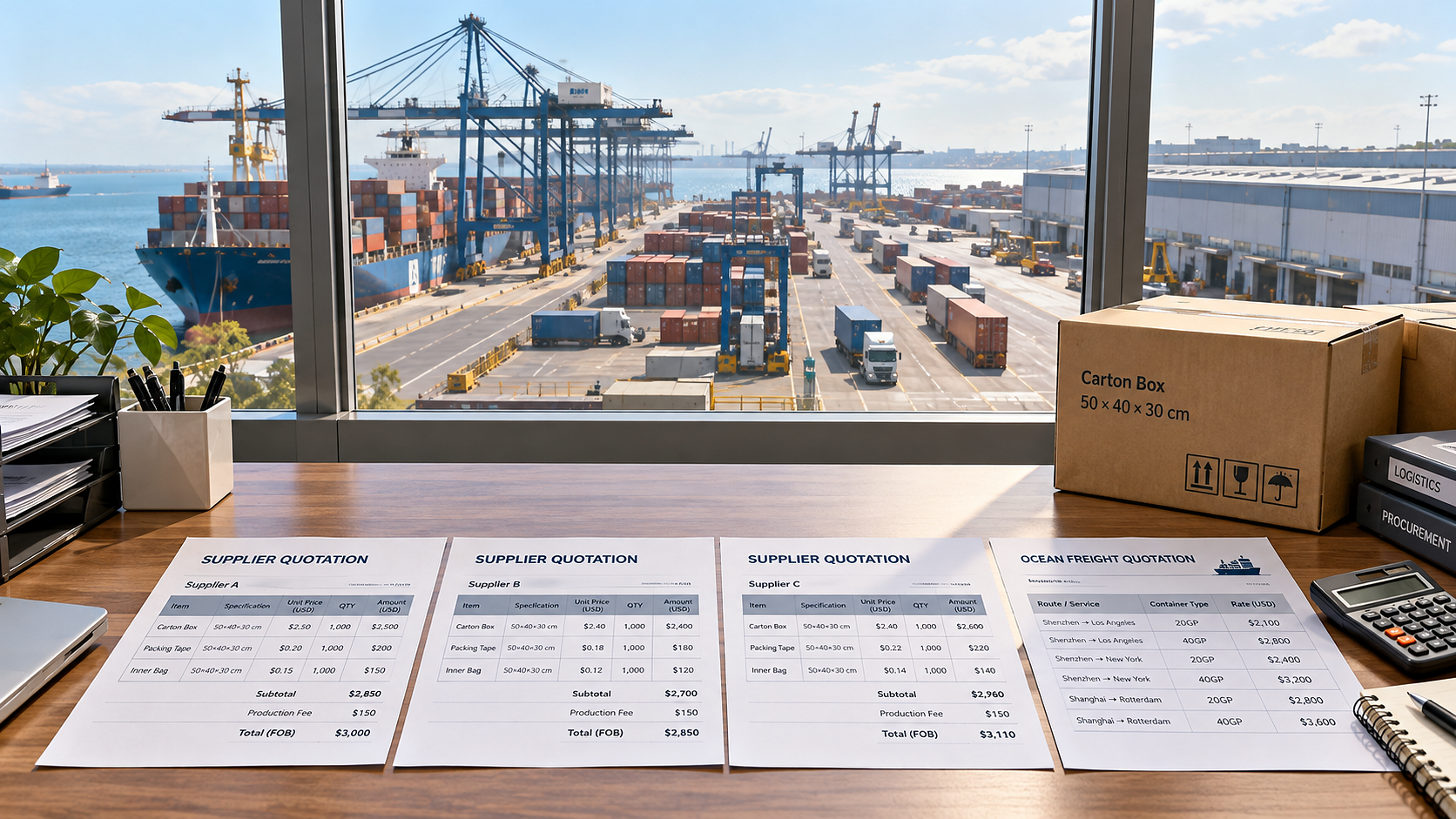
Consider three hypothetical suppliers offering the same specification, packaging, and 10,000-unit shipment to one destination warehouse. All quotations have been normalized to FOB at their respective ports.
The figures below are illustrative, not freight benchmarks or country-specific tariff guidance. To isolate logistics differences, each offer uses an assumed 5% duty on an assumed customs value equal to the goods price. An actual import requires the destination’s valuation rules and applicable tariff treatment.
Supplier B’s goods price is $2,000 above Supplier A’s, yet its landed cost is $600 lower. More importantly, B leads C by only $150 per shipment, or $0.015 per unit. That margin is too narrow to justify ignoring freight validity, delivery performance, or payment conditions.
The figures establish a cost ranking for this shipment configuration—not a permanent ranking of the suppliers or their countries. A different destination, container utilization, or order quantity could change the result.
Keep lead time, payment terms, and currency exposure visible
Two suppliers with similar landed costs may require different amounts of cash. A substantial production deposit followed by payment before shipment ties up funds earlier than payment after delivery. Compare the payment timeline from the first cash outflow through receipt, rather than using transit time alone.
A practical financing estimate is the amount funded multiplied by the annual funding rate and the relevant fraction of a year. Apply it to the actual payment stages where the difference matters. Avoid charging financing twice through both a detailed cash-flow model and an overlapping inventory carrying-cost allowance.
Longer replenishment lead time can also increase pipeline inventory. Greater variability may require additional safety stock, but that adjustment should reflect demand and service requirements—not an arbitrary percentage added to the purchase price. Separate production lead time, booking delay, transit time, and clearance time to identify which exposure the supplier can control.
Convert all quotations using the same exchange-rate basis and date. If treasury has committed a hedge for the purchase, use the relevant hedged economics consistently. For unhedged offers, test exchange-rate movement through expected payment dates. A USD quotation removes direct invoice-currency variation for a USD-funded buyer during its validity, but does not guarantee unchanged pricing at renewal.
Quality belongs in the decision adjustment as well. Where supported by inspection or acceptance records, compare cost per accepted unit and add expected rework or replacement expenses separately. Without comparable evidence, require samples, process validation, or a controlled initial order rather than inventing a defect allowance.
Test whether the saving survives a plausible change
A useful sensitivity analysis focuses on variables capable of reversing the decision. In the example, Supplier C needs only a $150 improvement relative to B to tie its landed cost. A modest change in routing charges could therefore matter more than another round of unit-price negotiation.
Test the quoted freight against an alternative rate scenario, the expected shipment size against a partial-load scenario, and any conditional preferential duty against the ordinary rate. Where disruption is material, show the cost of a defined event—such as a delayed shipment requiring partial airfreight—without presenting it as inevitable.
Preserve the evidence behind each material input: quotation date and validity, freight scope, tariff source, origin documentation, exchange-rate basis, and tax-recovery assumption. An unsupported assumption should remain visibly distinct from a confirmed charge.
The award decision should state both the expected saving and what could erase it. When the advantage is smaller than the unresolved cost uncertainty, securing a firmer freight quote, validating origin, or clarifying destination charges is more valuable than declaring a winner. The strongest landed cost comparison is not the most elaborate spreadsheet; it is the one that makes the supplier ranking defensible under the conditions the order will actually face.
Have questions about this sector analysis, or seeking best practices specific to your niche? Drop us a line below and let the senior consultants at GTIIN assist you.
“We respect your privacy. Your information is strictly confidential.”
Weekly Insights
Stay ahead with our curated technology reports delivered every Monday.
Recommended News
 Global SourcingOct 28, 2026How to compare Southeast Asian suppliers using landed cost analysis
 Market TrendsOct 28, 2026World Bank’s 2026 Off-Grid Solar Market Trends Report: Users Reach 149 Million
 Supply ChainOct 27, 2026How to account for chargeable weight in air freight cost analysis
 Supply ChainOct 27, 2026USTR Proposes Extending Pause on China Maritime Trade Measures to January 2027