Choosing a CNC Beam Saw Manufacturer: Evidence to Request
A CNC beam saw purchase can look straightforward when quotations list similar cutting lengths, motor ratings, and software functions. The risk sits in what those figures do not show: whether the machine will repeatedly hold panel dimensions, whether safety functions work under real operating conditions, whether spare parts can be identified years later, and whether the supplier can support commissioning without turning the buyer into the test engineer.
For procurement teams, the right question is not simply “Which manufacturer has the most features?” It is “What evidence can this manufacturer provide that the proposed machine, its controls, its safety system, and its service model are suitable for our operating conditions?” A disciplined evidence request reduces the chance of comparing polished brochures rather than comparable industrial assets.
Start with the production requirement, not the machine catalogue
A beam saw should be assessed against the panel flow it must handle. This means defining the incoming material, finished-part tolerance, cutting patterns, shift arrangement, operator skill level, and downstream process before issuing a request for quotation.
For example, a furniture-component plant processing coated particleboard may focus on edge quality, chip control, label accuracy, and cut-list integration. A cabinet producer with frequent small batches may place more weight on changeover speed and nesting logic than on maximum feed speed. A distributor cutting large-format panels for multiple customers may need reliable handling of mixed sheet types, traceability by job, and practical recovery procedures when labels or barcodes do not scan.
Procurement specifications should also separate required capability from desirable capability. A maximum cutting envelope matters only if it accommodates the largest panel actually purchased, including handling clearance. A high stated feed speed has limited value if the cutting program, pressure beam, scoring configuration, or outfeed arrangement becomes the real bottleneck.
Ask internal stakeholders to provide representative material samples and a short set of production files. These should include common parts, narrow strips, repeated cuts, long cuts, and any difficult materials such as melamine-faced board, plywood, laminates, or panels with protective film. This gives manufacturers a practical basis for proposing a configuration and creates a clearer foundation for later acceptance testing.
Request a machine configuration that can be audited
“Standard configuration” is rarely specific enough for a capital-equipment decision. The quotation should identify the exact machine arrangement being offered, including the saw carriage, main blade and scoring blade arrangement where applicable, pusher system, side alignment devices, clamps, pressure beam, air requirements, dust-extraction connections, electrical supply, software modules, and material-handling interfaces.
It is useful to request a line-item configuration sheet that distinguishes between included equipment, optional equipment, customer-supplied equipment, and assumptions requiring confirmation. A missing item can change the practical cost or commissioning timetable. Typical examples include extraction ducting, compressor capacity, electrical isolation equipment, panel infeed tables, barcode printers, waste handling, and interfaces to production-management software.
Manufacturers should also be asked to state the limits attached to each claimed capability. If a machine is described as suitable for thin panels, narrow strips, stacked cutting, or high-gloss surfaces, request the minimum and maximum material conditions under which that statement applies. The answer may depend on panel flatness, friction, surface finish, blade selection, clamp pressure, and whether an operator must use a special loading method.
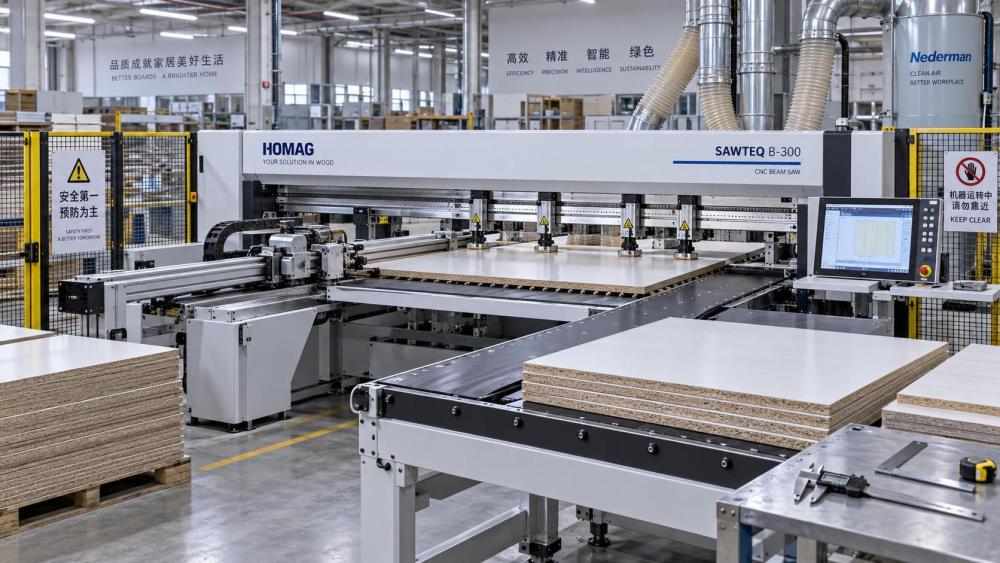
When reviewing product categories, buyers can use the Zhongding CNC beam saw range as a reference point for identifying the types of panel-saw configurations that may need to be compared. The useful procurement task is not to assume that one format suits every plant, but to match the available machine architecture to material dimensions, cutting volume, automation level, and layout constraints.
What performance evidence is more useful than a headline specification?
Catalogued specifications establish a starting point, but they do not demonstrate repeatability. A buyer should request a proposed factory acceptance test, commonly called a FAT, based on the buyer’s own materials and production patterns where possible. The test protocol should be agreed before purchase order release, rather than written after a machine has been built.
A practical FAT can include:
- cutting representative panel types at the intended stack height;
- measuring repeated finished-part dimensions from several positions within the cutting pattern;
- checking diagonal consistency or squareness on suitable sample parts;
- inspecting visible cut quality on the face and underside of coated panels;
- running a representative cutting program through the quoted software workflow;
- demonstrating label generation, job identification, and error handling if these functions are in scope;
- recording cycle timing using a defined cut list rather than an empty-machine demonstration.
The important point is that acceptance criteria must be measurable and tied to the proposed machine. Avoid copying a generic tolerance from another process without confirming that the panel type, tool condition, environmental conditions, and measurement method are comparable. A narrow tolerance may be technically possible for one material and production pattern but unsuitable as a contractual blanket requirement.
Ask who will provide measuring equipment, who will take readings, how many samples will be inspected, and what happens if one result falls outside the agreed band. The procedure should specify whether blade changes, warm-up time, and normal setup adjustments are permitted. Otherwise, a demonstration can become difficult to interpret.
Look beyond cutting speed
Actual throughput depends on more than saw travel speed. It is affected by loading, panel positioning, program optimization, saw-carriage movement, pusher travel, clamp cycles, label application, offloading, sorting, re-cuts, and operator interventions. If automation is proposed, ask for a layout drawing and a cycle analysis that states its assumptions. A claimed output rate may rely on identical panels, an uninterrupted material supply, or an ideal cutting pattern that does not resemble daily work.
Procurement teams should request a list of routine stops and reset procedures. This includes what happens after an emergency stop, a panel misalignment, a failed label print, a sensor fault, a low-air-pressure alarm, or an interrupted program. Recovery time can have a larger operational effect than a small difference in nominal feed speed.
Safety evidence should cover the machine, integration, and documentation
A CNC beam saw contains moving carriages, cutting tools, clamping systems, electrical equipment, pneumatic circuits, and potentially automated loading or unloading equipment. Safety cannot be assessed by asking whether the machine has an emergency-stop button. Request the safety documentation applicable to the delivered machine and require the supplier to identify the boundary between its responsibilities and those of the buyer or third-party integrator.
For woodworking machinery, ISO 19085-1 sets out general safety requirements for woodworking machines, while ISO 19085-5 addresses dimension saws, including panel sizing saws. These standards can provide a structured reference for discussions about safeguards, control systems, access areas, maintenance access, and information for use. Source: ISO 19085-1:2021, Safety of woodworking machines — Part 1: General requirements; ISO 19085-5:2021, Safety of woodworking machines — Part 5: Dimension saws, International Organization for Standardization.
Where equipment is supplied for the European Economic Area, the buyer should verify the relevant conformity route for the delivery date and scope of supply. At the time of writing, Directive 2006/42/EC remains applicable until the transition to Regulation (EU) 2023/1230 on 20 January 2027. Source: Regulation (EU) 2023/1230, Article 52, Official Journal of the European Union. This is not a substitute for legal or technical compliance advice, particularly where a saw is integrated into a larger automated line.
Evidence requests should include the declaration or declarations applicable to the equipment, risk-assessment information appropriate for the buyer’s review, electrical schematics, pneumatic diagrams, operating instructions, maintenance instructions, and a list of safety-related devices. If the machine connects to automatic handling equipment, request the planned safeguarding concept for transfer zones, including who is responsible for perimeter guarding, interlocked access doors, safety scanners, and reset locations.
Dust extraction also deserves specific attention. Fine wood dust and panel dust should be captured at the source through an extraction system matched to the machine and material. Ask the supplier for required airflow, connection sizes, recommended extraction arrangement, and any conditions that affect cutting performance or housekeeping. The buyer’s extraction contractor must then verify that the installed system achieves the required operating conditions.
Inspect the evidence behind build quality and maintainability
Manufacturing quality is difficult to judge from photographs of a finished machine. Procurement can ask for evidence that is harder to prepare cosmetically: drawings showing the main frame and access points, documentation for purchased critical components, lubrication requirements, preventive-maintenance schedules, and spare-parts lists with manufacturer part numbers where appropriate.
Questions worth asking include:
- Which items are expected to wear during normal operation, and what inspection interval is recommended?
- Which components can be replaced by trained site personnel, and which require factory support?
- Are saw blades, scoring blades, belts, bearings, clamps, sensors, and pneumatic components identified in the manuals?
- How are software backups created, stored, and restored?
- Can the buyer retain copies of electrical drawings, PLC backups, alarm lists, and parameter records?
- What consumables and recommended spare parts should be available before commissioning?
A supplier should be able to explain the distinction between preventive work and breakdown repair. “Low maintenance” is not enough. A machine that requires a brief, scheduled inspection of guides, clamps, lubrication points, and extraction condition may be more manageable than one with fewer stated tasks but limited diagnostic information.
Check whether technical documentation is available in the language required by the operating site. Translation quality matters because lockout procedures, blade-change steps, alarm recovery, and maintenance warnings must be understood without interpretation. Ask for sample manual sections before finalizing the purchase if documentation quality is a concern.
Delivery capability is a procurement risk, not a logistics detail
A credible delivery plan identifies the period needed for engineering, manufacturing, internal testing, packing, shipping, installation, commissioning, operator training, and final site acceptance. The plan should identify dependencies owned by the buyer, such as foundations, power supply, compressed air, dust extraction, network access, material availability, lifting equipment, and permits for installation work.
Request the proposed packing method, package dimensions, gross weights, unloading requirements, and lifting points early. A machine can arrive on time yet remain unusable if the facility door, forklift capacity, overhead clearance, or internal transport path has not been checked.
Commissioning scope should be defined in operational terms. Clarify whether it includes mechanical assembly, electrical connection, calibration, software setup, test cuts, training by role, and support for the first production jobs. If remote support is offered, ask about time-zone coverage, communication channels, response assumptions, and what diagnostic access is required from the site.
Use a weighted evidence matrix before commercial negotiation
Price comparisons become more reliable when technical, operational, and contractual evidence is scored before final negotiation. A simple matrix can prevent a low initial quotation from masking exclusions or unresolved risk.
The strongest manufacturer is not necessarily the one that makes the broadest claim. It is the one that can connect its proposed machine to a documented production requirement, demonstrate the agreed configuration, state its operating limits, and define what will be tested before and after installation. For procurement teams, evidence creates a more defensible decision than specification sheets alone.
Tags
Weekly Insights
Stay ahead with our curated technology reports delivered every Monday.
Recommended News
 Supply ChainSep 22, 2026How heavy equipment lifecycle data can reduce unexpected downtime
 Supply ChainSep 21, 2026How export regulations affect logistics lead times and delivery risk
 Industry StandardsSep 20, 2026What evidence is needed to pass a carbon reporting audit?
 Industry StandardsSep 19, 2026When does manufacturing compliance consulting reduce audit risk?