How to Use an Export Documentation Template Without Missing Key Trade Data
How to Use an Export Documentation Template Without Missing Key Trade Data
Using an export documentation template can streamline paperwork, reduce customs delays, and help operators capture every critical trade detail from the start. For teams handling cross-border shipments, the real challenge is not just filling in forms, but ensuring accuracy across product data, shipping terms, compliance records, and consignee information. This guide shows how to use a template efficiently without overlooking the key data that keeps global trade moving.
The part most teams underestimate is that an export document set is rarely a single document problem. A template may begin with the commercial invoice, packing list, shipping instruction, or internal dispatch checklist, but the failure point usually appears where one field has to match three or four other records. Product description on the invoice must align with what appears on the packing list. Quantities must reconcile with warehouse release data. Incoterms must match the sales contract and booking instruction. The consignee and notify party details must reflect what the carrier, customs broker, and sometimes the bank expect to see. The template works only when it is treated as a control document, not a typing shortcut.
That matters even more when shipments move across sectors with very different documentation sensitivities. A container of standard fasteners, a pallet of industrial sensors, and a bulk order of coated steel components may all use an export documentation template, but the fields that carry the highest risk are not the same. In one shipment, the problem is often a vague goods description. In another, it is origin support, product classification, or inconsistency between net weight, gross weight, and package count.
Where templates help most, and where they quietly fail
For repeat shipments of the same SKU family, templates save real time. The exporter already knows the standard unit of measure, packaging configuration, dimensions, and baseline consignee fields. In these lanes, the template is most useful when it locks in stable data and forces manual review only on variables such as shipment date, batch quantity, booking reference, port pair, and payment terms.
The trouble starts when teams reuse old templates too aggressively. A previous shipment may have gone under FOB terms, while the new order is CIF. The item description may still be commercially accurate but no longer detailed enough for customs review if the destination market has stricter scrutiny. Even something as routine as carton marks can create downstream confusion when warehouse staff use one version, the invoice shows another, and the bill of lading instruction reflects neither. Most documentation errors are not dramatic; they are inherited.
This is why experienced export teams build templates around data checkpoints rather than document names alone. They ask a narrower question: which fields, if wrong or inconsistent, can stop cargo release, delay customs entry, trigger amendment fees, or create payment disputes?
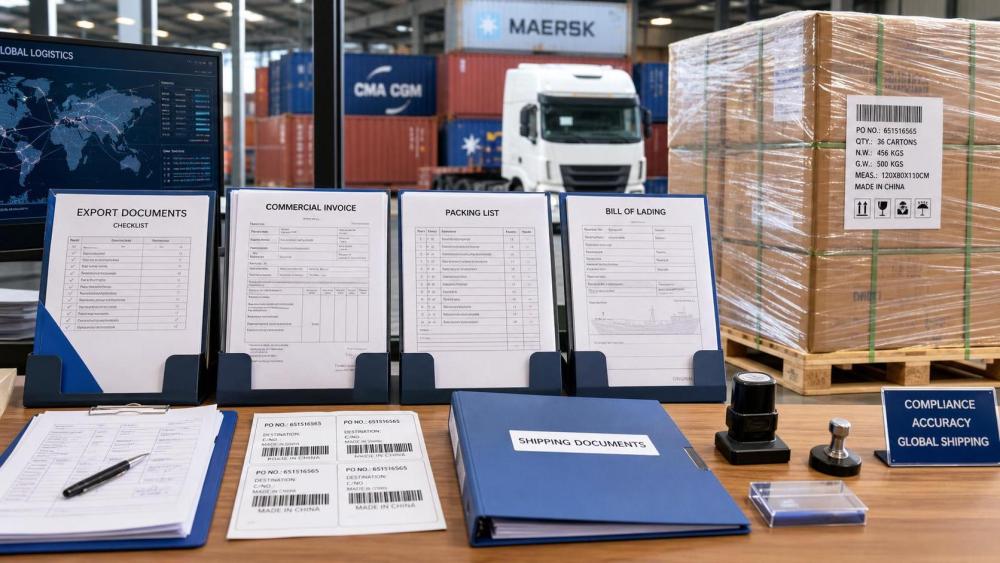
In practice, the answer usually sits in five groups of trade data:
- Identity data: exporter, importer, consignee, notify party, tax or registration identifiers where required.
- Goods data: product name, material or model reference, quantity, unit, net and gross weight, package count, and marks.
- Commercial data: invoice number, declared value, currency, payment terms, and Incoterms rule with named place.
- Transport data: mode, port or airport pair, carrier booking reference, container or package details, and requested shipping documents.
- Compliance data: country of origin, classification references where applicable, permit or license references, and any destination-specific declarations.
A good export documentation template should force these categories into the same workflow before cargo is handed over. If the template does not expose these dependencies, it may still look organized while missing the data that actually matters.
Industrial shipments need more precise product language than many sales teams expect
One recurring issue in industrial trade is the gap between commercial naming and customs-usable naming. Sales teams often write what buyers recognize quickly: “machinery parts,” “control modules,” “metal components,” “processed materials.” Those phrases may be acceptable in emails and quotations, but they are often too broad for export documents.
When using a template for machinery, electrical assemblies, fabricated metals, or engineered materials, the description field should be built to capture what the item is, not just what the seller calls it. If relevant and already verified internally, that may include model number, material type, function, and whether the goods are spare parts, complete units, or subassemblies. The point is not to turn the invoice into a technical manual. The point is to avoid a description so general that customs, freight partners, or banks have to guess.
This becomes more important when products carry coatings, treatment processes, or mixed-material construction. A template that only asks for “item name” often misses the details needed later for classification review, destination entry, or internal audit. GTIIN’s work across industrial sectors shows that documentation friction frequently grows where the physical nature of the goods is more complex than the wording used to describe them.
The template has to reflect the shipping lane, not just the company standard
Teams that export to multiple regions often standardize their forms too far. Internal consistency is useful, but destination rules, broker expectations, and customer document requirements are not uniform. The same exporter may need one document rhythm for intra-Asia container trade, another for shipments into the EU, and a different review level for markets where banks remain closely involved in trade document examination.
That does not mean creating a new template for every country. It means designing one core template with route-sensitive prompts. For example, some shipments need a stronger origin data trail because preferential treatment, trade remedies, or customer import controls depend on it. Others need closer control over consignee legal names and address formatting because local customs systems reject abbreviations or mismatched registration details. In some projects, the operational problem is less about customs law and more about port-side execution: warehouse label counts, pallet dimensions, and packing sequence must match the loading plan and the shipping instruction exactly, otherwise document amendments start before the vessel even departs.
An export documentation template should therefore include a short route review section. Not a long memo. Just enough to trigger the right questions before release.
Warehouse reality should shape the document, not the other way around
A surprisingly high number of document issues start on the packing floor. The template may ask for package count, dimensions, and weights, but if those values are entered before final packing confirmation, the document set becomes an assumption. That is manageable for stable cartonized goods. It is much less reliable for oversized cargo, mixed pallets, moisture-sensitive materials, or industrial components that require reinforcement, blocking, or export-grade wrapping after the initial pick list is issued.
For heavy equipment parts, steel fabrications, or fragile technical assemblies, the packing list should be fed by actual packed condition rather than planned condition whenever timing allows. Operators on site know that one added support frame, one pallet split, or one crate substitution can change dimensions, gross weight, package numbering, and marks. If the export documentation template does not reserve a final verification stage after packing completion, the paperwork may be internally neat and externally wrong.
This is also where digital templates outperform static spreadsheets. A shared form linked to warehouse confirmation, shipping booking, and commercial approval reduces the habit of maintaining parallel versions. The operational gain is not just speed. It is traceability: who changed the net weight, who updated the consignee address, who approved the final declared value.
Compliance fields should be visible early, even when they are not needed every time
Many exporters only notice missing compliance data after the shipment is already booked. That is late. A practical template puts compliance prompts near the top of the workflow, even if the answer for many orders is simply “not applicable.” That may include fields for origin basis, internal classification reference, controlled item review, buyer-requested declarations, or market-specific documentation support.
The value of doing this is not theoretical. Cross-border industrial trade increasingly sits beside sanctions screening, product controls, environmental declarations, and customer due diligence requirements. The documentation template does not replace legal review, and it should not pretend to. What it can do is prevent teams from forgetting to ask the question while the shipment is still movable.
This is especially relevant for companies exporting engineered goods into markets where customs and procurement teams both want more clarity. A buyer may not challenge the commercial invoice amount, but they may reject documents that do not support internal import filing, sustainability reporting, or supplier onboarding controls. Templates that capture only what the seller needs are often too narrow for current trade conditions.
What experienced teams check before they trust the template
A useful export documentation template is less about layout than about discipline. Before rolling one into daily use, strong teams usually test it against real shipment variation: a standard reorder, a mixed industrial consignment, a destination with tighter customs review, and a shipment handled under document-sensitive payment terms. If the same template cannot survive those conditions without side emails and manual patches, it is not yet doing the job.
Three checks tend to reveal weaknesses quickly. One: can the template reconcile commercial, logistics, and warehouse data without duplicate entry? Two: does it force review of the fields that most often generate amendments or broker queries? Three: can a new operator follow it without inheriting undocumented assumptions from the last shipment?
That is the practical standard. An export documentation template should reduce routine friction, but it also needs enough structure to catch exceptions before they become expensive. If a team is still chasing missing origin details, correcting package counts after loading, or explaining why the consignee name differs across documents, the issue is rarely that people forgot how to fill in a form. More often, the template was never built around the real trade data that moves with the cargo.
For exporters working across industrial supply chains, the better question is not whether to use a template. It is whether the template reflects the product, the lane, the packing reality, and the compliance exposure of the shipment in front of you. That is where documentation stops being clerical and starts becoming operational control.
Have questions about this sector analysis, or seeking best practices specific to your niche? Drop us a line below and let the senior consultants at GTIIN assist you.
“We respect your privacy. Your information is strictly confidential.”
Weekly Insights
Stay ahead with our curated technology reports delivered every Monday.
Recommended News
 Supply ChainNov 10, 2026China Extends Pause on 24% Additional Tariff on US Goods by Two Months
 Industry StandardsNov 10, 2026Which imports are subject to EU carbon border compliance?
 Global SourcingNov 09, 2026USTR Extends 178 China Section 301 Tariff Exclusions to January 2027
 Supply ChainNov 09, 2026How can a tariff risk management dashboard track cost exposure?