
Where is the US maritime freight transport market adding capacity?
A procurement team may see a familiar problem: container space appears available at one U.S. gateway, yet inland delivery is unreliable; another route offers a faster sailing but has limited chassis, rail slots, or warehouse capacity. The question is not simply whether more ships are entering the trade. Capacity in the U.S. maritime freight transport market is being added unevenly across ports, cargo types, terminals, and inland corridors.
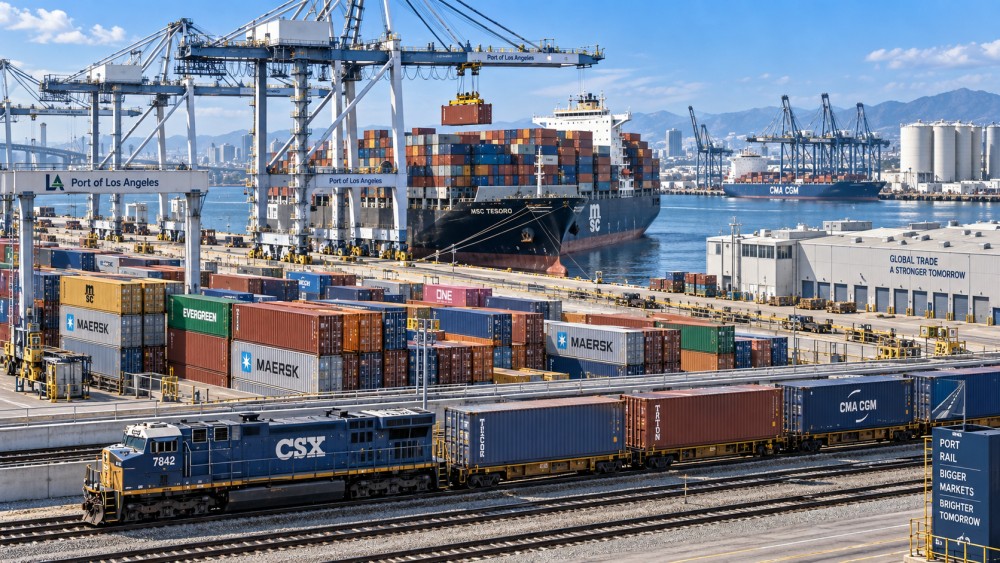
The clearest additions are concentrated around Gulf Coast energy and bulk-export gateways, Southeast and East Coast container gateways, selected Pacific Northwest routes, and the rail, barge, storage, and distribution systems connected to those ports. For decision-makers, the practical implication is that new maritime capacity only improves supply-chain resilience when the entire route—from origin factory to final inland destination—can absorb the shipment.
Capacity is expanding where cargo demand has become more durable
Port expansion is rarely driven by a temporary spike in freight volumes alone. Terminal operators, carriers, railroads, warehouse developers, and public authorities generally commit capital where they see sustained demand, physical constraints, and a credible connection to inland freight markets. In the United States, that logic is directing investment toward a few distinct cargo ecosystems rather than one uniformly expanding national network.
The first is the Gulf Coast, where export-oriented industrial production, energy products, chemicals, agricultural cargoes, and breakbulk freight create demand for specialized berths, storage, dredged channels, towage, tank farms, and rail or truck interfaces. The second is the Southeast and East Coast, where population growth, consumer imports, manufacturing investment, and diversified vessel calls support expansion of container terminals and distribution corridors. The third includes select Pacific gateways, especially where shippers need alternatives to highly concentrated import routes or want closer connections to Asian services and inland rail networks.
These developments do not mean every port in a region will offer the same operational advantage. A port may add quay space while remaining constrained by labor availability, container dwell time, rail handoffs, road access, local storage, or vessel scheduling. Capacity should therefore be evaluated as a route-specific condition, not as a regional headline.
Gulf Coast: more than a container story
The Gulf Coast is one of the most important areas for new maritime freight capability because its growth is tied to physical commodities that cannot be easily rerouted through standard container networks. Energy exports, refined products, liquefied gases, petrochemicals, project cargo, steel, machinery, grain, and other bulk commodities all require different terminal designs and operating disciplines.
For exporters and industrial buyers, capacity additions in this region often appear in forms that are less visible than a new container crane. They may include deeper navigation channels, improved vessel access, expanded liquid-bulk handling, additional laydown areas for oversized cargo, dry-bulk conveyor systems, rail-served industrial sites, or warehouse space near port zones. These assets matter because specialized freight can become delayed even when general port congestion is low.
A manufacturer moving heavy equipment components, for example, should not assume that a port handling high volumes of containerized imports can also accommodate out-of-gauge cargo efficiently. The relevant questions are whether the terminal has suitable lifting equipment, whether the berth can receive the intended vessel type, how cargo is secured before loading, and whether local roads permit the required dimensions and weights. Gulf Coast expansion is particularly meaningful for cargo owners who need these specialized capabilities, not just another container booking option.
Energy-linked traffic also changes the balance of vessel availability. Where export cargo is strong, carriers and charter operators may have more reason to position tonnage, containers, or specialized ships in the region. Yet an apparent increase in outbound capacity does not automatically create balanced import service. Equipment repositioning, sailing frequency, port calls, and the commercial priorities of vessel operators still determine whether a given origin-destination pair is practical.
Southeast and East Coast gateways are adding network flexibility
Along the Southeast and East Coast, capacity additions are closely tied to containerized imports, retail distribution, industrial inputs, automotive flows, and regional manufacturing. The most useful expansions are not necessarily the largest terminal projects. They are the ones that create an alternative when a primary gateway faces delay, weather disruption, berth crowding, labor constraints, or insufficient inland transport.
Several operational changes can increase effective capacity at these gateways:
- Additional berth space or yard reconfiguration that allows more vessel calls to be handled without excessive bunching.
- Modernized cranes and gate systems that improve the movement of containers between vessels, yards, trucks, and rail.
- Near-port distribution facilities that reduce the need to hold import containers in terminal yards.
- On-dock or nearby rail connections that allow cargo to move beyond the coastal market without relying solely on trucking.
- Expanded chassis pools, appointment systems, and return-location coordination, which can materially affect container release times.
For a buyer with factories or distribution centers in the interior United States, the inland connection may be more important than the port itself. A Southeast port can be an attractive alternative only when rail schedules, drayage availability, transload capacity, and destination-side warehouse receiving windows match the shipment plan. Diverting cargo to a gateway that is physically farther from the final market can still lower risk if its inland network is more reliable. The reverse is also true: a port with ample berth capacity may offer little value if containers wait days for a rail departure or truck appointment.
Decision-makers should distinguish between gateway capacity and network capacity. Gateway capacity concerns whether a ship can berth and unload. Network capacity concerns whether the released cargo can reach its next node predictably. Procurement continuity depends on the second measure.
Pacific gateways are changing through diversification, not replacement
The U.S. Pacific coast remains central to trans-Pacific trade, but the capacity question has become more nuanced. Many importers are no longer looking for one dominant entry point. They are seeking a portfolio of routings that can be activated when ocean schedules, terminal conditions, inland rail service, or inventory requirements change.
Capacity in Pacific gateways can be strengthened through terminal improvements, extended gate operations, rail coordination, equipment availability, and better synchronization between vessel discharge and inland movement. The Pacific Northwest can be relevant for cargo serving northern and inland markets, while Southern California remains important because of its scale, service density, and links to national distribution networks. However, neither should be treated as a universal answer for every shipment.
A company importing components from Asia may find that a direct Pacific service minimizes sailing time but creates more variability at the destination due to rail or drayage conditions. An all-water route to the East or Gulf Coast may take longer at sea but offer a better fit for inventory that is already intended for eastern production sites. The right choice depends on total landed logistics performance: transit variation, inventory carrying cost, cargo sensitivity, port handling requirements, and the ability to recover from disruption.
Inland infrastructure is where “added maritime capacity” becomes usable
In the U.S. maritime freight transport market, the most consequential expansion is often beyond the waterfront. Ports can move more cargo only if containers, bulk materials, and project shipments leave the terminal at a sustainable pace. This is why intermodal rail, inland ports, barge systems, trucking networks, transload facilities, and regional warehouses are central to the current capacity picture.
Rail-linked container services are especially important for importers shipping to inland manufacturing centers or large distribution regions. A direct rail transfer can reduce terminal dwell and lower dependence on long-haul trucking, but its value depends on schedule frequency, railcar availability, cut-off times, destination ramp conditions, and the ability to retrieve containers promptly at the inland terminal. A nominal rail connection is not enough; the service must match the buyer’s production and receiving calendar.
Barge and short-sea options can also matter for certain coastal, river-connected, bulk, and oversized freight movements. These modes may relieve pressure on roads or provide access to industrial sites that are not well served by rail. Their limitations are equally important: sailing frequency may be lower, handling windows can be narrower, and cargo may require additional transfers. They are best considered as part of a planned logistics design rather than a last-minute substitute for a disrupted truck route.
How to test whether an expanding gateway is relevant to your cargo
When reviewing a new port option or carrier service, start with the cargo flow rather than the announcement. A useful assessment begins by defining the point of failure the route is meant to solve. Is the concern vessel space, port delay, empty-equipment availability, customs processing, storage, rail departure, trucking capacity, or final delivery?
Then compare the proposed route against the current route using operating conditions that can be verified with carriers, forwarders, terminals, and inland providers:
Where capacity may look larger than it is
One recurring mistake is to interpret construction activity or a new carrier announcement as immediately available capacity. A terminal may be expanding but still operate under transitional constraints. A vessel service may be announced but have limited frequency, seasonal variability, equipment imbalances, or insufficient inland support. Likewise, more warehouse development near a port does not guarantee that space will be available for a specific commodity, temperature requirement, security protocol, or delivery pattern.
Another mistake is to assume that capacity is interchangeable across cargo types. Dry containers, refrigerated loads, dangerous goods, automobiles, heavy-lift machinery, liquid bulk, and dry bulk each depend on different equipment, permits, storage rules, labor skills, and terminal layouts. A route that works well for retail imports may be unsuitable for a chemical feedstock shipment or a large industrial assembly.
Contract structures also matter. Companies that rely entirely on spot bookings may find that apparent market capacity disappears when demand shifts. Those with predictable annual volumes may obtain more useful access by discussing equipment commitments, alternative discharge ports, inland routing options, and disruption procedures before a problem occurs. The objective is not to lock every shipment into one lane; it is to establish realistic operating choices in advance.
Building a routing strategy around capacity additions
Capacity is being added most meaningfully where the United States is handling more export-oriented industrial cargo, serving growing eastern and southern consumption centers, and strengthening links between ports and inland distribution networks. Gulf Coast infrastructure is particularly relevant for energy, chemicals, industrial materials, project cargo, and bulk flows. Southeast and East Coast gateways are gaining importance where containerized imports and regional distribution need alternatives. Pacific routes remain essential for trans-Pacific trade, but their role increasingly sits within a diversified gateway strategy.
A practical approach is to assign each major import or export lane a primary gateway, a qualified alternative gateway, and a defined set of trigger conditions for switching. Those triggers might include missed vessel cut-offs, extended terminal dwell, unavailable rail capacity, equipment shortages, severe weather exposure, or a production deadline that makes schedule variability unacceptable. Each alternative should be tested for cargo compatibility and inland execution before it is needed.
The most valuable capacity addition is therefore not simply a deeper berth, larger terminal, or additional ship call. It is a route that can move the right cargo, at the required cadence, through a port and inland network that remain workable when the preferred lane is under pressure.
Have questions about this sector analysis, or seeking best practices specific to your niche? Drop us a line below and let the senior consultants at GTIIN assist you.
“We respect your privacy. Your information is strictly confidential.”
Weekly Insights
Stay ahead with our curated technology reports delivered every Monday.
Recommended News
 Supply ChainNov 08, 2026He Lifeng Holds Trade Talks With Bessent and Greer
 Market TrendsNov 08, 2026How to use industrial commodity market analysis to forecast costs
 Supply ChainNov 07, 2026EU Opens Safeguard Investigation into PET Resin Imports
 Industry StandardsNov 07, 2026Which ISO quality management standard can a company be certified to?



