
What the Middle East industrial trade outlook means for import demand
The industrial trade outlook Middle East is changing the way business evaluators read import demand. The region is no longer defined only by oil exports, consumer goods imports, or a handful of major construction projects. Across the Gulf and wider Middle East, governments and industrial groups are investing in logistics corridors, energy transition assets, local manufacturing capacity, water infrastructure, food security, digital systems, and industrial cities.
For procurement teams, this creates a more complex picture than a simple “growth market” narrative. Import demand is rising in several industrial categories, but the purchasing logic is becoming more selective. Buyers are comparing total landed cost, technical conformity, maintenance support, delivery certainty, localization expectations, and exposure to geopolitical or shipping disruption. A supplier that looks competitive on unit price may become less attractive if documentation is incomplete, spare parts are distant, or project schedules rely on vulnerable transit routes.
This market analysis examines where import demand may strengthen, which trade signals deserve attention, and how evaluators can build a more realistic Middle East sourcing and market-entry view.
Import demand is being reshaped by industrial policy, not only project spending
A common mistake is to treat Middle East industrial purchasing as a direct response to construction cycles. Infrastructure spending remains important, particularly in transportation, utilities, urban development, ports, and industrial zones. Yet the more durable source of demand is increasingly tied to national industrial policy.
Many economies in the region are seeking to increase non-oil production, develop domestic processing capacity, improve energy efficiency, and build greater resilience in strategic supply chains. This does not necessarily mean imports will decline. In the near and medium term, industrial upgrading often requires more imports of machinery, components, specialized materials, engineering services, production equipment, and technical know-how.
For example, a new local manufacturing facility may reduce imports of finished goods over time while increasing demand for machine tools, automation controls, industrial sensors, electrical systems, testing equipment, packaging lines, process chemicals, and replacement parts. The same pattern can be seen in renewable energy, food processing, pharmaceuticals, water treatment, metals, and logistics.
Business evaluators should therefore distinguish between substitution risk and industrialization-led import demand. A category may face local-content pressure while still offering substantial opportunities for overseas suppliers of high-specification inputs or production assets.
Where the next import requirements are likely to concentrate
The Middle East is not one uniform industrial market. Demand profiles vary by country, project pipeline, regulatory environment, access to capital, and domestic manufacturing ambition. Still, several import-intensive areas are likely to remain relevant across the region.
Energy infrastructure and electrification
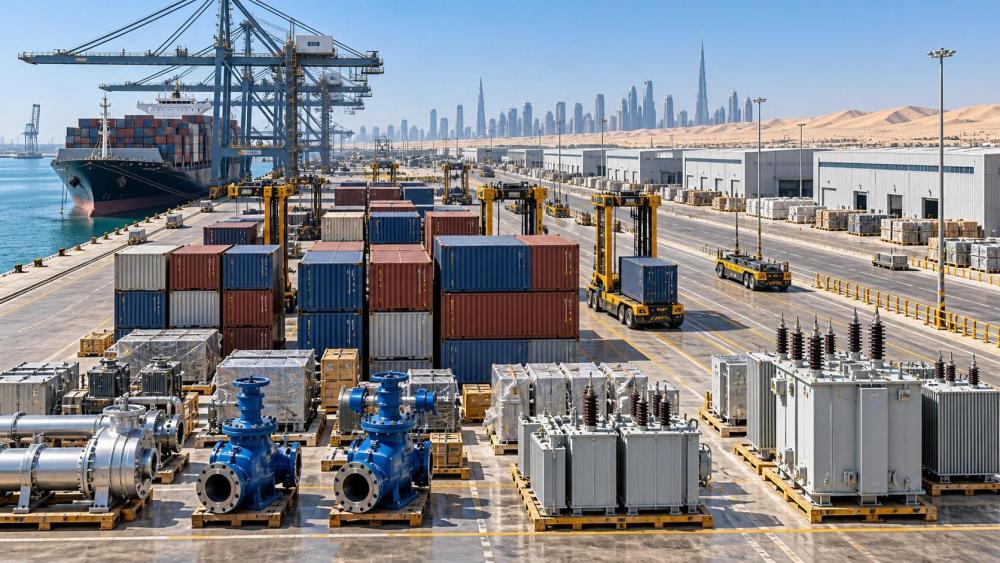
Hydrocarbon investment continues to support demand for valves, pumps, compressors, process controls, corrosion-resistant materials, safety systems, drilling-related equipment, and maintenance supplies. Alongside this established base, power-grid modernization and renewable deployment are expanding procurement needs for transformers, switchgear, cable systems, energy storage components, solar balance-of-system equipment, monitoring devices, and power-management software.
Importers in this segment are rarely buying a generic product alone. They are assessing operating conditions: heat resistance, dust exposure, voltage standards, commissioning requirements, inspection protocols, and availability of after-sales support. Product specifications that perform well in temperate markets may require adaptation for high ambient temperatures, harsh coastal environments, or remote operating sites.
Water, environmental systems, and industrial utilities
Water security remains a structural concern, making desalination, wastewater treatment, pipeline networks, pumping stations, filtration systems, and water-quality monitoring important procurement categories. Industrial expansion also increases the need for cooling systems, emissions controls, waste handling, process water management, and energy-efficient utility equipment.
Here, a procurement decision is often shaped by lifecycle performance more than by purchase price. Membrane durability, chemical compatibility, maintenance intervals, local technical training, and verified performance records can influence supplier selection as much as the initial bid.
Manufacturing equipment and production automation
As industrial zones attract investment in metals, plastics, food, building materials, chemicals, packaging, and assembly operations, demand for machinery will not be limited to major production lines. Smaller but recurring import opportunities often arise in industrial automation, quality inspection, warehouse equipment, conveyors, robotic handling, compressed-air systems, tooling, and factory maintenance.
The opportunity is particularly relevant for suppliers that can explain how their equipment fits into existing plants. A buyer may not need a full turnkey line; they may need a reliable retrofit, a control-system upgrade, or a replacement component that can operate without disrupting production.
Logistics, ports, and trade-enabling infrastructure
The region’s position between Asia, Europe, and Africa continues to support investment in ports, free zones, warehouses, inland logistics facilities, and customs modernization. This strengthens demand for material-handling machinery, refrigeration equipment, fleet technologies, cargo inspection systems, industrial shelving, protective packaging, and warehouse automation.
Import demand in logistics is also linked to the quality of regional connectivity. New transport links can shorten delivery routes, but they do not eliminate bottlenecks caused by port congestion, changing carrier schedules, inland trucking constraints, or customs documentation errors. For industrial buyers, the relevant question is not simply whether an item can reach a port, but whether it can arrive at the installation site in usable condition and on schedule.
Reading the trade outlook beyond headline growth figures
The most useful Middle East market assessment combines macro indicators with operational evidence. Strong investment announcements may signal future demand, but they do not automatically translate into immediate purchase orders. Evaluators need to identify where budgets are funded, projects are moving into procurement, and technical approvals are advancing.
Several signals deserve closer attention:
- Capital-project progression: Monitor whether projects are in planning, tendering, contract award, construction, commissioning, or expansion. Import needs differ sharply at each stage.
- Industrial licensing and zone development: New industrial permits, factory registrations, and utility connections can indicate demand before major equipment imports appear in trade statistics.
- Import composition: A rise in machinery, electrical equipment, industrial chemicals, metals, or components may reveal more than aggregate import value.
- Supplier prequalification activity: When engineering firms, state-linked entities, or large manufacturers update approved-vendor lists, procurement opportunities may be approaching.
- Freight and customs conditions: Transit volatility can affect buyer behavior, including decisions to hold more safety stock, seek regional warehousing, or diversify origins.
These signals should be read together. A large infrastructure announcement without tender activity is not the same as a project with approved technical specifications and an active supplier shortlist. Likewise, a temporary surge in imports may reflect inventory rebuilding rather than long-term market expansion.
Localization does not end the role of foreign suppliers
Local-content initiatives are an important part of the industrial trade outlook Middle East. Governments and major buyers increasingly favor local assembly, domestic employment, in-country service capability, technology transfer, and regional stock availability. For exporters unfamiliar with the market, this can appear to be a barrier. It is better understood as a change in market-access expectations.
In many industrial categories, overseas suppliers remain essential because technical capacity cannot be developed overnight. However, suppliers may need to offer a different commercial model: working with a qualified distributor, maintaining critical spare parts in-region, training local technicians, supporting local assembly, or documenting how the product contributes to broader industrial objectives.
Localization should not be treated as a box-ticking exercise. A nominal local partnership with no technical capability may create more operational risk than it solves. Business evaluators should test whether a local partner can handle customs clearance, project coordination, warranty claims, site access, basic diagnostics, and communication with end users. The reliability of that support network can become decisive after equipment is delivered.
Compliance is now a procurement issue, not an administrative afterthought
Industrial imports into Middle Eastern markets can involve product registration, conformity assessment, labeling requirements, certificates of origin, customs classification, safety documentation, and sector-specific approvals. Requirements vary by destination and product type. Electrical equipment, pressure systems, chemicals, food-processing inputs, medical-related equipment, and construction materials may all face different verification pathways.
For buyers, incomplete paperwork can mean delayed clearance, unexpected storage charges, missed installation windows, or a dispute over responsibility. For suppliers, the risk is not merely a rejected shipment; it is damage to trust with a distributor, contractor, or procurement department that may have limited tolerance for schedule disruption.
A stronger evaluation process asks practical questions early: Which party controls the import declaration? Are product certificates valid for the destination market? Does the technical file match the delivered configuration? Are Arabic-language labels or manuals required? Is a batch-level inspection possible? Can the supplier provide traceability for critical materials and components?
These questions may feel procedural, but in industrial trade they are closely connected to revenue certainty. A technically suitable product that cannot move smoothly through the border is not a dependable supply option.
Supply chain risk is becoming part of the commercial comparison
Recent disruption across maritime routes and regional transport networks has made lead time less predictable for many importers. The effect is not identical across all sectors. Low-value, easily substituted goods may shift quickly between suppliers. High-value equipment, engineered components, and project-specific materials are less flexible because specifications, approvals, and installation schedules restrict substitution.
For that reason, evaluators should compare suppliers using a resilience lens rather than a quoted-price lens alone. Consider the origin of critical subcomponents, the number of transport legs, packaging protection, insurance terms, spare-parts availability, and the supplier’s ability to communicate when schedules change. A lower-cost route with weak visibility can carry a far higher business cost if it delays a plant shutdown or a commissioning milestone.
Regional inventory can be valuable, but it should be selective. Carrying every item locally is expensive and often unnecessary. The better approach is to identify high-failure, long-lead-time, safety-critical, and project-critical parts, then establish inventory or contingency arrangements around those items.
A practical framework for evaluating import opportunities
When assessing a product category or supplier for the Middle East, business teams can use a five-part review:
- Demand fit: Is demand linked to a one-time project, recurring maintenance, factory expansion, or a long-term policy priority?
- Specification fit: Can the product meet local environmental conditions, engineering standards, language needs, and customer approval requirements?
- Trade feasibility: Are tariff exposure, customs procedures, certificates, packaging, and shipment terms understood before quoting?
- Service credibility: Who manages installation, training, warranty, troubleshooting, and spare parts after delivery?
- Supply resilience: What happens if the preferred shipping route, component source, or local distributor becomes unavailable?
This framework helps separate attractive-looking markets from commercially workable ones. It also supports a more honest conversation between procurement, engineering, finance, and logistics teams. The winning decision is often not the lowest-cost option on paper, but the option with the clearest path from order placement to reliable operation.
What business evaluators should watch next
The Middle East’s industrial transformation will not move in a straight line. Energy prices, public financing, regional security conditions, global freight availability, and commodity cycles can all alter purchasing schedules. Yet the underlying direction remains significant: more industrial capacity, more sophisticated infrastructure, and more attention to supply-chain control.
For importers and exporters, the practical implication is clear. The region should be evaluated market by market and sector by sector, with equal attention to demand creation, technical access, compliance readiness, and delivery resilience. Broad optimism is not enough; neither is broad caution.
GTIIN’s approach to global sourcing and supply-chain mapping is useful in this context because it connects macro-industrial shifts with the operational details that determine whether trade can actually happen. By tracking industrial investment, import structures, regulations, freight conditions, and supplier capability together, business evaluators can form a more grounded view of opportunity.
The industrial trade outlook Middle East points toward selective but meaningful import growth. The strongest opportunities are likely to favor suppliers and buyers that understand the difference between selling into a market and becoming a dependable part of its industrial ecosystem.
Have questions about this sector analysis, or seeking best practices specific to your niche? Drop us a line below and let the senior consultants at GTIIN assist you.
“We respect your privacy. Your information is strictly confidential.”
Weekly Insights
Stay ahead with our curated technology reports delivered every Monday.
Recommended News
 Supply ChainNov 08, 2026He Lifeng Holds Trade Talks With Bessent and Greer
 Market TrendsNov 08, 2026How to use industrial commodity market analysis to forecast costs
 Supply ChainNov 07, 2026EU Opens Safeguard Investigation into PET Resin Imports
 Industry StandardsNov 07, 2026Which ISO quality management standard can a company be certified to?



