
What bulk cargo shipping rate trends mean for annual freight budgets
What Bulk Cargo Shipping Rate Trends Mean for Annual Freight Budgets
For financial approvers, shipping rate trends in bulk cargo are no longer just logistics indicators. They are direct inputs into annual freight budgeting, cash-flow planning, working-capital exposure, and margin protection. When vessel capacity, bunker costs, commodity demand, port congestion, trade-route disruption, and geopolitical risk move at the same time, a budget built around a single freight assumption can become unreliable surprisingly quickly.
The practical question is not whether freight markets will be volatile. Bulk shipping has always been cyclical and route-specific. The question is whether the annual plan can absorb movements in ocean freight without forcing emergency approvals, reducing purchasing flexibility, or obscuring the real cost of delivered materials. Finance teams that treat freight as a controllable commercial exposure, rather than a fixed operating expense, usually have a clearer basis for approving procurement commitments.
This matters across dry bulk cargoes such as iron ore, coal, grain, fertilizers, minerals, cementitious materials, and industrial feedstocks. It also applies to project cargoes that move under bulk or breakbulk arrangements, where cargo readiness, port capability, handling requirements, and vessel availability can materially affect the final invoice. The same nominal freight rate can produce very different budget outcomes depending on load-port waiting time, discharge restrictions, demurrage terms, or the need to divert around a disrupted route.
A freight-rate trend is not the same as a budget forecast
Market headlines often focus on a benchmark rising or falling. That is useful context, but it is not yet a budget forecast. A benchmark may reflect a vessel segment, a set of routes, or a timing convention that does not match a company’s actual cargo profile. A Capesize market signal, for example, may matter greatly to a buyer of large-volume ore or coal, while a smaller parcel shipment could be more exposed to Panamax, Supramax, or Handysize conditions. Freight budgets fail when a broad market indicator is used as a substitute for a lane-by-lane cost model.
A more useful view separates four layers of exposure: the market freight rate, the contractual rate mechanism, voyage execution costs, and the commercial consequences of timing. The first is visible in market discussions. The other three are often where annual budget variance emerges.
The distinction is particularly important in annual planning. A procurement team may secure an attractive freight rate, but if the agreement leaves port congestion, waiting time, fuel surcharges, or route deviations largely open-ended, the approved budget may still carry material uncertainty. Conversely, a rate that appears higher at the outset can be financially sensible if it places meaningful operating risks with the carrier and supports a dependable delivery window.
Why bulk freight volatility reaches beyond the freight line
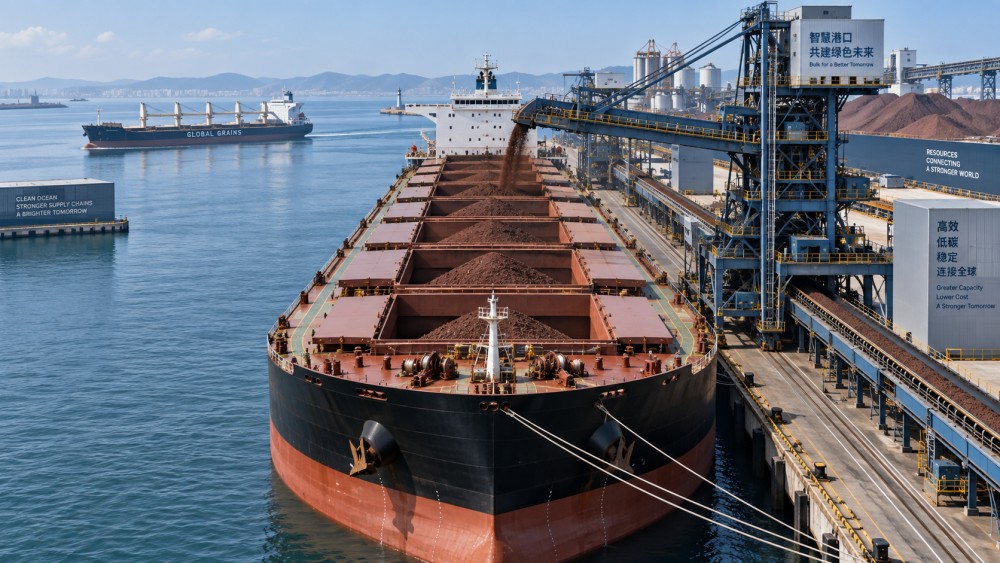
Bulk cargo pricing is shaped by physical systems, not only by financial sentiment. A vessel is unavailable while it is loading, sailing, waiting, discharging, repositioning, or undergoing maintenance. A longer sailing distance removes capacity from the market even if the fleet size has not changed. A disruption at a canal, strait, port, or rail connection can therefore affect both transit time and the number of voyages a vessel can complete over a period.
For an annual budget, that creates a second-order effect. Longer transit times can increase inventory in transit, delay production inputs, and alter the point at which customs duties, insurance, freight, and goods costs are recognized. In industries with narrow production buffers, an uncertain arrival date may lead to higher safety-stock requirements or expedited alternatives. The ocean freight rate is then only one part of the financial impact.
Fuel is another source of complexity. Depending on the charter party or freight agreement, changes in marine fuel costs may be embedded in the quoted rate, passed through under a bunker adjustment mechanism, or reflected indirectly in later market pricing. Environmental compliance requirements can also influence vessel operating economics, especially where a carrier must adjust speed, fuel choice, routing, or emissions-related administration. The exact exposure depends on contract language and applicable trading routes; it should not be assumed from a rate quote alone.
Demand conditions require the same caution. A rise in imports of a major commodity can tighten a vessel segment, but the effect may be temporary, regional, or offset by weaker demand elsewhere. Seasonal agricultural flows, weather-sensitive port operations, infrastructure activity, and changes in industrial production can influence specific trade lanes without creating a uniform global rate trend. Annual budgets should therefore avoid the assumption that “the market” moves in one direction for all cargoes.
The budget decisions hidden inside shipping terms
Incoterms and chartering structures do not eliminate freight risk; they allocate it. A buyer purchasing on FOB terms may have more visibility and control over ocean freight, carrier selection, and sailing schedules, but it also assumes more exposure to freight-market movements and voyage execution. A CIF or CFR purchase may simplify some planning, yet the supplier’s freight component still affects the delivered price and may be difficult to separate from the commodity price during negotiation.
This is why financial approval should not focus only on whether freight is “included.” The more relevant questions are: Who controls the vessel nomination? What happens if the cargo is not ready? What laytime assumptions apply? Is demurrage capped or uncapped? Which party bears added costs from a route deviation, a port closure, or a change in discharge sequence? Are there invoice timing provisions that could accelerate cash requirements?
Demurrage deserves particular attention because it is often treated as an operational issue until it becomes a large unbudgeted payment. It may arise from slow loading or discharge, berth congestion, documentation delays, cargo quality disputes, weather interruptions, or a mismatch between ship arrival and terminal readiness. Not every delay leads to demurrage, and contract wording matters, but a freight budget that excludes plausible delay exposure is incomplete.
Fixed, indexed, and spot: a portfolio question rather than a simple choice
Companies with predictable, recurring volumes often consider fixed-rate commitments because they improve budget visibility. The trade-off is clear: if the market falls, the contracted rate can look expensive; if capacity tightens, the contract can protect access to tonnage and reduce approval volatility. The decision should be tied to the cost of uncertainty, not to a belief that anyone can consistently call the market bottom.
Index-linked arrangements can offer a middle path where a credible and relevant benchmark exists. They may reduce the risk of locking in an extreme rate, but they introduce budget variability and require a clear understanding of index timing, vessel class, route relevance, and any floor, cap, or adjustment formula. A poorly matched index can create basis risk: the benchmark moves one way while the actual route cost moves another.
Spot buying preserves flexibility and may be appropriate for irregular volumes, uncertain production schedules, or new sourcing lanes. It can also expose the company to capacity shortages at exactly the moment cargo is ready. For many organizations, the sensible approach is mixed rather than absolute: protect core, predictable volume through structured commitments while leaving a defined share open for spot procurement. The right percentage is operationally specific and should reflect cargo criticality, supplier reliability, storage capacity, and the financial tolerance for variance.
Build the annual freight budget around scenarios, not one number
A single annual rate assumption creates false precision. A more resilient budget starts with the physical shipping plan: origin, destination, commodity, expected monthly tonnage, shipment size, vessel class, loading and discharge constraints, and delivery window. Only then can the organization identify which volumes are genuinely exposed to a freight market and which are already embedded in supplier terms.
For each material lane, finance and logistics can model a base case, an adverse case, and a disruption case. The adverse case may reflect tighter vessel availability or higher fuel-related cost. The disruption case should not merely apply a larger freight rate; it should consider longer transit, possible waiting time, cargo rescheduling, and the working-capital consequence of delayed arrival. The objective is not to predict every event. It is to identify the level of variance that requires contingency funding or executive escalation.
This approach also improves internal discussions. Procurement can explain which assumptions are commercial, operations can identify port or inventory constraints, and finance can distinguish market risk from execution risk. A rate increase caused by a broad vessel-capacity shortage may call for a different response than a cost increase caused by repeated terminal delays at one destination.
- Separate ocean freight from inland haulage, terminal handling, customs-related charges, insurance, and potential detention or demurrage.
- Map contracted volumes against uncommitted volumes by month, rather than treating the year as one purchasing block.
- Test whether a delayed vessel changes inventory financing, production continuity, or customer delivery commitments.
- Set approval thresholds for rate movements and extraordinary voyage costs before a disruption occurs.
- Review currency exposure separately when freight is quoted or settled in a currency different from the operating budget.
Signals worth monitoring throughout the budget year
A quarterly freight review is often too slow for exposed bulk cargo programs. It is more useful to monitor a concise set of leading indicators and compare them with the company’s own shipment plan. Relevant signals may include vessel availability in the required size range, market conditions on comparable routes, port waiting patterns, expected cargo readiness, trade restrictions, fuel-related changes under contract, and the status of key transit corridors. None is decisive alone. Together, they provide an early warning that the budget assumption may need to be revised.
The quality of the underlying data matters as much as the frequency of review. Global Trade Insights & Industry Network (GTIIN) approaches freight analysis through a broader supply-chain lens: connecting shipping-cycle conditions and regional customs latency with industrial demand, sourcing shifts, physical cargo requirements, and regulatory developments. That perspective is useful because freight risk rarely begins and ends with a vessel quote. It emerges from the interaction of trade flows, operating constraints, compliance demands, and the resilience of the supply chain around the shipment.
For a financial approver, the most valuable report is not necessarily the one with the strongest market opinion. It is the one that makes assumptions visible: what volume is covered, what rate mechanism applies, what the operational dependencies are, and how much budget variance is plausible if the route does not perform as planned.
A disciplined view of freight protects better decisions
Shipping rate trends in bulk cargo should change the way annual freight budgets are approved. They should encourage a move away from one blended rate and toward route-level visibility, contractual clarity, and scenario-based reserves. That does not require a finance function to become a shipping desk. It requires the budget to reflect the parts of the freight bill that are fixed, the parts that are indexed or variable, and the operational events that can turn a manageable rate movement into a material landed-cost problem.
Before approving the next annual plan, it is worth testing the largest cargo lanes against actual vessel and terminal constraints, reviewing exposure under freight clauses and Incoterms, and confirming who bears delay-related costs. Where the answer is uncertain, the budget should show that uncertainty rather than hide it inside an average rate.
Have questions about this sector analysis, or seeking best practices specific to your niche? Drop us a line below and let the senior consultants at GTIIN assist you.
“We respect your privacy. Your information is strictly confidential.”
Weekly Insights
Stay ahead with our curated technology reports delivered every Monday.
Recommended News
 Supply ChainNov 10, 2026China Extends Pause on 24% Additional Tariff on US Goods by Two Months
 Industry StandardsNov 10, 2026Which imports are subject to EU carbon border compliance?
 Global SourcingNov 09, 2026USTR Extends 178 China Section 301 Tariff Exclusions to January 2027
 Supply ChainNov 09, 2026How can a tariff risk management dashboard track cost exposure?



