
North America shipping market analysis: freight rates, capacity, and 2026 outlook
North America Shipping Market Analysis: Freight Rates, Capacity, and the 2026 Outlook
In North America shipping market analysis, freight rates rarely move in a straight line. They react to inventory cycles, port performance, equipment imbalances, carrier capacity discipline, and policy shocks that can surface with very little warning. For enterprise teams planning procurement, production, or distribution across the US, Canada, and Mexico, the key question is not whether rates will rise or fall in isolation. It is how fast the market can reprice, where capacity is likely to tighten, and which lanes may remain volatile into 2026.
That distinction matters because North America is not one shipping market. East Coast, West Coast, Gulf Coast, inland rail, and cross-border trucking each follow different drivers. A container shortage in one port complex does not always mean the same stress appears on inland routes. Likewise, softer demand in one sector may be offset by stronger flows in automotive, energy, agriculture, or industrial equipment. A useful shipping market analysis North America view has to read those layers together, not as separate headlines.
What is really moving freight rates now
Freight rates in the region are being shaped by a mix of short-cycle and structural forces. On the short-cycle side, import ordering patterns still matter a lot. When shippers front-load inventory ahead of tariff deadlines, labor actions, peak retail season, or capacity concerns, spot pricing can move quickly even if underlying demand is not broad-based. That is one reason contract renewals and spot exposure must be managed separately. They do not behave the same way in a stressed market.
On the structural side, vessel alliances, port call strategies, and inland network constraints continue to influence the actual cost of moving freight. A lane can look “available” on paper while still carrying hidden cost through detention, chassis shortages, poor dwell performance, or longer transit variability. For manufacturers with tight line-side inventory, the total landed cost is often more important than the headline ocean or truck rate. GTIIN’s trade intelligence work typically treats rate movements together with service reliability, customs latency, and inland handoff risk, because those are the factors that affect execution, not just budget planning.
Capacity is not just about space
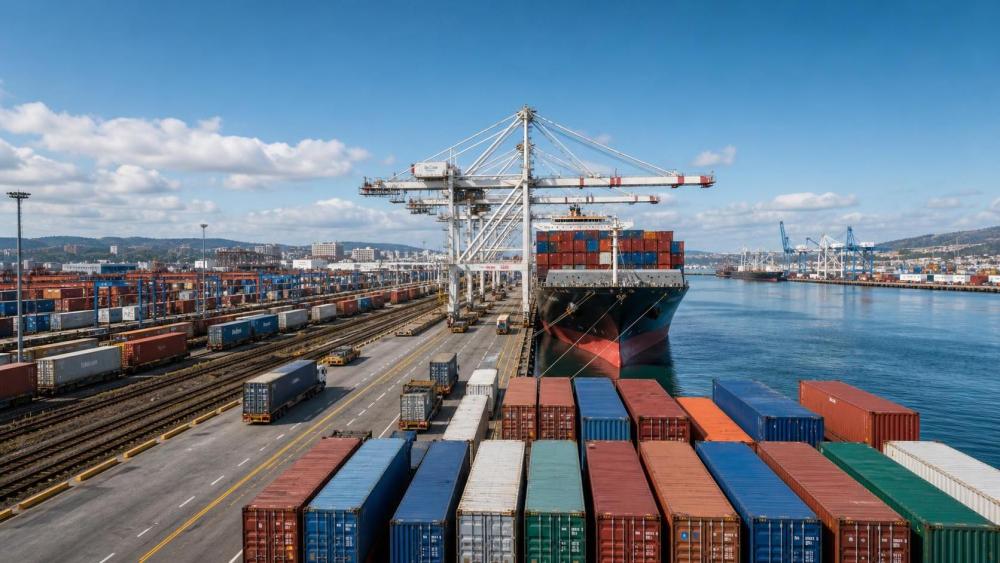
When decision-makers talk about capacity, they often mean vessel slots or truck availability. In practice, capacity is broader. It includes equipment positioning, port productivity, inland rail consistency, driver supply, warehouse throughput, and the ability of carriers to accept volume without degrading service. If one part of that chain fails, apparent market capacity can disappear very quickly.
This is especially visible in cross-border trade between the US and Mexico, where manufacturing concentration has increased pressure on trucking corridors, border processing, and warehouse staging. A facility may have enough booked capacity, but if customs timing slips or trailers are not repositioned in time, the shipment plan still breaks. The same logic applies to Canada routes tied to rail availability and winter operating conditions. Capacity is not a static number; it is a moving service outcome.
For shippers, the practical question is whether the market has “true slack” or only temporary relief. True slack means multiple legs can absorb volume without immediate service erosion. Temporary relief usually appears when demand softens seasonally, but underlying constraints remain. Those constraints can return fast once retail build, industrial replenishment, or project cargo demand picks up again.
Why 2026 may look different from a simple rate cycle
The 2026 outlook should not be reduced to a simple “higher” or “lower” freight forecast. Several forces may pull in different directions. If demand stays uneven, some lanes could remain competitive on price. But if infrastructure bottlenecks, policy changes, or equipment repositioning costs intensify, rate relief may prove short-lived. That is particularly relevant for shippers relying on just-in-time replenishment or single-port concentration.
One issue to watch is how carriers balance utilization versus yield. In softer periods, pricing may look attractive until service levels begin to fluctuate. In tighter periods, the opposite occurs: space is available only at a premium, and shippers pay for predictability. Neither condition is ideal if your supply chain cannot tolerate frequent rerouting. The best-prepared teams are usually the ones that map optionality before the market turns, not after.
Another factor is policy uncertainty. Trade rules, customs enforcement intensity, environmental compliance costs, and tariff frictions can all change the economics of routing and sourcing. Even when no single policy creates a market shock, the accumulation of smaller changes can alter shipment behavior enough to move local capacity and pricing. For enterprises with multi-country sourcing, this means 2026 planning should be built around scenario ranges, not one base case.
How enterprise teams should read the market
The most useful shipping market analysis North America teams can build is lane-specific and execution-oriented. That means separating ocean, drayage, truckload, intermodal, and cross-border flows rather than assuming one freight benchmark explains all of them. It also means tracking the operational signals that often precede rate movement: dwell time, blank sailing behavior, equipment imbalances, border wait times, and warehouse congestion near major gateways.
Procurement teams should also be careful not to overreact to a brief rate dip. A softer quarter does not necessarily justify redesigning the network or locking into the longest possible commitment. If service reliability is still unstable, low rates can become expensive once disruption costs are added back in. The smarter approach is often to align contract structure with shipment criticality: core volume may need more protection, while discretionary or less time-sensitive lanes can stay flexible.
This is where GTIIN’s market-trend and supply-chain-resilience perspective is useful. The point is not to chase a single number, but to understand how freight rates, capacity, and operating risk interact across the value chain. In practice, that means asking whether a carrier, port, or inland route can still perform under pressure, not just whether it is cheap this month.
What to watch before 2026 planning is locked in
Before finalizing 2026 freight budgets, most enterprise teams should pressure-test four items. First, confirm which lanes are exposed to seasonal surges and which are vulnerable to structural congestion. Second, review how much of your volume depends on a single port, border crossing, or inland hub. Third, compare contract coverage against actual service history, not against quoted rates alone. Fourth, check whether your sourcing and distribution plans still make sense if transit times widen by a few days.
That last point is often underestimated. In many industrial categories, a small delay can create a much larger downstream problem: missed assembly windows, safety stock inflation, production rescheduling, or expensive expediting. Those are not theoretical costs. They usually appear only after the freight market has already tightened and alternatives are limited.
For that reason, a credible North America shipping market analysis should end with actions, not predictions. Teams do not need perfect visibility. They need a working framework for reading rate signals, understanding capacity realism, and deciding when to buy flexibility versus when to commit. In a market that can shift quickly across ports, borders, and inland routes, that is often the difference between controlled spend and repeated disruption.
Have questions about this sector analysis, or seeking best practices specific to your niche? Drop us a line below and let the senior consultants at GTIIN assist you.
“We respect your privacy. Your information is strictly confidential.”
Weekly Insights
Stay ahead with our curated technology reports delivered every Monday.
Recommended News
 Supply ChainNov 10, 2026China Extends Pause on 24% Additional Tariff on US Goods by Two Months
 Industry StandardsNov 10, 2026Which imports are subject to EU carbon border compliance?
 Global SourcingNov 09, 2026USTR Extends 178 China Section 301 Tariff Exclusions to January 2027
 Supply ChainNov 09, 2026How can a tariff risk management dashboard track cost exposure?



