
Global Viticulture Shifts: Market Trends and Rising Demand for Premium Stainless Steel Wine Tanks
The global viticulture and commercial winemaking industry is currently navigating a period of profound structural transformation. While the traditional image of winemaking evokes centuries-old estates and rustic cellars, the modern reality is a highly competitive, capital-intensive global market. Driven by shifting consumer demographics, the expansion of new world wine regions, and the undeniable impact of global climate change, wineries are forced to adapt rapidly to survive. At the center of this industrial evolution is the surging demand for advanced, scalable fermentation and storage infrastructure.
As commercial wineries attempt to balance the need for increased production volume with uncompromising quality control, the reliance on advanced metallurgical equipment has reached unprecedented levels. This comprehensive market analysis explores the macroeconomic drivers and global export trends that are currently reshaping the viticulture landscape, leading to a massive spike in global procurement for heavy-duty, premium stainless steel wine tanks in 2026.
The Expansion of "New World" Viticulture Markets
Historically, the global wine market was dominated by the "Old World" heavyweights: France, Italy, and Spain. However, the last decade has seen a meteoric rise in "New World" production zones. Countries such as Chile, Argentina, South Africa, Australia, and notably, the United States (particularly the Pacific Northwest), have dramatically increased their global market share.
This geographical expansion is not characterized by the establishment of small, boutique vineyards, but rather by the construction of massive, industrialized winemaking facilities. These New World producers are inherently unburdened by the strict, often restrictive historical appellation laws of Europe. Consequently, they operate with a highly commercial mindset, focusing on maximum yield, absolute consistency, and rapid scalability.
To achieve this industrial scale, New World wineries require massive capital investments in infrastructure. The demand is no longer for small, artisanal wooden barrels, but for towering, multi-thousand-liter fermentation vessels. This aggressive expansion in the Americas and the Southern Hemisphere is the primary catalyst driving the global export market for advanced beverage processing machinery, creating a robust and sustained demand curve for international steel fabricators.
Climate Change and the Necessity of Absolute Thermal Control
Perhaps the most disruptive macro-trend impacting global viticulture is climate change. Across both the Northern and Southern Hemispheres, traditional harvest seasons are becoming increasingly erratic. Prolonged heatwaves, unpredictable frost events, and shifting precipitation patterns are fundamentally altering the chemical composition of the harvested grapes.
Grapes are now frequently arriving at the crush pad with significantly higher sugar concentrations and lower natural acidity than historical averages. This altered chemistry makes the primary fermentation process far more volatile and intensely exothermic (heat-generating). If a winery cannot immediately and aggressively control the temperature of the fermenting must, the yeast will die, and the batch will spoil, leading to catastrophic financial losses.
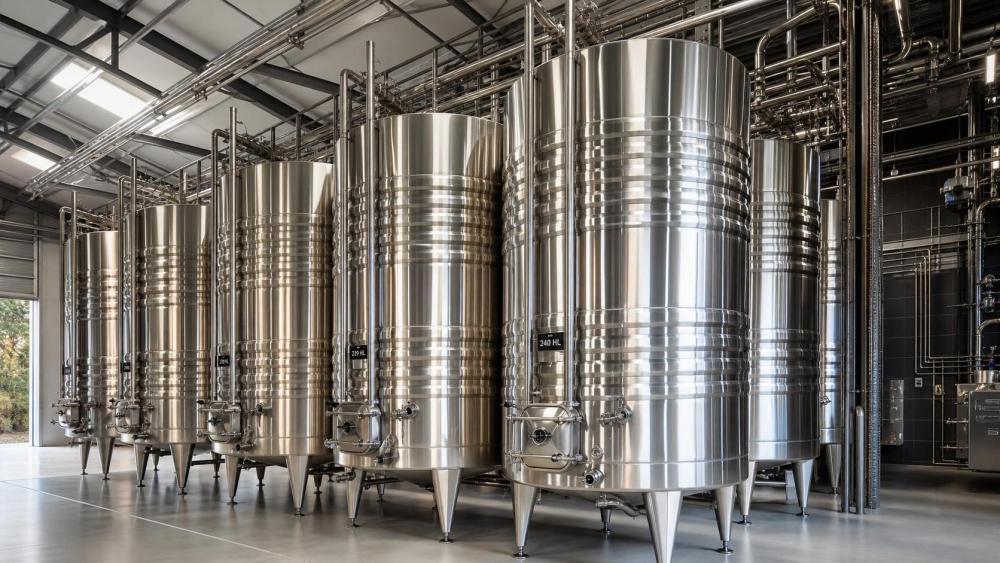
Consequently, the procurement focus has shifted entirely away from basic storage vessels toward highly engineered thermodynamic reactors. Wineries are aggressively upgrading their infrastructure to tanks featuring precision-welded, high-pressure dimple cooling jackets. The market trend is clear: equipment that cannot guarantee absolute, rapid thermal control under extreme environmental stress is now considered obsolete. This climate-driven necessity has created a massive replacement cycle, forcing established wineries to overhaul their aging infrastructure.
The Premiumization of Wine and the Demand for Sanitary Design
While overall global wine consumption volume has seen periods of stagnation, the value of the market continues to grow. This divergence is driven by the macro-trend of "premiumization." Consumers across key markets in North America, Europe, and Asia are drinking less wine by volume, but they are consistently choosing higher-quality, higher-priced bottles.
This shift toward premium products drastically raises the stakes for commercial producers. When a winery is producing a $10 bottle of wine, minor sensory defects might be tolerated. However, when producing a $50 or $100 bottle, the product must be absolutely flawless. There is zero tolerance for volatile acidity, oxidation, or bacterial contamination (such as Brettanomyces).
To guarantee this level of purity, procurement standards for manufacturing equipment have become exceptionally stringent. Wineries are demanding tanks constructed from high-grade 316L austenitic stainless steel, prioritizing extreme resistance to pitting corrosion. Furthermore, the market is dictating rigorous standards for internal surface polishing (low
Global Supply Chain Volatility and Strategic Procurement
The surging demand for heavy-duty winery equipment is colliding with ongoing volatility in the global macroeconomic supply chain. The primary raw materials required for these vessels—nickel, chromium, and refined steel—are subject to significant geopolitical pricing pressures and tariff fluctuations.
Furthermore, the highly specialized manufacturing process (requiring advanced TIG welding robotics and massive rolling mills) is concentrated in specific global manufacturing hubs, predominantly in Asia and parts of Eastern Europe. This geographical concentration forces western wineries to rely on complex, long-distance maritime shipping logistics.
As freight rates fluctuate and port congestions remain a persistent threat, procurement directors are forced to adopt highly strategic purchasing models. The trend has shifted away from "just-in-time" purchasing toward long-term, multi-year capacity planning. Wineries must now accurately forecast their infrastructure needs 12 to 18 months in advance, locking in steel prices and securing manufacturing slots to ensure their equipment arrives before the biological deadline of the harvest season.
The Evolving Landscape of Capital Expenditure (CAPEX)
As commercial winemaking becomes increasingly capital-intensive, the way financial institutions and winery CFOs evaluate equipment purchases is evolving. The focus has decisively shifted from evaluating the initial Free On Board (FOB) purchase price to calculating the Total Cost of Ownership (TCO) over a projected 25-to-30-year lifespan.
Financial models now heavily penalize cheap, sub-standard equipment. A tank that requires excessive labor to clean, consumes more energy due to inefficient cooling jackets, or risks catastrophic failure mid-harvest represents an unacceptable financial liability.
When conducting long-term CAPEX planning, evaluating the verified lifespan and metallurgical integrity of a Stainless Steel Wine Tank is the paramount financial metric. Investors and stakeholders demand assurance that the massive capital deployed into the tank farm will yield reliable, predictable, and uninterrupted production for decades. This sophisticated financial approach strongly favors premium manufacturers who can provide certified metallurgical documentation and demonstrable engineering superiority.
Conclusion
The global commercial wine industry is undergoing a relentless modernization process, driven by climate volatility, the premiumization of consumer tastes, and the aggressive expansion of New World markets. In this highly competitive landscape, the fermentation and storage infrastructure is the critical engine of profitability.
As wineries globally scramble to upgrade their facilities to meet these new realities, the market for highly engineered, sanitary, and thermodynamically efficient stainless steel vessels will continue to surge. For industry stakeholders, understanding these macroeconomic trends is essential. The future of commercial viticulture belongs to those who view their tank farms not merely as storage, but as the ultimate strategic asset in guaranteeing product quality and ensuring long-term corporate scalability.
Have questions about this sector analysis, or seeking best practices specific to your niche? Drop us a line below and let the senior consultants at GTIIN assist you.
“We respect your privacy. Your information is strictly confidential.”
Weekly Insights
Stay ahead with our curated technology reports delivered every Monday.
Recommended News
 Supply ChainNov 08, 2026He Lifeng Holds Trade Talks With Bessent and Greer
 Market TrendsNov 08, 2026How to use industrial commodity market analysis to forecast costs
 Supply ChainNov 07, 2026EU Opens Safeguard Investigation into PET Resin Imports
 Industry StandardsNov 07, 2026Which ISO quality management standard can a company be certified to?



