
Which documents are needed to prove product conformity for exports?
Which documents are needed to prove product conformity for exports?
A missing test report or an outdated declaration can delay shipments and expose your business to regulatory risk. Proving product conformity for exports means matching documentation to the product, destination market, and applicable regulations—not simply collecting certificates. A file may look complete while covering the wrong model, an obsolete configuration, or a standard that does not address the intended use.
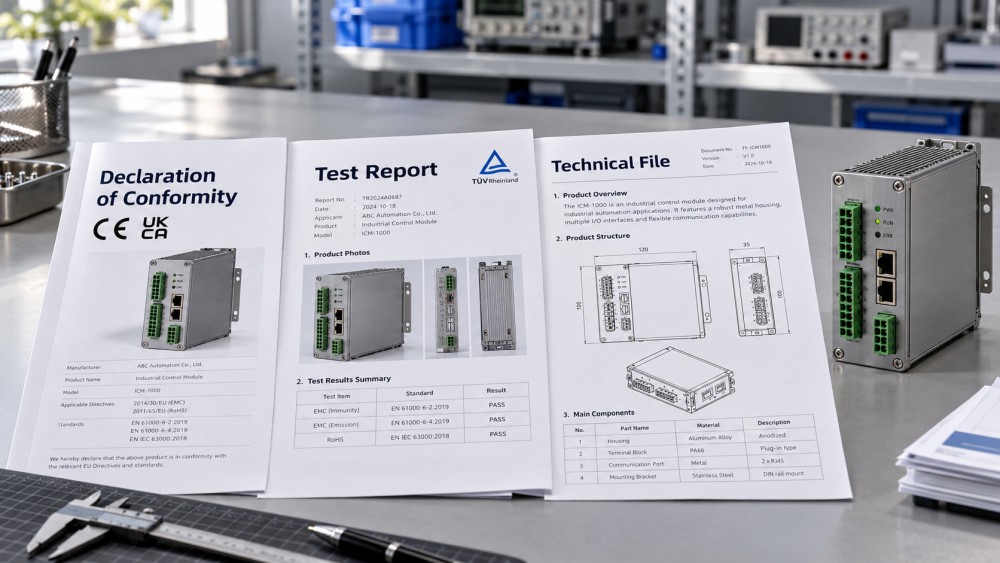
The documents commonly needed include a declaration of conformity or other legally prescribed certification, laboratory test reports, technical documentation, and production traceability records. Third-party certificates, registrations, or shipment-specific approvals may also be required. There is no universal export conformity certificate: the correct package depends on the regulatory route, and not every record must travel with the goods.
Establish the compliance route before requesting documents
Start with the finished product, its intended use, and where it will be placed on the market. A component supplied for integration into machinery may have different obligations from a complete machine. Wireless functionality, hazardous substances, pressure, food contact, and use in explosive atmospheres can each introduce additional requirements.
Customs classification helps identify import controls, but an HS code alone does not establish every applicable safety or environmental obligation. Record the product’s technical characteristics alongside its tariff classification. Also identify the manufacturer, importer, and any required local representative; their responsibilities and document-retention duties may differ.
A useful starting record is a compliance matrix linking each applicable requirement to its evidence. It should state the legislation, assessment route, relevant standards and editions, responsible party, and any gaps. Distinguish statutory requirements from customer specifications. Both can affect acceptance, but a buyer’s approval does not establish legal market access.
What the main conformity documents actually prove
Declarations of conformity and prescribed compliance certificates
A declaration of conformity is a formal statement by the responsible party that the identified product meets specified legal requirements. Under many EU product regimes requiring CE marking, the manufacturer draws up an EU Declaration of Conformity after completing the applicable conformity assessment. The declaration is not a laboratory report, and a voluntary “CE certificate” does not replace it.
Review the product identification, manufacturer details, applicable legislation, referenced standards, and authorized signature. Where a notified body participates, include the details required by the relevant legislation. Requirements differ by product regime, so a generic declaration template should not be accepted without checking its mandatory content.
Other markets use different mechanisms. In the United States, for example, products subject to applicable Consumer Product Safety Commission rules may require a General Certificate of Conformity or a Children’s Product Certificate, depending on the product. Electrical, radio, medical, and other regulated products follow their own frameworks. An EU declaration is not a substitute for these obligations.
Laboratory test reports
Test reports document how identified samples performed against specified requirements. They should identify the sample, test methods, standard editions, conditions, results, and any deviations. Photographs, ratings, component details, and configuration descriptions help establish whether the tested sample represents the goods being exported.
Laboratory competence matters, but acceptance also depends on the regulatory scheme. ISO/IEC 17025 accreditation can support confidence in testing; verify that the relevant method falls within the laboratory’s accredited scope. Some schemes additionally require testing by a specifically recognized or designated laboratory. Accreditation alone does not guarantee regulatory acceptance.
A passing report for one model does not automatically cover a product family. Differences in power supply, enclosure material, firmware, protective devices, or operating limits may require documented engineering justification or additional testing.
Technical documentation and risk assessment
The technical file explains why the conformity claim is justified. Depending on the applicable rules, it may contain drawings, circuit diagrams, specifications, bills of materials, risk assessments, calculations, test reports, instructions, labels, and production-control procedures. Its purpose is to connect legal requirements with the design and the evidence.
For machinery, for instance, a risk assessment should address relevant hazards and the measures used to reduce them. A collection of component certificates cannot demonstrate that the assembled machine is safe. Integration can create risks involving guarding, emergency stops, electrical interfaces, or control-system behavior that individual component approvals do not cover.
Third-party certificates and regulatory approvals
Independent certification is mandatory under some assessment routes and optional under others. Verify whether the issuing body has the required designation or recognition, whether the certificate covers the exact product and manufacturing locations where relevant, and whether surveillance or renewal conditions apply.
For EU legislation requiring notified-body involvement, check the body’s designation and scope in the European Commission’s NANDO database. A recognizable logo is not enough. Likewise, a voluntary safety certificate can support commercial acceptance without satisfying every legal obligation in the destination market.
Supporting records: essential in context, not universal substitutes
Several records are routinely requested in international procurement, but their evidentiary value is narrower than buyers sometimes assume.
Commercial invoices, packing lists, transport documents, and certificates of origin serve customs or commercial purposes. They are generally not proof of product safety conformity. However, some destination-country conformity programs require a product or shipment certificate linked to import clearance. Confirm the exact program, exemptions, and issuing process before dispatch.
Check validity against the shipped product—not just the document date
A document can be genuine and still be unsuitable. The most useful review follows the identity of the product through the declaration, report, certificate, nameplate, purchase specification, and shipment records.
- Identity: Do model numbers, ratings, brand names, and variants align? Document any relationship between private-label and original-manufacturer models.
- Technical coverage: Does the evidence address the actual voltage, frequency, materials, accessories, software, and operating environment?
- Regulatory coverage: Are all applicable obligations addressed, rather than only the easiest test category?
- Authenticity: Can the issuer verify the report or certificate through an official channel?
- Change control: Have design, supplier, production-site, or standard changes been assessed for their effect on existing evidence?
Test reports do not have one universal expiry period. Their continued usefulness depends on scheme rules, product changes, applicable requirements, and acceptance criteria. Similarly, a newer standard edition does not automatically invalidate all earlier evidence. For EU harmonized standards, check the relevant Official Journal references and any withdrawal dates affecting presumption of conformity.
Supplier statements about restricted substances also need scrutiny. A declaration covering the finished product should have a defensible basis, such as controlled material data, component declarations, or targeted testing. Testing one accessible surface may not address restrictions applying to individual materials throughout the assembly.
Build a release file that can withstand a specific question
Keep a controlled master file rather than an unstructured folder of PDFs. Assign ownership, record revision status, and link each exported configuration to its supporting evidence. Preserve batch or serial traceability where required or necessary to identify affected goods. An authority investigating a defect needs to know which units are covered, not merely whether the supplier possesses a certificate.
Separate documents that must accompany the product from those retained for regulatory access. Required instructions, safety information, markings, and declarations must meet the relevant language and delivery rules. A full technical file may contain confidential design information and need not automatically be distributed to every customer. Confidentiality, however, cannot prevent legally required access by authorities.
Set retention periods from the applicable legislation or scheme, not a blanket company assumption. Before release, verify who holds the records, who can retrieve them, and whether the importer has the information needed to fulfill its obligations.
This is where trade intelligence connects with quality control. Global Trade Insights & Industry Network (GTIIN) brings an independent industry-standards and supply-chain perspective to cross-border decisions. Market intelligence can flag regulatory developments and sourcing risks; the release decision still needs product-specific evidence checked against official requirements.
Before approving the next export shipment, ask one concrete question: can every conformity claim be traced to the exact goods being shipped? If the answer depends on an unexplained model difference, an unverifiable certificate, or a missing assessment, close that gap before release—not after customs or a market-surveillance authority asks for proof.
Have questions about this sector analysis, or seeking best practices specific to your niche? Drop us a line below and let the senior consultants at GTIIN assist you.
“We respect your privacy. Your information is strictly confidential.”
Weekly Insights
Stay ahead with our curated technology reports delivered every Monday.
Recommended News
 Supply ChainNov 08, 2026He Lifeng Holds Trade Talks With Bessent and Greer
 Market TrendsNov 08, 2026How to use industrial commodity market analysis to forecast costs
 Supply ChainNov 07, 2026EU Opens Safeguard Investigation into PET Resin Imports
 Industry StandardsNov 07, 2026Which ISO quality management standard can a company be certified to?



