
Verification of Conformity: When Importers Need It and What Inspectors Check
A Verification of Conformity (VoC) becomes important when the destination country makes it a condition of import, customs clearance, market access, or both. For quality-control and safety teams, the practical question is rarely whether a product appears well made. It is whether the shipment can demonstrate compliance with the destination market's applicable technical rules in the form, timing, and documentary chain that its authorities accept.
That distinction matters because a shipment may have test reports, a supplier declaration, and even an established certification from another market, yet still fail at the border if the importing country requires a country-specific conformity programme. A VoC is therefore best treated as an import-control deliverable, not as a generic quality certificate.
Importers should identify the requirement before production release or booking, not after goods are packed. Once cargo has reached a port without the required certificate, the available remedies can be expensive and limited: additional inspection, re-testing, document correction, storage charges, return shipment, or destruction may all become possible depending on the destination regime and product category.
When an importer needs a Verification of Conformity
A VoC requirement is usually tied to a national or regional conformity assessment programme. These programmes are commonly used where authorities want goods checked before shipment, at the point of export, or before they enter domestic distribution. The exact scope varies by market. It may cover a broad range of regulated consumer and industrial goods, while excluding certain low-risk products, raw materials, temporary imports, samples, or goods imported for a defined industrial project.
For an importer, four questions determine whether a VoC is likely to be required.
- Is the destination market operating a mandatory pre-export or import conformity programme? The answer must be established against the destination country's current rules, not assumed from a neighboring market or a previous shipment.
- Is the specific product category within scope? Product descriptions used in commercial documents are often too broad. Classification may depend on the customs code, product function, voltage, material composition, intended user, or risk category.
- Does the applicable programme require a certificate for every shipment, a registered product, or an approved supplier route? These are operationally different models. A product approval or registration does not automatically replace a shipment certificate.
- Who is legally responsible for arranging the evidence? The exporter may coordinate testing and inspection, but the importer often bears the commercial and regulatory consequences when documents do not match the cargo declaration.
Importers should be careful with the phrase “certificate of conformity.” It is used broadly in international trade and may refer to a manufacturer-issued statement, a laboratory-backed certificate, a third-party product certificate, or a document issued under a destination-country programme. These documents do not have equal legal weight. The acceptance question is specific: does the issuing body, inspection route, standard basis, and shipment reference satisfy the requirement imposed by the importing authority?
A CE marking, for example, may be relevant evidence for a product destined for the European Economic Area, but it is not a universal substitute for a destination-specific VoC. Similarly, an ISO-certified factory may indicate that a management system has been audited; it does not prove that every product configuration, label, test result, and shipment complies with a particular importing country's product regulations.
Start with the product, not the paperwork
The most common planning error is to begin by asking which certificate can be obtained. The better starting point is a product compliance profile. Before purchase order release, the quality or safety team should define the exact item being imported: model number, variants, bill of materials where relevant, intended use, technical ratings, packaging configuration, and destination market.
This profile should then be matched to the applicable requirements. A small difference in configuration can alter the conformity route. An electrical appliance sold with a plug for one market, for instance, may require different marking, plug, voltage, safety, or electromagnetic compatibility evidence than the same appliance shipped elsewhere. A chemical product can trigger different label, safety-data, restricted-substance, or transport controls depending on its composition and intended use. Machinery may require attention to guards, emergency stops, instructions, noise declarations, and the identity of the responsible economic operator.
Where the product is assembled from purchased components, component certificates should not be treated as final proof for the finished item. They may support the technical file, but inspectors and regulators can still assess the completed product as supplied. Integration can introduce new risks: wiring changes, enclosure modifications, software functions, incompatible materials, altered load ratings, or missing end-product instructions.
For high-volume sourcing, a controlled compliance matrix is more useful than a folder full of PDFs. It should link each SKU or model family to its destination market, applicable standards or regulations, required tests, label artwork, documentation, certificate status, expiry date where relevant, and approved production site. This gives procurement, quality, logistics, and customs teams one version of the import readiness status.
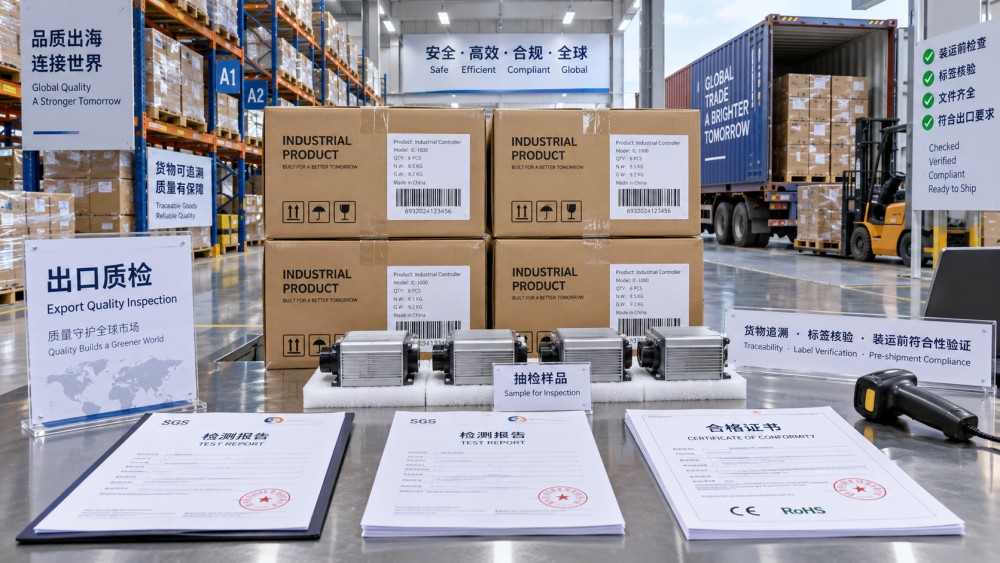
What inspectors typically check
An inspection under a conformity programme is designed to compare physical goods and supporting evidence against the declared compliance basis. It is not simply a visual factory visit, and it is not limited to checking whether cartons are intact. The depth of review depends on the product, programme route, risk level, available test evidence, and any inconsistencies found during document review.
Product identity and model traceability are normally among the first checks. Inspectors may compare model numbers, product names, ratings, dimensions, batch references, quantities, country-of-origin declarations, and manufacturer details across the goods, invoice, packing list, test reports, labels, and application documents. A test report for a closely related model is not automatically valid for the exported model. Minor-looking suffixes can represent a different power supply, material grade, capacity, safety feature, or destination configuration.
Marking and labeling receive close attention because labels are visible evidence at both the border and in the market. Depending on the goods and destination, the review may include product identification, manufacturer or importer details, electrical ratings, hazard warnings, safety symbols, language requirements, country-of-origin marking, batch or serial traceability, handling labels, and mandatory regulatory marks. The label must be legible, durable where required, and consistent with the supporting documentation. A correct test report cannot cure a label that omits mandatory warnings or identifies a different model.
Test reports and technical evidence are checked for relevance, completeness, and applicability. Inspectors commonly look at the test standard, edition or version where relevant, laboratory competence or recognition, report date, specimen identification, test conditions, conclusions, and whether the report applies to the actual production configuration. An old report is not necessarily invalid, but it needs to remain technically applicable. Changes in materials, components, standards, or product design can weaken its usefulness.
Physical condition and safety characteristics may also be assessed through sampling and visual examination. For industrial goods, this can include guards, warning devices, protective enclosures, fasteners, pressure-related markings, load information, surface finish, corrosion protection, or operating instructions. For consumer goods, inspectors may focus on accessible sharp edges, small parts, flammability-related information, plug and cord arrangement, battery compartments, or age-grade warnings. Visual inspection cannot replace laboratory testing, but it can reveal a mismatch between the tested sample and the production shipment.
Packaging and shipment consistency matter because the certificate usually relates to identifiable goods in a defined consignment. Carton counts, packing lists, batch data, product descriptions, and shipping documents need to reconcile. Mixed consignments deserve particular care. A container can include compliant products alongside products that have not been included in the application, are subject to a different standard, or require a separate approval route.
The evidence chain must survive handoffs
Many VoC failures are document-control failures rather than laboratory failures. The product may satisfy the technical requirement, but the information changes as it moves from supplier to exporter, freight forwarder, inspection provider, customs broker, and importer. A spelling change in the manufacturer name, a missing model suffix, an invoice description that is too generic, or a late change in quantity can interrupt the evidence chain.
Quality teams should treat the following records as a connected package rather than independent files:
- Purchase order and approved product specification
- Applicable test reports, certificates, declarations, and technical documents
- Approved label and packaging artwork
- Inspection booking information and inspection outcome
- Commercial invoice, packing list, transport document, and customs declaration data
- Any destination-market registration, authorization, or shipment certificate required by the programme
Before inspection, the exporter and importer should reconcile the data fields that recur across these documents: legal manufacturer name, factory address, brand, model number, product description, country of origin, quantity, and shipment reference. This is especially important where a trading company is named on commercial documents while test evidence identifies the factory. That arrangement can be acceptable in some circumstances, but the relationship should be clear and supported rather than left ambiguous.
Translation is another avoidable source of risk. Instructions, warnings, product labels, and certificates may be required in a prescribed language or contain mandatory terminology. A commercial translation that changes a safety warning, omits a technical limitation, or uses a different product identity can create a compliance problem even when the original document was accurate.
Why “pre-shipment inspection passed” is not the end of the process
A passed inspection is valuable, but it should not be mistaken for a blanket release from all importer obligations. Border authorities can conduct their own checks. Market-surveillance authorities may later examine the goods in distribution. In addition, some requirements sit outside the primary VoC process, such as customs valuation, tariff classification, controlled-goods permits, transport rules for dangerous goods, environmental obligations, or local registration requirements.
The scope of the certificate also matters. It may cover only the identified shipment, only the specified product and model, or only the conformity elements assessed under the applicable programme. Importers should avoid presenting it internally as proof that all legal obligations have been met. A better reading is more precise: it provides evidence that a defined consignment has passed the required conformity assessment route, subject to the programme's stated conditions.
This is why safety managers should retain the underlying technical evidence and change-control records after clearance. If a regulatory inquiry arises, the team may need to show more than the final certificate: how the product was identified, which version was tested, which labels were approved, and whether the shipment matched the assessed configuration.
A practical release gate before cargo moves
The most reliable control point is a joint release gate involving procurement, quality, logistics, and the importer of record. It should occur before cargo handover, while production and shipping documents can still be corrected.
For recurring imports, this gate should be repeated when any material factor changes: supplier factory, product revision, component substitution, label design, applicable standard, destination, or commercial entity named in the transaction. Reusing last year's certificate package without reviewing those changes is a common source of false confidence.
A Verification of Conformity is most manageable when it is built into product approval and shipment planning. The importer that waits for the certificate at the end of the process is often forced to solve a documentation problem after it has become a logistics problem. The importer that defines the product, evidence, labels, inspection route, and document owners before dispatch has a far better basis for predictable clearance and defensible market compliance.
Have questions about this sector analysis, or seeking best practices specific to your niche? Drop us a line below and let the senior consultants at GTIIN assist you.
“We respect your privacy. Your information is strictly confidential.”
Weekly Insights
Stay ahead with our curated technology reports delivered every Monday.
Recommended News
 Supply ChainNov 10, 2026China Extends Pause on 24% Additional Tariff on US Goods by Two Months
 Industry StandardsNov 10, 2026Which imports are subject to EU carbon border compliance?
 Global SourcingNov 09, 2026USTR Extends 178 China Section 301 Tariff Exclusions to January 2027
 Supply ChainNov 09, 2026How can a tariff risk management dashboard track cost exposure?



