
North America Contract Logistics Market: Demand Shifts by Industry and Region
North America Contract Logistics Market: Demand Shifts by Industry and Region
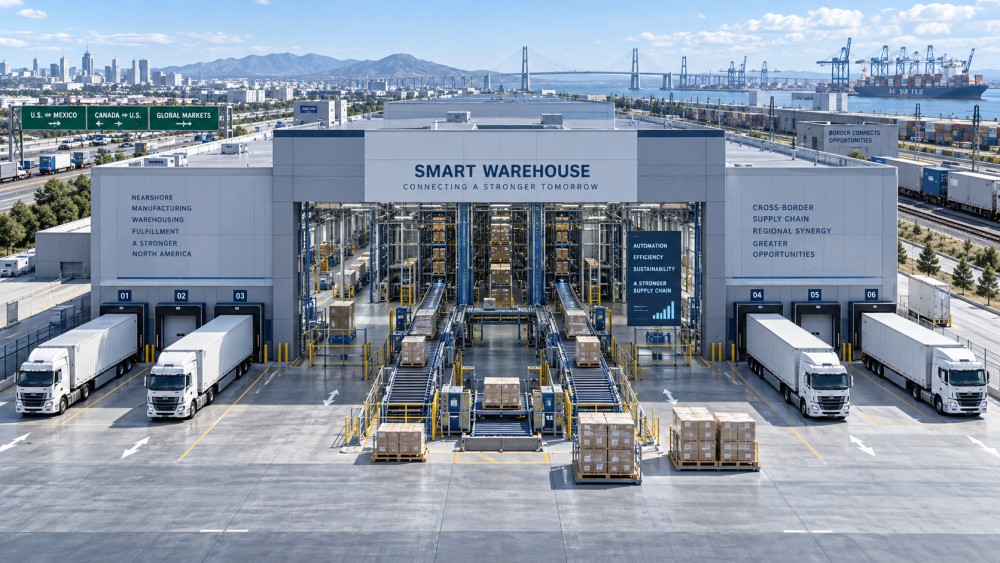
The North America contract logistics market is being reshaped by shifting demand across manufacturing, retail, healthcare, automotive, and technology supply chains.
For business evaluators, the central question is no longer whether to outsource logistics, but which capabilities, locations, and commercial structures justify outsourcing.
Overall demand remains resilient, yet growth is becoming more selective. Customers increasingly reward providers that combine warehouse capacity with systems integration, labor stability, compliance expertise, and regional flexibility.
Decisions now depend heavily on network design. A lower quoted warehouse rate may create higher total cost when transportation distance, inventory buffers, customs delays, and fulfillment failures are considered.
The United States continues to anchor regional demand, while Mexico gains importance through nearshoring. Canada remains strategically valuable for cross-border distribution, regulated products, and selected industrial corridors.
Business evaluators should assess contract logistics providers through a total-value framework. This includes service reliability, implementation capability, technology fit, scalability, risk exposure, and measurable productivity improvement.
What Is Driving Demand in the North America Contract Logistics Market?
Contract logistics demand is rising because manufacturers and distributors need more variable operating models. They want capacity that can expand, contract, and relocate without owning every facility.
Nearshoring is a major catalyst. Companies moving production closer to North American customers require new inbound logistics, supplier consolidation, customs coordination, and distribution capacity near emerging manufacturing centers.
Inventory policies have also changed. Many organizations now hold more safety stock for critical materials, while still expecting logistics partners to control carrying costs and inventory accuracy.
E-commerce remains important, but its influence has matured. Retailers now prioritize profitable fulfillment, improved returns management, and inventory positioning rather than simply adding more warehouse space.
Labor constraints continue to shape demand. Warehousing customers increasingly seek providers with established recruiting pipelines, retention programs, automation tools, and disciplined workforce management practices.
Transportation volatility has reinforced the value of integrated logistics services. Warehousing decisions are increasingly connected to port routing, drayage availability, freight procurement, and last-mile performance.
Regulatory complexity is another factor. Healthcare, food, chemicals, and cross-border operations require documented procedures that many companies find costly to build and maintain internally.
As a result, the North America contract logistics market is moving beyond basic storage. Buyers increasingly purchase operating resilience, data visibility, compliance control, and specialized execution.
Industry Demand Is Splitting into Distinct Service Requirements
Manufacturing remains one of the largest demand sources, particularly for industrial machinery, electrical equipment, construction materials, aerospace components, and consumer durable goods.
Manufacturers typically need inbound material handling, line-side replenishment, sequencing, kitting, packaging, and finished-goods distribution. Their priority is avoiding production disruption while reducing working capital.
For these customers, a provider’s experience with engineering changes, bill-of-materials control, and production schedules can matter more than warehouse square footage alone.
Automotive logistics requires especially rigorous performance. Suppliers need just-in-time and just-in-sequence delivery, traceability, quality containment procedures, and recovery plans for transportation disruption.
Mexico’s automotive clusters are increasing demand for bilingual coordination, customs expertise, returnable packaging management, and cross-border freight orchestration between plants and North American suppliers.
Retail and consumer goods clients focus on omnichannel fulfillment. They need rapid order processing, store replenishment, returns disposition, promotional handling, and inventory allocation across channels.
However, retail contracts should be evaluated carefully. High peak-season demand can make labor costs, throughput assumptions, and service-level penalties materially different from annual average conditions.
Healthcare and life sciences require validated processes, temperature controls, lot traceability, serialisation support, and strict product security. These requirements limit the viable provider pool.
Technology and electronics companies often prioritize secure storage, component traceability, postponement, configuration, repair returns, and protection against obsolescence in rapidly changing product portfolios.
United States: The Largest Market, but Not a Single Logistics Region
The United States represents the largest share of the North America contract logistics market, supported by its consumer base, industrial production, port infrastructure, and advanced distribution networks.
Yet the country should not be evaluated as one homogeneous market. Regional demand patterns vary significantly by labor conditions, transportation access, industry concentration, and real-estate availability.
Southern and southeastern states continue to attract manufacturing and distribution investment. Automotive, aerospace, food, consumer products, and advanced manufacturing support demand across these corridors.
Texas benefits from its central geography, border connectivity, energy sector, port access, and large population centers. It remains important for both domestic and Mexico-linked supply chains.
The Midwest retains a strong industrial logistics base. Automotive, machinery, chemicals, food, and durable-goods manufacturers value its rail connections and access to major consumption markets.
California remains essential for import distribution and technology supply chains, despite high operating costs. Port proximity and market density can outweigh expense for certain time-sensitive products.
Inland logistics hubs are gaining significance as companies seek alternatives to congested coastal nodes. These locations can support inventory buffering, transloading, and national distribution strategies.
Evaluators should compare total landed cost rather than selecting sites by rent alone. Labor productivity, freight miles, taxes, utility resilience, and customer proximity materially affect economics.
Mexico Is Becoming a Core Contract Logistics Growth Market
Mexico is increasingly central to North American logistics strategies because nearshoring investment is expanding in automotive, electronics, appliances, medical devices, and industrial equipment.
Manufacturers are establishing or enlarging facilities near the United States border and in established industrial centers such as Monterrey, Bajio, Queretaro, and central Mexico.
This expansion creates demand for supplier parks, inbound consolidation, customs brokerage coordination, bonded operations, cross-docking, and transport management tailored to border crossings.
Mexico-based operations often require more than local warehousing. Providers must manage communication across suppliers, plants, carriers, customs authorities, and distribution centers in multiple jurisdictions.
Border reliability remains a practical concern. Delays can result from inspection activity, documentation errors, capacity constraints, security issues, or changes in operating procedures.
A capable provider should demonstrate proven border-crossing processes, escalation protocols, bilingual account management, and visibility that identifies exceptions before they affect production schedules.
Security assessment is equally important. Evaluators should examine facility controls, cargo monitoring, employee screening, carrier management, incident response, and insurance provisions for high-value freight.
Mexico’s opportunity is substantial, but savings assumptions require discipline. Lower labor costs can be offset by customs complexity, inland transportation, inventory buffers, and management overhead.
Canada’s Role Is Defined by Cross-Border Connectivity and Specialized Demand
Canada’s contract logistics market is smaller than the United States market, but it remains important for cross-border distribution, consumer goods, industrial products, and regulated supply chains.
Ontario and Quebec are especially significant because they combine population density, manufacturing activity, rail infrastructure, and direct connections to the northeastern United States.
Western Canada serves different needs. British Columbia supports Pacific trade flows, while Alberta and Saskatchewan create specialized demand linked to energy, agriculture, and resource industries.
Canadian logistics decisions frequently involve customs and tax considerations. Companies should evaluate whether inventory should be positioned domestically, imported through the United States, or managed through integrated networks.
Cold-weather operating capability can also be relevant. Facility resilience, yard management, temperature controls, and transportation contingency planning may influence service quality during severe conditions.
For cross-border programs, the best provider is not necessarily the largest local warehouse operator. It is often the partner with consistent customs knowledge and network-wide visibility.
Business evaluators should also review bilingual documentation capabilities where appropriate, particularly for Quebec operations, customer service environments, and regulated product communications.
How to Evaluate a Contract Logistics Provider Beyond Price
Price remains important, but warehouse pricing alone rarely captures the business impact of a contract logistics arrangement. Evaluators should begin with clear operational requirements.
Define expected volumes, order profiles, inventory characteristics, seasonality, service levels, product handling needs, and likely changes over the contract term before requesting proposals.
Providers should then be compared using normalized assumptions. Differences in labor standards, overtime treatment, automation investments, storage density, and transportation scope can distort quotations.
Implementation capability deserves close scrutiny. A provider may operate excellent facilities but still struggle with startup governance, systems migration, inventory transition, or workforce ramp-up.
Ask for evidence from comparable launches. Relevant indicators include implementation duration, inventory accuracy after go-live, order-fill performance, productivity stabilization, and exception resolution speed.
Technology assessment should focus on operational usefulness. Warehouse management systems, transport management tools, customer portals, application programming interfaces, and reporting must support actual decision-making.
Data ownership and integration responsibilities should be explicit. Ambiguity over master data, inventory adjustments, performance reporting, and cybersecurity accountability can create avoidable disputes later.
Commercial flexibility is increasingly valuable. Contracts should define volume bands, change-control mechanisms, capital recovery terms, exit obligations, and performance remedies without creating unmanageable rigidity.
Automation Changes the Economics, but Not Every Operation Needs It
Automation is expanding across the North America contract logistics market, particularly where labor availability is constrained and order volumes support repeatable processes.
Common investments include goods-to-person systems, autonomous mobile robots, conveyor systems, automated storage, dimensioning equipment, vision tools, and voice-directed picking applications.
Business evaluators should avoid treating automation as automatically superior. The right solution depends on order volatility, product dimensions, stock-keeping unit diversity, facility duration, and capital structure.
High-volume, stable operations may justify dedicated automation. Variable or short-term programs may benefit more from flexible layouts, labor management, and modular technologies.
Providers should explain who funds the equipment, how depreciation is recovered, what happens if volumes decline, and whether assets can be redeployed after contract termination.
Automation should also be linked to measurable outcomes. Useful metrics include picks per labor hour, error reduction, space utilization, safety performance, order-cycle time, and operating cost.
A strong business case includes downside scenarios. Evaluators should test whether projected savings remain credible if demand softens, product profiles change, or implementation takes longer than expected.
Risk, Resilience, and Compliance Are Now Core Buying Criteria
Resilience has become a commercial requirement rather than an optional enhancement. Supply chain disruption can quickly outweigh small savings achieved through low-cost warehousing contracts.
Evaluators should review a provider’s business continuity plans, alternate facilities, labor contingencies, power backup, cybersecurity controls, carrier diversification, and crisis communication procedures.
Inventory visibility is essential during disruption. Companies need timely information about stock status, inbound delays, order backlogs, transportation exceptions, and customer-impacting constraints.
Compliance requirements should be matched to the product category. Food, pharmaceuticals, chemicals, batteries, defense-related goods, and controlled items require specialized processes and trained personnel.
Environmental performance is also becoming more relevant. Customers increasingly examine energy use, packaging reduction, emissions reporting, waste handling, and transportation optimization within logistics tenders.
For multinational buyers, governance matters. A provider should offer consistent reporting while retaining enough local expertise to manage state, provincial, federal, and cross-border requirements.
The most resilient model is not always the most decentralized one. The appropriate network balances redundancy with inventory cost, operating complexity, and management control.
Practical Outlook for Business Evaluators
The North America contract logistics market will continue to benefit from nearshoring, supply chain diversification, e-commerce refinement, and the growing need for specialized operations.
Growth, however, will be uneven. Providers with strong manufacturing expertise, cross-border execution, labor management, technology integration, and regulated-industry capabilities are likely to gain share.
For buyers, the most useful starting point is a network-level analysis. Identify where inventory, production, customer demand, and transportation risk create the largest economic exposure.
Next, separate genuinely strategic requirements from standard warehousing activities. This prevents organizations from overpaying for capabilities that do not affect service, resilience, or growth.
Provider selection should combine quantitative analysis with operational due diligence. Site visits, reference checks, systems demonstrations, and implementation reviews are more revealing than headline rates.
Regional strategy should remain flexible. United States, Canada, and Mexico operations increasingly function as connected supply chain components rather than independent national logistics programs.
Ultimately, the best contract logistics decision improves more than warehouse efficiency. It strengthens customer service, lowers disruption risk, supports market expansion, and creates clearer control over total supply chain cost.
Have questions about this sector analysis, or seeking best practices specific to your niche? Drop us a line below and let the senior consultants at GTIIN assist you.
“We respect your privacy. Your information is strictly confidential.”
Weekly Insights
Stay ahead with our curated technology reports delivered every Monday.
Recommended News
 Supply ChainNov 10, 2026China Extends Pause on 24% Additional Tariff on US Goods by Two Months
 Industry StandardsNov 10, 2026Which imports are subject to EU carbon border compliance?
 Global SourcingNov 09, 2026USTR Extends 178 China Section 301 Tariff Exclusions to January 2027
 Supply ChainNov 09, 2026How can a tariff risk management dashboard track cost exposure?



