
EU CBAM Deadlines: When Must Importers Report and Surrender Certificates?
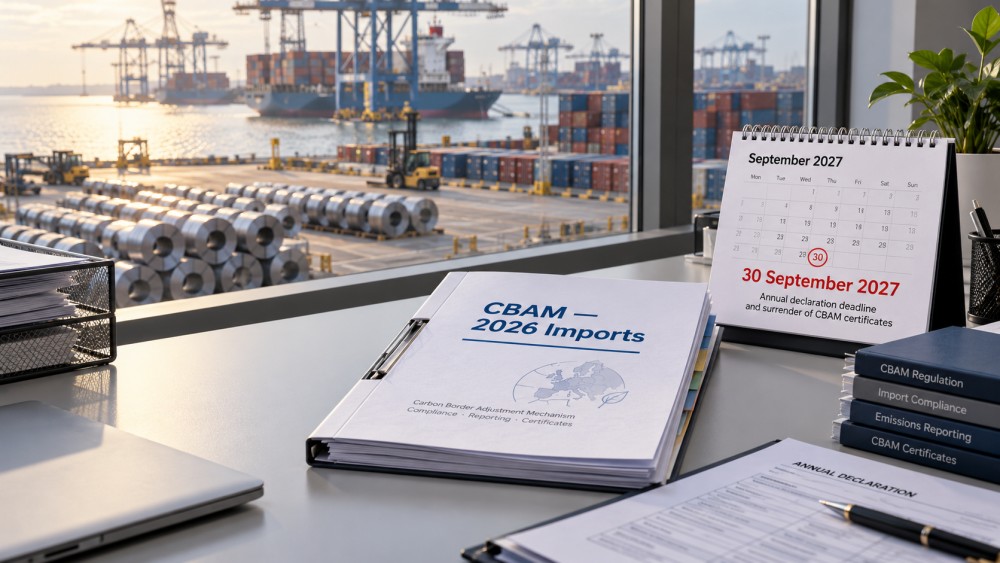
EU CBAM financial obligations apply to covered imports from 1 January 2026, but the first annual declaration and certificate surrender are due by 30 September 2027, covering 2026 imports. Certificate sales for those imports begin on 1 February 2027. These dates reflect the amended CBAM Regulation; older guidance citing a first surrender deadline of 31 May 2027 is no longer the correct compliance calendar.
Transitional reporting runs on a separate timetable. The final quarterly report, covering October–December 2025, was due by 31 January 2026. No CBAM certificates are required for transitional-period imports. The critical distinction is between when imported emissions become subject to the financial mechanism, when emissions information must be reported, and when certificates must actually be surrendered.
The CBAM deadlines that belong on the compliance calendar
The principal legal framework is Regulation (EU) 2023/956, as amended by Regulation (EU) 2025/2083. Transitional reporting is governed by Implementing Regulation (EU) 2023/1773. Reading the original regulation without its amendments can produce an incorrect deadline schedule.
For example, covered goods imported in November 2026 belong in the annual declaration due by 30 September 2027. Goods imported in February 2027 belong in the declaration due by 30 September 2028. A delayed supplier invoice or emissions statement does not move the import into a later compliance year.
Check whether the importer is actually within scope
A deadline matters only after the goods, import procedure, origin and responsible entity have been established. CBAM initially covers specified goods in cement, iron and steel, aluminium, fertilisers, electricity and hydrogen. Coverage is defined through the Combined Nomenclature codes in Annex I, not simply by a product’s commercial description or the industry in which it is used.
A metal-containing assembly is therefore not automatically covered because it contains steel or aluminium. Equally, describing a covered item as a component does not remove it from scope. The customs classification and the regulation’s specific exclusions must be checked against the actual goods.
The amended rules introduce a 50-tonne annual mass-based exemption for relevant goods, assessed per importer across the applicable covered categories. It is not a separate allowance for each supplier, shipment or customs code. Electricity and hydrogen do not benefit from this mass-based exemption.
If the applicable annual threshold is exceeded, obligations apply to the relevant imports for the calendar year, not merely to the tonnage above 50 tonnes. An importer approaching the threshold therefore needs complete records from the start of the year. Waiting until the crossing shipment to request emissions information can leave earlier imports unsupported.
This exemption should not be applied retrospectively to erase transitional reporting duties. The transitional and definitive periods have different legal requirements.
Transitional reports: quarterly deadlines, without certificates
The transitional period covered imports from 1 October 2023 to 31 December 2025. Reports were due one month after each quarter ended: 30 April, 31 July, 31 October and 31 January, as applicable. The final report was therefore due on 31 January 2026.
These reports required information about imported quantities, embedded emissions and relevant carbon prices in the country of origin. They were not annual CBAM declarations and did not require certificate purchases or surrender.
Under the ordinary transitional correction rule, a report can be modified within two months after the end of the relevant quarter. For the final quarter of 2025, that ordinary modification window ended on 28 February 2026. This correction window must not be confused with the initial filing deadline.
Further correction routes involve the competent authority and the conditions in the transitional implementing regulation. They should not be treated as an automatic extension. Where a report is missing or materially inaccurate, the responsible entity should follow the applicable registry and authority procedure rather than assume that the definitive-period declaration can replace it.
The end of transitional reporting also does not mean that transitional records can be discarded. Customs reconciliations, calculation files, supplier communications and correction histories may still be relevant to compliance checks.
Authorisation is separate from the reporting deadline
The September 2027 declaration deadline does not allow an importer to postpone its authorisation arrangements until 2027. Under the definitive regime, imports subject to the authorisation requirement must be handled by an authorised CBAM declarant.
The amended framework provides a temporary arrangement allowing relevant imports to continue while an authorisation application is pending, provided the application was submitted by 31 March 2026 and the legal conditions are satisfied. This is not a general exemption from authorisation or an extension of the annual reporting deadline.
The responsible entity should be identified explicitly. Depending on the customs arrangement, an indirect customs representative can act as the authorised CBAM declarant. Appointing a customs service provider does not, by itself, establish that the provider has accepted this role.
The operational record should therefore connect the importer’s EORI number, the relevant authorisation or application status, the customs representation arrangement and the entity responsible for the CBAM declaration. A complete supplier emissions file cannot compensate for an unresolved legal responsibility at importation.
Certificate purchases and surrender follow different clocks
The opening of certificate sales on 1 February 2027 does not defer the start of the financial mechanism. Covered imports made during 2026 still generate obligations that must be settled in 2027.
For 2026 embedded emissions, certificate prices are based on the relevant quarterly averages of EU ETS auction prices under the amended pricing framework. Treating the eventual purchase date as the sole determinant of the cost would therefore give a misleading estimate of the 2026 exposure.
Certificate surrender is the compliance act that settles the annual obligation. Purchasing certificates is necessary to obtain the balance used for surrender, but purchasing alone does not complete compliance. The declarant must also submit the annual declaration and surrender the required number by 30 September.
From 2027, a separate quarterly certificate-balance requirement applies. At each quarter-end, the account must meet the statutory 50% holding requirement, calculated under the amended rules. There is no equivalent quarterly holding requirement for 2026.
This creates two overlapping controls from 2027: annual settlement for the previous year and quarterly balance management for the current year. A calendar containing only the September deadline is therefore incomplete.
The number of certificates to surrender is not necessarily equal to the unadjusted embedded emissions total. The calculation must account for the applicable EU ETS free-allocation adjustment and any eligible deduction for a carbon price effectively paid in the country of origin. Supporting evidence matters: an unsupported assertion that a supplier has paid a carbon charge is not sufficient to establish a deduction.
Why emissions documentation must be ready before September
The annual deadline is the end of a chain of technical checks, not the starting point for collecting supplier information. Customs quantities must be reconciled, emissions must be calculated using the applicable methodology, and any required verification must be completed before the declaration can be finalised.
For actual embedded emissions, the definitive regime requires verification by an appropriately accredited verifier. A supplier’s self-declaration, an ISO 14001 certificate or a general product carbon footprint does not automatically fulfil this requirement.
Verification also cannot repair an unsuitable calculation boundary. The evidence must correspond to the producing installation, relevant production process, applicable reporting period and imported goods. Where precursor emissions are required, omitting them can make an otherwise detailed calculation incomplete.
The distinction between direct and indirect emissions is another important control. Under the current framework, the emissions included differ by goods category. Applying the same electricity-related calculation to every covered product can therefore produce an incorrect result.
Default values are available under the legal framework, subject to the applicable rules. Their use should be identified clearly rather than mixed invisibly with installation-specific data. A missing supplier response does not justify inserting an unsupported estimate into the declaration.
Build an evidence trail that survives reconciliation
A defensible compliance file should allow a reviewer to move from the customs entry to the declared emissions and then to the certificate calculation. The essential links include:
- Import identity: customs declaration reference, import date, CN code, origin, net mass and responsible declarant.
- Production identity: the producing installation and process, rather than only the trading company issuing the invoice.
- Calculation basis: reporting period, methodology, activity data, emission factors and relevant precursor information.
- Assurance: the verification report where required, including its scope and any unresolved findings.
- Financial adjustments: evidence supporting eligible carbon-price deductions and the applicable free-allocation adjustment.
A shipment does not necessarily need its own independently measured emissions result. Installation- and production-period data can support multiple consignments where the methodology permits. The essential control is demonstrable applicability: the declared emissions intensity must actually relate to the goods and production route concerned.
Records supporting the annual declaration must be retained until the end of the fourth year after the year in which the declaration was, or should have been, submitted. Files should preserve calculation versions and corrections, not just the final spreadsheet.
The deadline risk is usually an unresolved handover
CBAM combines information that sits in different systems. Customs records establish what entered the EU and when. Production records establish how the goods were made. Verification establishes the assurance attached to actual emissions. Certificate records establish whether the financial obligation has been settled.
A workable internal calendar should therefore set earlier cut-offs for supplier submissions, customs reconciliation, calculation approval and verification completion. These internal dates are management controls, not additional statutory deadlines, and should reflect the volume and complexity of the import portfolio.
Two errors deserve particular attention: treating 2026 as a reporting-free year because certificate sales begin in 2027, and relying on the superseded 31 May annual deadline. The legally significant sequence is 2026 imports, certificate sales from February 2027, and declaration plus surrender by 30 September 2027, with authorisation and evidence preparation handled before they become a barrier to compliance.
Primary legal references: Regulation (EU) 2023/956 establishing CBAM; Regulation (EU) 2025/2083 amending the CBAM framework; and Implementing Regulation (EU) 2023/1773 on transitional reporting. The applicable consolidated legislation and European Commission implementation guidance should govern any operational filing decision.
Have questions about this sector analysis, or seeking best practices specific to your niche? Drop us a line below and let the senior consultants at GTIIN assist you.
“We respect your privacy. Your information is strictly confidential.”
Tags
Weekly Insights
Stay ahead with our curated technology reports delivered every Monday.
Recommended News
 Supply ChainNov 08, 2026He Lifeng Holds Trade Talks With Bessent and Greer
 Market TrendsNov 08, 2026How to use industrial commodity market analysis to forecast costs
 Supply ChainNov 07, 2026EU Opens Safeguard Investigation into PET Resin Imports
 Industry StandardsNov 07, 2026Which ISO quality management standard can a company be certified to?



