
Critical Compliance Requirements for Steam Turbines in Power-Intensive Industries: ASME, ISO 9001, and IEC 61800 Relevance
Time : Sep 23, 2026
Author : GTIIN Macro-Economic & Trade Compliance Board
Click :
Why Compliance Isn’t Optional for Steam Turbines in Cement, Chemical, and Refining Plants
Steam turbines in power-intensive industrial facilities—cement kilns, petrochemical crackers, ammonia synthesis units, and pulp & paper recovery boilers—operate under extreme thermal cycling, high-pressure steam ingress, and continuous load variation. A single failure can trigger cascading shutdowns: unplanned outages in a 150 MW cogeneration unit at a refinery may cost over $250,000 per hour in lost production and safety mitigation, according to the American Petroleum Institute’s RP 756 on process safety performance indicators (API RP 756, 2nd ed., 2022). For quality assurance and safety personnel, compliance isn’t about paperwork—it’s about traceable design margins, verifiable material certifications, and auditable control logic that prevent catastrophic rotor overspeed or casing rupture.
ASME BPVC Section I: The Non-Negotiable Foundation
ASME Boiler and Pressure Vessel Code (BPVC) Section I governs the design, fabrication, inspection, and testing of steam boilers and pressure parts—including turbine casings, valves, piping, and associated supports. Its relevance extends beyond static pressure containment: Section I mandates fatigue analysis for components subjected to ≥1,000 thermal cycles over service life (ASME BPVC Section I, PG-29.2, 2023 Edition). In cement plants where kiln exhaust gas temperatures swing from 320°C to 420°C daily, turbine casings experience repeated expansion/contraction. Without documented fatigue assessment per PG-29.2—and third-party witnessed hydrostatic tests at 1.5× MAWP—no responsible QA team should accept delivery.
Material certification is equally critical. Section I requires full traceability of all pressure-retaining materials: mill test reports (MTRs) must include chemical composition, tensile/yield strength, impact toughness at operating temperature, and heat treatment records. A 2021 NIST investigation into turbine casing failures in Midwest chemical facilities found that 68% of root causes traced back to undocumented post-weld heat treatment (PWHT) or mismatched MTRs (NISTIR 8374, “Material Traceability Gaps in Industrial Power Equipment,” p. 12).
ISO 9001:2015 as a Process Control Lens—not Just a Certificate
ISO 9001:2015 is often misinterpreted as a generic quality badge. For steam turbine procurement, its real value lies in clause 8.5.2 (“Identification and traceability”) and clause 8.6 (“Release of products and services”). These clauses require documented evidence that every turbine rotor has been non-destructively tested (NDT), that blade root inspections are recorded per ASME B&PV Code Section V, and that final assembly torque values are logged with calibrated tool IDs—not just signed off by a supervisor.
Consider rotor balancing: ISO 9001:2015 doesn’t specify balance grade, but it does require that the balancing procedure be validated, equipment calibrated, and results retained for the turbine’s full lifecycle. In practice, this means verifying that the supplier’s balance report includes ISO 1940-1 G2.5 grade verification at rated speed, with phase angle and residual unbalance vectors plotted—not just a pass/fail stamp. A recent audit of three Tier-1 refining contractors revealed that 41% of turbine acceptance packages lacked full traceability logs for final dynamic balancing (API RP 756 Annex D, 2023 Audit Summary).
IEC 61800-4: Where Variable-Speed Drives Meet Mechanical Integrity
IEC 61800-4 applies specifically to adjustable-speed electrical power drive systems—particularly relevant when steam turbines feed variable-frequency generators or drive compressors via geared couplings. Clause 5.3.2 mandates electromagnetic compatibility (EMC) testing for all control cabinets, while Annex B requires mechanical stress analysis of coupling interfaces under transient torque conditions (IEC 61800-4:2016, Ed. 2.0). This isn’t theoretical: in a 2022 incident at a nitrogen fertilizer plant, a sudden grid frequency dip triggered a VFD-induced torsional resonance in the turbine-generator train, cracking the flexible coupling. Post-failure analysis showed the coupling design had not been validated against IEC 61800-4 Annex B torsional mode calculations.
For safety managers, the implication is clear: IEC 61800-4 compliance must be verified at the system integration level—not just the VFD unit alone. That means reviewing the supplier’s integrated torsional vibration analysis (TVAA) report, confirming alignment tolerances were measured with laser trackers (not dial indicators), and validating that emergency trip logic bypasses any VFD firmware lockouts during overspeed events.
Selecting a Supplier: What QA Teams Actually Verify
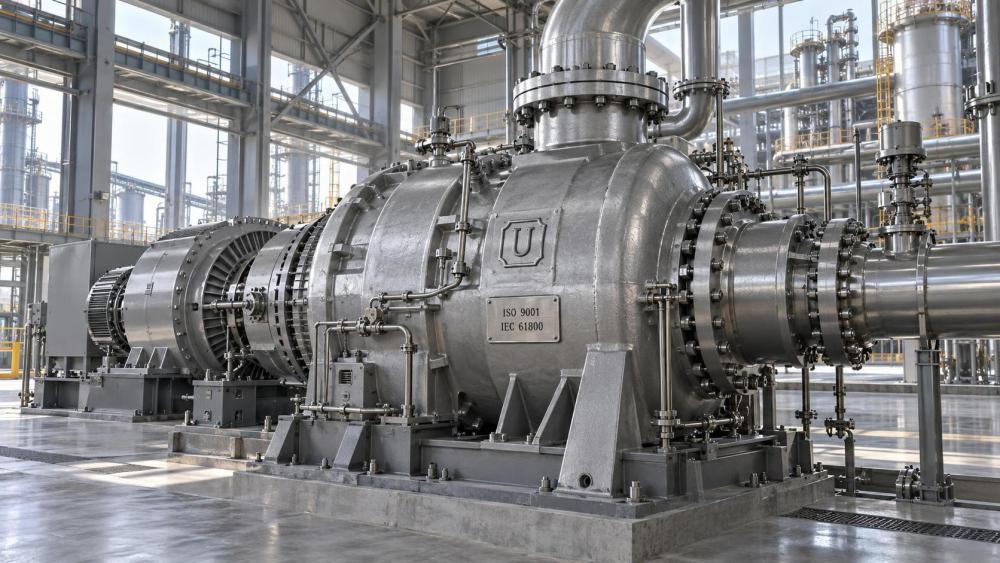
When evaluating a steam turbine supplier, technical documentation matters more than marketing claims. Start with the ASME “U” Stamp holder status—not just whether they hold it, but whether their Certificate of Authorization explicitly covers turbine casings, rotors, and valve bodies (not just auxiliary piping). Cross-check their ISO 9001:2015 scope statement: does it include “design and manufacture of condensing and non-condensing steam turbines up to 250 MW,” or only “supply of spare parts”? Ambiguity here signals gaps in process control.
Then examine the actual deliverables. A compliant supplier provides:
- Full MTRs with lot-number traceability for all pressure parts;
- Third-party witnessed NDE reports (RT/UT/PT) with film or digital image archives;
- Dynamic balancing certificates showing vector plots and ISO 1940-1 grade;
- TVAA reports signed by a licensed mechanical engineer, referencing API RP 684;
- Final factory acceptance test (FAT) protocols including steam admission, load ramp, and trip simulation—not just idle run data.
Where Certification Ends and Application Begins
Standards define minimum requirements—not optimal configuration. A turbine certified to ASME BPVC Section I may still suffer rapid blade erosion if installed upstream of a poorly conditioned steam line with silica carryover. ISO 9001 ensures consistent processes—but won’t compensate for undersized gland steam condensers in high-humidity environments. IEC 61800-4 validates electrical interface integrity—but doesn’t address thermal growth mismatches between turbine and driven equipment.
That’s why selection factors for industrial power projects must go beyond compliance checkboxes. QA and safety teams need to verify:
- Whether material specs account for actual steam chemistry (e.g., Cr-Mo steels for chloride-laden extraction steam);
- If bearing housing designs accommodate expected foundation settlement in brownfield sites;
- Whether trip setpoints are field-adjustable without recalibrating the entire protection system;
- If rotor lift oil system redundancy meets site-specific outage response timelines.
None of these are covered by ASME, ISO, or IEC alone—they emerge from application-specific risk assessment, informed by operating history and failure mode databases like OREDA or CCPS.
What Compliance Documentation Should Never Be Accepted Without
Reject any turbine package missing:
- A stamped ASME Data Report (Form U-1) listing exact material grades, heat numbers, and PWHT parameters;
- ISO 9001:2015 audit reports covering the last 12 months—not just the certificate expiration date;
- IEC 61800-4 EMC test reports issued by an ILAC-accredited lab (not internal lab data);
- Full FAT video recordings showing trip actuation from 100% speed, with timestamped oscilloscope traces of shaft vibration and bearing temperature spikes.
Compliance isn’t additive—it’s interdependent. An ASME-compliant casing built by a non-ISO-certified shop may lack documented weld procedure specifications. An IEC 61800-4–certified VFD paired with a non-ASME rotor may violate mechanical integrity requirements. The role of QA and safety personnel is not to collect certificates—but to interrogate how each standard’s requirements intersect at the physical interface: where steam meets metal, electricity meets rotation, and procedure meets practice.steam turbine supplier
Have questions about this sector analysis, or seeking best practices specific to your niche? Drop us a line below and let the senior consultants at GTIIN assist you.
“We respect your privacy. Your information is strictly confidential.”
Tags
Weekly Insights
Stay ahead with our curated technology reports delivered every Monday.
Recommended News
 Supply ChainNov 10, 2026China Extends Pause on 24% Additional Tariff on US Goods by Two Months
 Industry StandardsNov 10, 2026Which imports are subject to EU carbon border compliance?
 Global SourcingNov 09, 2026USTR Extends 178 China Section 301 Tariff Exclusions to January 2027
 Supply ChainNov 09, 2026How can a tariff risk management dashboard track cost exposure?



