
Carbon Accounting Basics for Scope 1, 2, and 3 Reporting
Carbon Accounting Basics for Scope 1, 2, and 3 Reporting
For finance approvers, carbon accounting has moved into the core reporting agenda.
It now affects compliance, budget approval, supplier reviews, and risk visibility.
That shift is easy to understand.
Regulators, investors, customers, and lenders increasingly expect consistent emissions data.
In practice, better carbon accounting also improves purchasing discipline and operational planning.
This matters even more in global supply chains with volatile energy prices and tighter disclosure rules.
The starting point is simple: understand Scope 1, Scope 2, and Scope 3 reporting.
Once those boundaries are clear, data collection and approval decisions become much easier.
Why carbon accounting now sits with financial decision-making
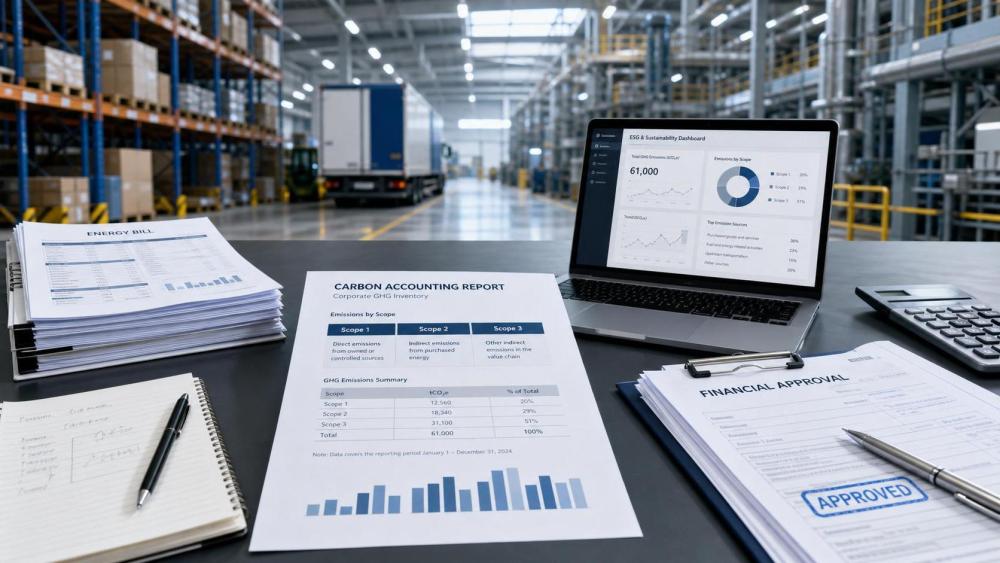
Carbon accounting is no longer a side report prepared once a year.
It influences capital allocation, sourcing choices, and future compliance costs.
More companies now face pressure from frameworks such as the GHG Protocol, ISSB, CSRD, and CBAM-linked expectations.
Even where reporting is not yet mandatory, buyers are already asking for emissions transparency.
That creates a very practical question.
Can the organization defend its carbon accounting data during audits, procurement reviews, or board-level approvals?
If the answer is unclear, the business carries reporting risk.
From a finance perspective, carbon accounting works like any other control environment.
You need clear boundaries, reliable inputs, traceable methods, and documented assumptions.
The basic structure of Scope 1, 2, and 3
The three scopes divide emissions by source and level of control.
This structure is the backbone of carbon accounting.
Scope 1: direct emissions
Scope 1 covers emissions from sources the company owns or controls directly.
Common examples include on-site fuel combustion, company vehicles, and process emissions.
Refrigerant leakage often sits here too.
Scope 2: indirect energy emissions
Scope 2 covers emissions from purchased electricity, steam, heating, or cooling.
The emissions happen elsewhere, but the energy use belongs to the reporting company.
This area often changes quickly because grid factors and energy contracts change.
Scope 3: value chain emissions
Scope 3 includes upstream and downstream emissions across the value chain.
This usually includes purchased goods, transportation, business travel, waste, product use, and end-of-life treatment.
For many companies, Scope 3 is the largest part of carbon accounting.
It is also the hardest to measure well.
What each scope means for reporting accuracy
The challenge is not only classification.
It is also matching each scope with the right evidence and calculation method.
- Scope 1 often relies on meter data, fuel purchase records, or maintenance logs.
- Scope 2 usually depends on utility bills, contract details, and location-based or market-based factors.
- Scope 3 frequently requires supplier data, spend-based estimates, and category-level assumptions.
This is where carbon accounting becomes a controls issue.
If methods vary by site or business unit, totals become hard to compare.
If supplier assumptions are weak, Scope 3 may look precise but remain unreliable.
A practical approach is to prioritize material categories first.
That means focusing effort where emissions, cost exposure, or compliance risk are highest.
Common carbon accounting mistakes in Scope 1, 2, and 3 reporting
Most reporting problems come from process gaps, not bad intentions.
- Using inconsistent organizational boundaries across regions or subsidiaries.
- Mixing estimated data with actual data without clear labels.
- Counting supplier emissions twice across internal entities.
- Ignoring updates to emission factors or energy market instruments.
- Collecting large volumes of data without checking materiality first.
These issues are more common in cross-border operations.
Local invoices, freight records, and supplier formats often differ by market.
That is why carbon accounting needs a documented governance process, not only a reporting tool.
A simple decision framework for finance-led review
When reviewing emissions reporting, a simple framework helps reduce uncertainty.
This kind of review keeps carbon accounting grounded in business reality.
It also helps separate high-confidence data from directional estimates.
How Scope 3 affects procurement and supply chain decisions
From a sourcing angle, Scope 3 is often where the largest exposure sits.
Purchased materials, logistics, packaging, and supplier energy mixes can change the emissions profile significantly.
This creates two useful signals for decision-makers.
- First, supplier selection is becoming both a cost decision and a carbon accounting decision.
- Second, data transparency is becoming a sourcing capability, not just a reporting extra.
In real operations, this may influence contract terms, approved vendor lists, and product design choices.
It can also support stronger supply chain resilience.
When companies map emissions hotspots, they often uncover hidden concentration risks and inefficient freight patterns.
Practical steps to strengthen carbon accounting
A strong start does not require perfect data on day one.
It requires a disciplined roadmap.
- Define the reporting boundary using a recognized standard.
- Separate Scope 1, 2, and 3 owners across finance, operations, and procurement.
- Rank emission sources by materiality, spend, and compliance relevance.
- Document calculation methods and data-quality assumptions.
- Request better supplier data for the largest Scope 3 categories.
- Introduce periodic review and internal sign-off controls.
This sequence makes carbon accounting more manageable.
It also helps teams avoid overinvesting in low-impact data collection.
Final takeaway
Carbon accounting is ultimately about decision quality.
When Scope 1, 2, and 3 reporting is structured well, the business gains clearer visibility into risk, cost, and compliance readiness.
That visibility supports better approvals, better supplier conversations, and better long-term planning.
For organizations operating across complex trade networks, that is no longer optional.
A practical next step is to review current emissions boundaries, identify the largest Scope 3 categories, and tighten the evidence behind each reported figure.
That is often where stronger carbon accounting begins to create real business value.
Have questions about this sector analysis, or seeking best practices specific to your niche? Drop us a line below and let the senior consultants at GTIIN assist you.
“We respect your privacy. Your information is strictly confidential.”
Weekly Insights
Stay ahead with our curated technology reports delivered every Monday.
Recommended News
 Supply ChainNov 10, 2026China Extends Pause on 24% Additional Tariff on US Goods by Two Months
 Industry StandardsNov 10, 2026Which imports are subject to EU carbon border compliance?
 Global SourcingNov 09, 2026USTR Extends 178 China Section 301 Tariff Exclusions to January 2027
 Supply ChainNov 09, 2026How can a tariff risk management dashboard track cost exposure?



