
Poultry Farming in Ethiopia: Cages or Deep Litter for Layers?
Cages are a stronger option when a layer farm needs to use limited building space intensively and can support reliable water delivery, manure removal, maintenance, and replacement parts. Deep litter is often more practical where capital is constrained, suitable bedding is available, and staff can manage floor conditions and nest use consistently. Neither system compensates for an unsuitable poultry house or weak flock management.
For an Ethiopian project, the decision should start with the actual site rather than a supplier’s stated bird capacity. Elevation, seasonal conditions, water availability, power reliability, access roads, and service support need to be established locally. A cage installation and a deep-litter house may accommodate the same flock, yet expose the business to very different operating risks.
Define the two systems before comparing quotations
“Cages” is not a complete technical specification. Conventional cages, furnished cages, and different tier arrangements have different space requirements, equipment needs, and welfare implications. Deep litter normally means birds moving on a bedding-covered floor, with feeders, drinkers, nests, and any specified perches arranged within the house. It does not automatically mean outdoor access.
The distinction matters because a cheap conventional cage quotation should not be compared directly with a fully equipped floor house containing nests, ventilation equipment, water storage, and manure-handling provisions. Both proposals must cover the same production boundary: from receiving feed and water to dispatching saleable eggs and removing manure.
FAO’s Small-scale Poultry Production describes housing, litter, feeding, and management requirements relevant to this comparison. It is useful background, but its general guidance should not replace a site-specific engineering design or current strain-management recommendations. [1]
These differences describe management demands, not guaranteed performance rankings. Welfare outcomes also depend on equipment design, flock management, and animal-based observations; the EFSA assessment of laying-hen welfare provides a detailed review of these issues. [2]
Let the site determine the equipment specification
Before requesting firm prices, prepare a site information sheet. Record seasonal temperature and humidity information, building orientation, roof construction, drainage, water source, storage arrangements, and electrical supply. Where reliable records are unavailable, identify the uncertainty explicitly rather than inserting an assumed national average.
A naturally ventilated house needs a layout that allows air to reach the birds without obstructions. Cage rows, tiers, partitions, and stored materials can change that airflow. A deep-litter house needs the same attention to ventilation, together with protection against rain entry and conditions that keep bedding manageable. FAO identifies ventilation and moisture control as core poultry-housing considerations. [1]
For mechanically ventilated proposals, request the design assumptions behind fan selection and air distribution. Installed fan capacity alone does not show that the occupied building will ventilate properly. Ask how performance will be checked after installation and what happens when electricity is interrupted.
Water deserves a separate review. Specify the source, treatment needs, usable storage, distribution pressure, flushing arrangements, and access for cleaning. Ask the supplier to demonstrate delivery at the least favorable point in the system while other lines are operating. Agree water-quality requirements with the flock veterinarian and equipment supplier rather than accepting an undefined claim that the water is “suitable.”
Compare complete installed systems, not cage prices
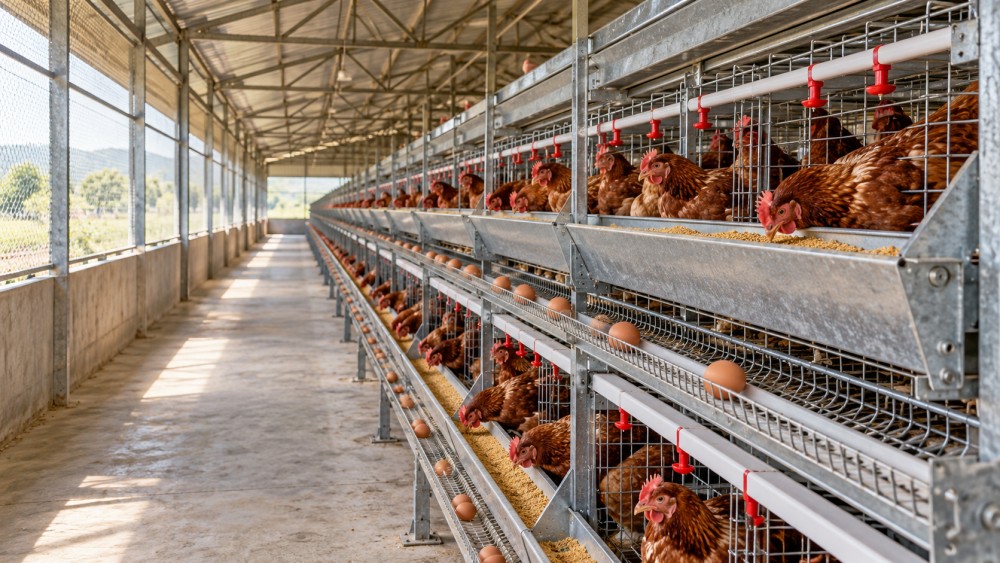
Equipment planning for poultry farming in ethiopia should connect cage or floor-system costs with the building, utilities, installation, and operating plan. A per-bird equipment price is only useful when its inclusions are clear. It cannot, by itself, establish which housing system offers the better investment.
Use a common bill-of-quantities structure for competing offers. Separate the building and civil works from bird accommodation, feeding, drinking, egg handling, manure handling, electrical work, installation, and commissioning. Show freight, insurance, import-related charges, inland delivery, and spare parts separately where applicable, using current quotations rather than assumed allowances.
For cages, examine the frame, wire specification, surface protection, connectors, floor construction, egg-roll arrangement, and access for removing birds. Request material documentation and measurable acceptance criteria. Words such as “heavy-duty” or “galvanized” are insufficient without a defined specification.
For deep litter, include nests, bedding storage, drinker supports, feed storage, floor preparation, drainage, and cleanout access. A floor system may require less specialized bird-accommodation equipment, but it still needs a complete production layout. Omitting these items makes the initial comparison misleading.
Installation responsibilities should be explicit. Who checks foundations, anchors equipment, connects utilities, adjusts drinker lines, and trains staff? Define when supplier responsibility ends and farm responsibility begins, especially where several contractors share the installation.
Test the operating risks that differ most
Manure removal and litter condition
Cage systems separate birds from much of their manure, but the manure still needs a workable removal, storage, and disposal route. Specify whether removal uses belts, scrapers, or manual methods, and identify the labor, machinery, and access each requires. Assess where manure will go during periods when transport or field access is difficult.
Deep litter places more responsibility on bedding management. Drinker leakage, rain entry, and inadequate drying can create wet areas; correcting the water or building problem matters more than repeatedly covering it with fresh material. FAO discusses keeping litter dry and managing drinkers as practical husbandry requirements. [1]
Neither system is inherently a complete biosecurity measure. Staff movement, rodents, wild-bird access, equipment sharing, carcass handling, and cleaning procedures still require a farm-specific plan developed with veterinary input. Do not accept a housing quotation as evidence that disease risks have been controlled.
Egg handling and flock inspection
Ask how eggs move from the bird area into trays or other collection equipment, and then into storage. In a cage proposal, inspect roll-out surfaces, transfer points, collection access, and adjustment procedures. In a floor proposal, examine nest location, accessibility, cleaning, and arrangements for identifying and collecting eggs laid outside nests.
A deep-litter plan should include management for encouraging nest use, not merely a nest purchase. A cage plan should show how staff will inspect every tier and remove sick, injured, or dead birds safely. Walk through both layouts from an operator’s perspective before approving capacity.
Welfare and buyer acceptance
Conventional cages restrict several highly motivated behaviors, while cage-free housing introduces management challenges that also require attention. EFSA’s laying-hen welfare assessment examines behavioral restrictions, injuries, resting, movement, and other welfare consequences across housing systems. It does not support treating the housing label alone as proof of good welfare. [2]
Confirm the intended egg buyer’s requirements before purchasing equipment. If a buyer requires cage-free production, an otherwise functional cage installation may not meet the commercial brief. Keep buyer specifications separate from legal obligations, and verify applicable Ethiopian requirements with the relevant authorities; requirements from other jurisdictions should not be presented as Ethiopian law.
Build the financial model around saleable eggs
Compare annualized cost per saleable egg, not just investment per bird placed. The calculation should include feed, pullets, labor, utilities, veterinary inputs, bedding where applicable, repairs, financing, depreciation, and egg-handling costs. Credit manure revenue only where there is a credible outlet and a realistic allowance for handling and transport.
Use the same flock assumptions in the initial comparison so that equipment differences remain visible. Then test how the result changes when production, losses, labor needs, bedding prices, repair costs, or financing conditions vary. Performance assumptions should come from identified breeder guidance, reliable farm records, or an explicitly labeled planning assumption—not a supplier’s unsupported promise.
Useful stress tests include:
- A water interruption: Can stored water reach all birds, and can staff verify delivery?
- A delayed spare part: Can the affected feeder, drinker, or manure section operate manually or be isolated?
- A bedding shortage: Is an acceptable alternative available, and what would substitution cost?
- A power failure: Which functions stop, and what backup arrangement has actually been provided?
- A weaker egg market: Can the farm meet debt and operating commitments at lower realized revenue?
These tests expose the cost of dependence. A highly automated installation may be appropriate where support is dependable; a simpler system may be more resilient where repairs and replacement components take longer to obtain. Neither conclusion should be assumed without checking local conditions.
Make commissioning part of the purchase decision
Agree an acceptance checklist before placing the order. It should cover equipment quantity, layout, materials, assembly quality, operating access, utility connections, manuals, training, and spare-parts identification. Record defects and responsibility for correction rather than relying on informal assurances.
Before birds arrive, operate feed and water systems through their intended range. Check for leaks, uneven delivery, inaccessible controls, sharp edges, and cleaning obstacles. Where fans, belts, or other powered equipment are supplied, have competent personnel verify installation and guarding against applicable requirements. Do not describe an installation as safety-certified unless the relevant evidence exists.
Some conditions can only be evaluated with birds present. Establish follow-up checks for water access, feed distribution, litter condition, nest use, egg damage, bird injuries, and ventilation performance. Use current strain guidance and veterinary advice to set management targets; do not invent universal thresholds for every flock and building.
Choose the system the farm can sustain
Cages deserve consideration when building space is constrained, the intended market accepts the housing system, and the farm can support its maintenance and utility dependencies. Deep litter deserves consideration when suitable floor housing, bedding, nest management, and daily husbandry can be provided reliably.
The strongest procurement decision is a documented match between site conditions, buyer requirements, staffing, cash flow, and equipment support. Approve the system only after its routine work—and its likely failures—have a practical, funded response.
Sources
[1] Sonaiya, E. B., and Swan, S. E. J. Small-scale Poultry Production: Technical Guide. FAO Animal Production and Health Manual No. 1. Food and Agriculture Organization of the United Nations, 2004. Reference for general housing, ventilation, litter, feeding, and husbandry principles.
[2] EFSA Panel on Animal Health and Welfare. “Welfare of laying hens on farm.” EFSA Journal, 2023, 21(2):7789. Reference for welfare consequences, housing-system differences, behavioral needs, and animal-based assessment.
Have questions about this sector analysis, or seeking best practices specific to your niche? Drop us a line below and let the senior consultants at GTIIN assist you.
“We respect your privacy. Your information is strictly confidential.”
Tags
Weekly Insights
Stay ahead with our curated technology reports delivered every Monday.
Recommended News
 Supply ChainNov 10, 2026China Extends Pause on 24% Additional Tariff on US Goods by Two Months
 Industry StandardsNov 10, 2026Which imports are subject to EU carbon border compliance?
 Global SourcingNov 09, 2026USTR Extends 178 China Section 301 Tariff Exclusions to January 2027
 Supply ChainNov 09, 2026How can a tariff risk management dashboard track cost exposure?



