Cage vs. Floor Housing in an Ethiopian Poultry Farm Business Plan
For an Ethiopian commercial layer project, cage housing is not automatically the more profitable choice, and floor housing is not automatically the cheaper one. The decision depends on the complete production system: building design, feed and water delivery, manure handling, labor, equipment support, and the market for the eggs. Comparing cage prices with the cost of an empty floor house leaves most of that system unpriced.
A useful business plan should compare two workable designs at the same planned output, with explicit assumptions about operating conditions. It should also distinguish layers from broilers. The comparison below focuses on egg production; conventional broiler production normally uses floor-based housing, so layer-cage economics should not be transferred to a meat-bird project. FAO’s Poultry Development Review describes these different housing and production requirements. [1]
Define the housing alternatives before requesting prices
“Cage” and “floor” are broad categories, not complete specifications. A cage proposal might use manual feeding and egg collection or include automatic feed distribution, egg belts, and manure removal. Floor housing might mean a single-level deep-litter house with nests, or a more complex aviary. Those alternatives have different investment and management requirements.
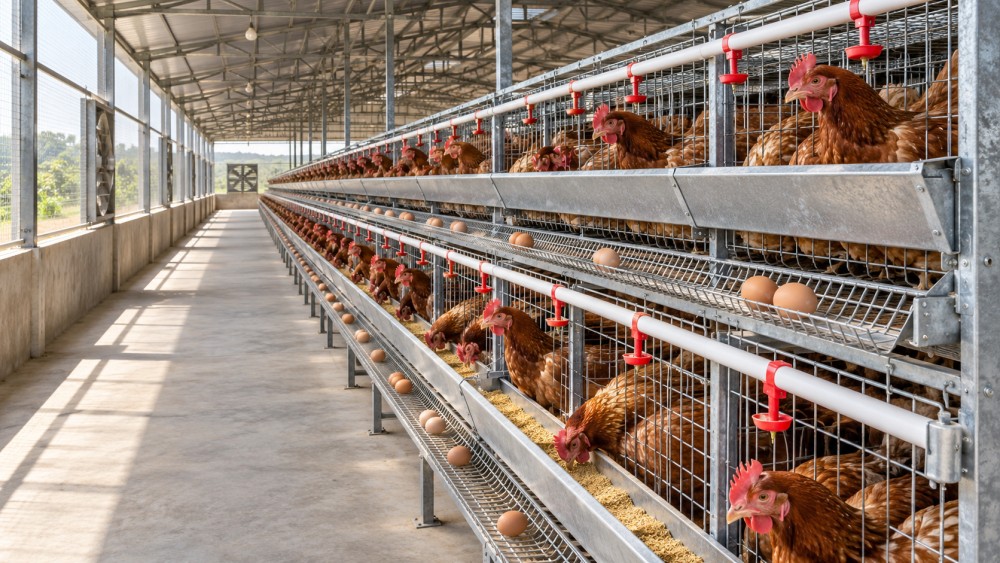
For a practical initial assessment, compare a specified layer-cage installation against a specified single-level deep-litter layer house. Identify any enriched features separately. Do not accept a quotation that describes only bird capacity without explaining usable space, feeding access, drinking points, manure clearance, and service aisles.
These are inspection categories rather than guaranteed performance differences. FAO’s housing guidance describes how equipment and husbandry interact; neither housing label establishes productivity by itself. [1][2]
Test the design against the actual Ethiopian site
A national business-plan template cannot establish conditions at an individual farm. Obtain site-specific information on temperature, humidity, water availability, road access, electricity interruptions, and the availability of maintenance services. Record seasonal conditions rather than relying on one inspection during favorable weather.
Ventilation deserves particular attention when comparing layouts. A cage arrangement that accommodates more birds within a building footprint also changes the distribution of birds and manure within that space. The ventilation assessment must follow the proposed flock and layout, not merely the building’s external dimensions. Floor housing also needs a deliberate ventilation design: litter does not remove moisture by itself. FAO identifies ventilation, temperature control, and litter condition as connected management issues. [1]
Ask the designer to explain airflow paths, air inlets, roof configuration, and how birds will be observed throughout the house. If fans are required, the financial model should include their energy demand, maintenance, and backup arrangements. Do not treat standby power as optional while assuming uninterrupted mechanical ventilation in the production forecast.
Water planning should cover source capacity, storage, treatment requirements, delivery pressure, and access for flushing and repairs. Require water-quality testing appropriate to the proposed supply before finalizing treatment equipment. The inspection should also establish how a blocked line, failed regulator, or leaking drinker will be detected and isolated. Drinking-water provision and hygiene are addressed in FAO’s poultry management guidance. [1][2]
Compare cost per saleable egg, not equipment cost per bird
A cage quotation and a floor-house construction estimate are rarely comparable without adjustment. One may include drinkers and feeders while excluding installation; the other may include the shell but omit nests, bedding, or storage. Create a common scope before calculating either option’s return.
Equipment-planning material described as a poultry farm business plan pdf in ethiopia can provide a starting framework for organizing cage, equipment, and building questions. Its assumptions still need reconciliation with local quotations, the proposed site, and a complete floor-housing alternative. A planning document is not a substitute for an itemized project budget.
Separate the model into installed capital, recurring operating costs, and working capital. Installed capital should cover foundations, building works, equipment, transport, applicable import charges, installation, commissioning, and initial spares. Obtain current quotations and professional advice for charges rather than copying percentages from another project.
Operating costs should include feed, replacement birds, labor, utilities, veterinary inputs, sanitation, repairs, egg packaging, and waste handling. Floor housing needs an explicit bedding and litter-management allowance. Cage housing needs an allowance for its actual manure-removal method and for mechanical components where fitted.
Use a consistent comparison:
Modeled cost per saleable egg = total costs allocated to the production period ÷ eggs expected to meet the intended buyer’s specification.
Document how capital costs are allocated and how spent-hen or manure revenue is treated. Keep financing cash flows separate from operating comparisons so that loan terms do not obscure differences between the housing systems.
Saleable output should account for expected mortality, production, breakage, dirty eggs, and buyer rejection. Use traceable flock-performance assumptions, preferably supported by the selected bird supplier’s management documentation and relevant operating records. Test less favorable outcomes rather than assuming either system will achieve its best technical performance.
Labor savings depend on which tasks actually disappear
Automation should be evaluated through a task schedule. List feeding, inspection, egg collection, grading, cleaning, manure handling, maintenance, and recordkeeping for each design. Then identify who performs each task and what happens when equipment is unavailable.
A manually operated cage installation should not receive the labor assumptions of a fully automated house. Equally, a floor-house budget should not omit nest inspection, litter work, or the collection of eggs laid outside nests. FAO’s production guidance describes these management demands across housing systems. [1][2]
Maintenance capability can change the preferred level of automation. For each critical component, establish whether the farm can diagnose faults, obtain replacements, and restore operation within an acceptable period. A lower routine labor requirement may be offset by service dependence or prolonged downtime.
Procurement documents should identify electrical requirements, motor and gearbox specifications where relevant, locally obtainable consumables, and recommended spare parts. Require operating manuals that match the equipment delivered. A generic brochure is insufficient for maintenance planning.
Keep egg quality, welfare, and biosecurity separate in the assessment
Egg quality depends partly on the route from bird to collection point. In cages, examine the egg-support surface, roll-out path, joints, collection edges, and transfers. In floor housing, examine nests, nest material, access, and collection routines. Both designs need a defined route to grading and storage. FAO discusses housing and management factors affecting egg cleanliness and handling. [1][2]
Do not convert these observations into an unsupported claim that one system always produces cleaner or less damaged eggs. Request evidence relevant to the proposed equipment and management conditions, and define how quality losses will be recorded during operation.
Animal welfare requires a separate review. Conventional cages restrict opportunities for behaviors such as nesting, perching, and dust bathing; floor systems can provide more behavioral opportunities, but their outcomes still depend on design and management. These trade-offs are discussed in FAO’s review. [1] Confirm whether intended buyers impose housing requirements before committing capital. A buyer specification is not necessarily a national legal requirement.
Biosecurity is likewise not guaranteed by a housing type. Establish controlled entry, clean and dirty routes, pest management, cleaning procedures, and arrangements for dead-bird handling. WOAH’s Terrestrial Animal Health Code, Chapter 6.5, sets out biosecurity procedures for poultry production. [3] Use it as a technical reference, while verifying applicable Ethiopian requirements with the relevant authorities and veterinary advisers.
Make procurement and commissioning measurable
A technically useful equipment specification describes interfaces as well as individual products. Cage dimensions must agree with the building layout; drinking systems must suit the available supply; manure equipment must connect to a workable storage and removal arrangement. For floor housing, nests, feeders, drinkers, and access routes must be coordinated rather than fitted independently into leftover space.
Require drawings and an itemized bill of materials before order confirmation. Clarify material specifications, corrosion protection, fasteners, anchoring, installation responsibilities, and exclusions. Where a supplier makes durability or capacity claims, request the underlying specification or test documentation rather than treating descriptive language as verification.
Agree on commissioning checks before delivery:
- Verify that delivered quantities, dimensions, and components match the approved documents.
- Inspect alignment, accessible sharp edges, anchoring, and maintenance access.
- Flush drinking lines and check leaks, pressure control, and function across the installation.
- Test installed drives, controls, protective devices, and shutdown arrangements with qualified personnel.
- Demonstrate cleaning, manure removal, routine servicing, and relevant manual fallback procedures.
These are proposed acceptance checks, not a claim of certification or legal compliance. Any required electrical, structural, environmental, or animal-health approvals need separate confirmation. Complete checks that can be performed without birds before flock placement.
Choose the system that survives realistic operating setbacks
Run both designs through the same downside scenarios: higher feed costs, weaker egg prices, delayed flock placement, equipment failure, water interruption, and slower-than-planned sales. Add system-specific pressures, such as bedding shortages for floor housing or delays in obtaining proprietary cage components. Avoid assigning financial benefits to manure unless handling costs and a credible outlet are documented.
Cages may suit a layer project where space, egg collection, manure handling, and maintenance support have been engineered together. Floor housing may suit a project where suitable bedding, nest management, labor, and the intended market support that choice. Neither conclusion should be reached from purchase price alone.
The stronger Ethiopian poultry business plan is the one that translates the selected housing system into a buildable layout, a complete cost model, and an operating routine the farm can sustain. Resolve water supply, ventilation, manure removal, market requirements, and repair arrangements before fixing the flock capacity.
Sources
[1] Food and Agriculture Organization of the United Nations. Poultry Development Review. 2013. Reference for poultry housing, management, welfare, and production-system distinctions.
[2] Sonaiya, E. B., and Swan, S. E. J. Small-scale Poultry Production: Technical Guide. FAO Animal Production and Health Manual No. 1, 2004. Reference for housing, equipment, feeding, watering, and husbandry principles.
[3] World Organisation for Animal Health. Terrestrial Animal Health Code, Chapter 6.5, “Biosecurity Procedures in Poultry Production.” Technical reference; applicable local requirements require separate verification.
Have questions about this sector analysis, or seeking best practices specific to your niche? Drop us a line below and let the senior consultants at GTIIN assist you.
“We respect your privacy. Your information is strictly confidential.”
Tags
Weekly Insights
Stay ahead with our curated technology reports delivered every Monday.
Recommended News
 Supply ChainNov 10, 2026China Extends Pause on 24% Additional Tariff on US Goods by Two Months
 Industry StandardsNov 10, 2026Which imports are subject to EU carbon border compliance?
 Global SourcingNov 09, 2026USTR Extends 178 China Section 301 Tariff Exclusions to January 2027
 Supply ChainNov 09, 2026How can a tariff risk management dashboard track cost exposure?